
Explore this animal in Size of Extinct Animals ↗
05 / Mesozoic
Tyrannosaurus
Tyrannosaurus rex
A deep skull, bone-crushing bite and keen senses made it one of the last giant theropods.
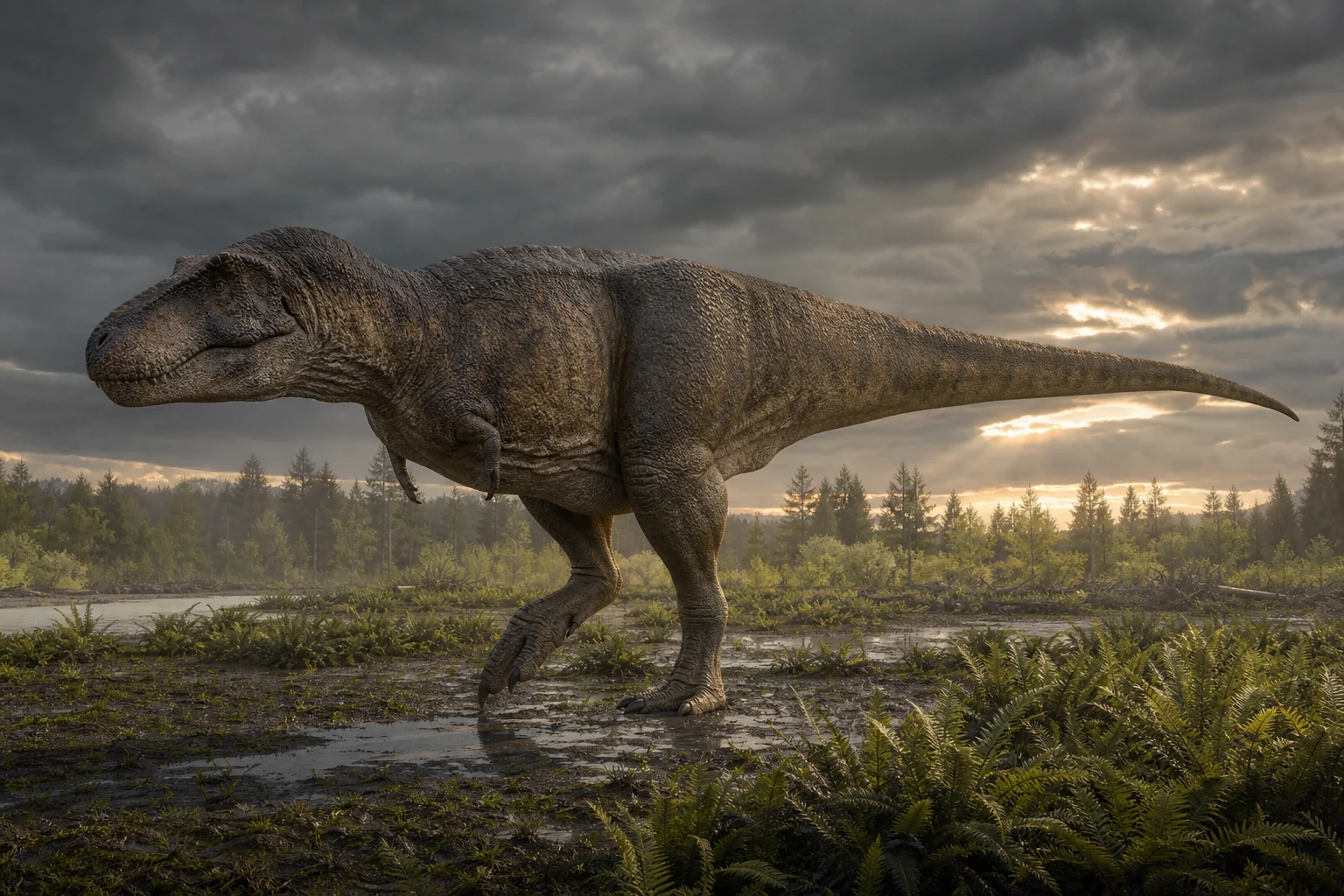 View original image · 1536 × 1024
- Time range
- About 68–66 million years ago
- Final stage
- End of the Cretaceous
- Geographic range
- Western North America
T. rex facts: choose the measurement or question
Tyrannosaurus rex was a large meat-eating dinosaur of latest-Cretaceous western North America. Adult size, juvenile growth and feeding evidence answer different questions; a single maximum-size figure cannot describe them all.
Size and height
Hip height is a more reproducible measure than head height, which changes with posture. Length includes the tail; weight is reconstructed from bones and body models.
Diet and behaviour
Healed bite injuries can demonstrate an attack on living prey. Tooth marks on an unhealed carcass can also record scavenging, so both kinds of evidence matter.
01 / ANSWER FIRST
What was Tyrannosaurus rex?
Tyrannosaurus rex was a giant two-legged predator that lived in western North America during the final two million years of the Cretaceous. A deep skull, thick bone-crushing teeth, powerful senses and rapid teenage growth made it the apex predator of its ecosystem.
It was neither the fastest monster in cinema nor an oversized scavenger unable to hunt. Fossils show a large animal with a horizontal backbone, a balancing tail and unusually robust jaws. Healed prey wounds demonstrate attacks on living dinosaurs, while carcass bite marks and a strong sense of smell show that it also scavenged. The best reconstruction is therefore a flexible carnivore shaped by age, opportunity and a changing floodplain environment.
02 / QUICK FACTS
T. rex at a glance
- Scientific name
- Tyrannosaurus rex
- Age
- About 68–66 million years ago
- Length
- Typically about 12 m (39 ft)
- Hip height
- About 3.5–4 m (11.5–13 ft)
- Body mass
- Typically 5–7 tonnes; largest over 8
- Diet
- Large dinosaurs and carcasses
- Range
- Western North America
- Teeth
- Around 60 thick, serrated teeth
03 / SIZE
How big was Tyrannosaurus rex?
A representative adult was close to 12 metres long, 3.5–4 metres high at the hips and about 5–7 tonnes. The largest known skeletons were bigger: SUE and Scotty approached 13 metres and exceeded eight tonnes under several modern volumetric estimates. They are exceptional individuals, not a species average.
Length alone can mislead because tails differ in completeness and reconstructed curvature. Hip height is measured from weight-bearing limbs, while mass depends on a three-dimensional body volume and assumed tissue density. Responsible comparisons therefore identify both the specimen and the method.
Read the complete T. rex size guideApproximate hip height
T. rex held its body and tail horizontally; it did not stand upright like older museum mounts.
04 / GROWTH & LIFE HISTORY
From lightly built juvenile to giant adult
A small, fast-starting theropod
Young animals had proportionally longer legs, lighter skulls and more slender teeth than adults. Direct hatchling material is rare, so the earliest stage remains incomplete.
Still far from full size
Bone histology shows famous half-grown specimens were immature. They occupied a more agile, medium-predator role before the adult transformation.
Explosive growth
Growth rings record a surge that could add hundreds of kilograms per year, building the deep skull, broad torso and heavy limbs of an adult.
Adult size and a short life
Most known animals reached effective adult size before twenty. The oldest well-studied individuals lived only into their late twenties.
05 / ANATOMY & SENSES
Built around the head
Skull and teeth
A skull up to roughly 1.5 metres long carried thick, serrated teeth built to resist high forces and repeatedly puncture flesh and bone.
Eyes and smell
Forward-facing eyes provided depth perception. Large olfactory regions in brain endocasts indicate a highly developed sense of smell.
Legs and tail
Powerful hindlimbs supported a horizontal body while the long muscular tail balanced the head and torso. Adult speed remains debated.
Two-fingered arms
The arms were short but muscular. Feeding, mating and rising have all been proposed, yet their principal function remains unresolved.
06 / DIET & FEEDING
What did T. rex eat?
Tooth marks and ecosystem evidence identify hadrosaurs and ceratopsians among its food. A healed Edmontosaurus tail injury surrounding an embedded tyrannosaur tooth proves that at least one live prey animal escaped an attack. Other bones, coprolites containing bone fragments and heavily worn teeth document intensive carcass use.
Biomechanical work places adult bite force around 18–35 kilonewtons across studied specimens. Thick teeth produced extreme local pressure, allowing T. rex to break bone and extract nutrients inaccessible to many other theropods.
Read the complete diet and hunting guide07 / HUNTER OR SCAVENGER?
Both—not one or the other
Living large carnivores hunt and scavenge according to risk and opportunity. T. rex had the senses, jaws and body to attack prey, while no efficient predator would ignore a usable carcass. Fossils support both behaviours.
Young tyrannosaurs probably pursued smaller, faster prey with slender bodies and blade-like teeth. As the skull broadened and bite strengthened, adults shifted toward large herbivores and bone-rich feeding. One species may therefore have filled several predator niches during its lifetime.
08 / RANGE & HABITAT
Where did T. rex live?
Tyrannosaurus fossils come from western North America near the end of the Cretaceous. At the time, retreating inland seas bordered warm river systems, forests, wetlands and coastal plains.
Hell Creek
Montana, North Dakota, South Dakota and Wyoming preserve T. rex with Triceratops, Edmontosaurus and a diverse floodplain community.
Lance
Wyoming deposits record similar latest-Cretaceous river and coastal-plain ecosystems.
Frenchman and Scollard
Canadian formations extend the northern record into Saskatchewan and Alberta.
Laramidia
These regions formed part of the western landmass separated from eastern North America by the Western Interior Seaway.
09 / FOSSIL EVIDENCE
How do scientists reconstruct T. rex?
Dozens of partial skeletons and a smaller number of highly complete individuals allow anatomy, growth and variation to be tested across age classes.
SUE
An exceptionally complete adult preserves skull, ribs, gastralia, limbs and many pathologies, anchoring modern whole-body reconstruction.
Scotty
A large, mature Canadian individual demonstrates that some adults exceeded the dimensions of more typical skeletons.
Growth series
Juvenile and adult bones contain annual growth marks that reveal a dramatic adolescent transformation.
Trace evidence
Healed bites, punctured prey bones, coprolites and tooth wear record feeding more directly than skeleton shape alone.
10 / EXTINCTION
Why did T. rex go extinct?
T. rex disappeared in the end-Cretaceous mass extinction about 66 million years ago, when an asteroid impact triggered darkness, cooling, wildfires and a collapse of primary production and food webs.
There is no evidence that its short arms, large size or specialised feeding caused an isolated decline before the event. Tyrannosaurus remained part of the latest Cretaceous fauna until the same global crisis eliminated all non-avian dinosaurs. Birds survived because they belonged to smaller, ecologically different lineages capable of passing through the disrupted world.
12 / FREQUENTLY ASKED QUESTIONS
Tyrannosaurus rex FAQ
How big was Tyrannosaurus rex?
A typical adult was about 12 metres long, 3.5–4 metres high at the hips and roughly 5–7 tonnes. Exceptional specimens such as SUE and Scotty exceeded eight tonnes and approached 13 metres.
What did T. rex eat?
T. rex ate large herbivorous dinosaurs including hadrosaurs and ceratopsians. It could kill live prey and also use carcasses when available, as most large predators do.
Was T. rex a hunter or a scavenger?
Both. A healed Edmontosaurus tail wound around an embedded tyrannosaur tooth proves at least one prey animal escaped a live attack, while bite-marked carcasses and powerful smell also support scavenging.
How strong was a T. rex bite?
Biomechanical modelling estimates roughly 18,000–35,000 newtons across adult specimens. Thick teeth concentrated that force into pressures capable of repeatedly breaking and consuming bone.
How fast could T. rex run?
There is no agreed adult top speed. Bone-stress models challenge true running, while a 2021 tail-motion model estimated preferred walking at about 4.6 km/h (2.9 mph). Preferred walking is not a maximum-speed estimate.
Did T. rex have feathers?
Direct skin impressions from Tyrannosaurus preserve scales in several body regions, while smaller relatives had filamentous coverings. Sparse feathers in young animals remain plausible, but a fully feathered adult T. rex is not directly demonstrated.
What were the tiny arms used for?
The two-fingered arms were small but muscular. Proposed uses include holding during feeding, mating or helping the body rise, but no single function is confirmed.
When and where did T. rex live?
Tyrannosaurus rex lived about 68–66 million years ago in western North America, in river floodplains and coastal lowlands represented by formations such as Hell Creek, Lance, Frenchman and Scollard.
04 / SOURCES & FURTHER READING
Check the source record
Use the scientific name to compare taxonomy, occurrence records and the fossil record. Database coverage and classifications may differ.
05 / REVISION HISTORY
How has this record changed?
- Expanded answers to reader questions, clarified the scope of fossil evidence and improved routes to related explanations.
- Upgraded to a bilingual S-tier topic hub with new size and feeding evidence guides.
- Verified authoritative entity sources and added three responsive reconstruction sizes.
- Initial bilingual species record published.
06 / CORRECTIONS & ADDITIONS