
Explore this animal in Size of Extinct Animals ↗
08 / Mesozoic
Velociraptor
Velociraptor mongoliensis
This turkey-sized feathered predator carried a raised sickle claw on each foot.
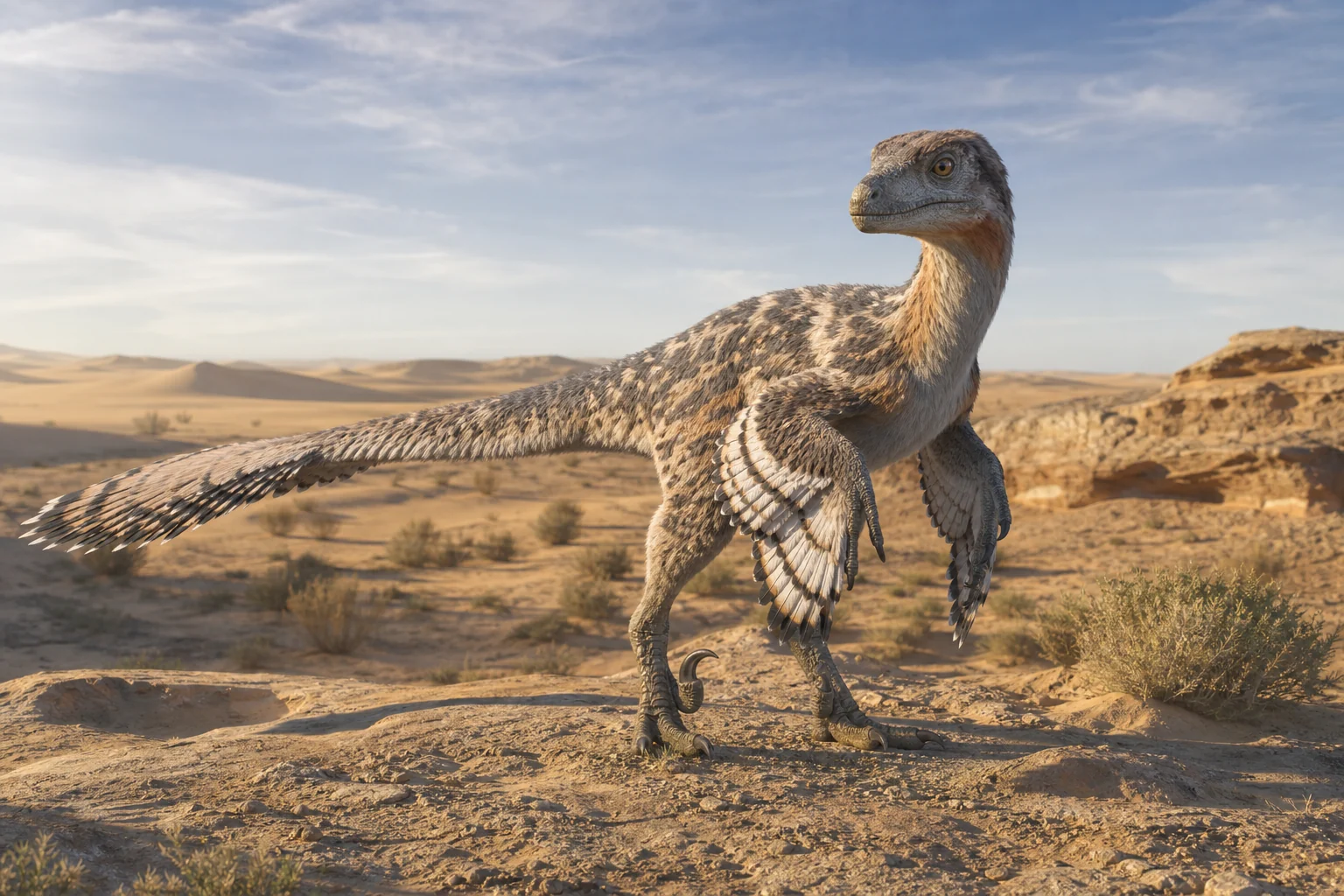 View original image · 1536 × 1024
- Time range
- About 75–71 million years ago
- Final stage
- Late Cretaceous
- Geographic range
- Mongolia · Northern China
01 / ANSWER FIRST
What was Velociraptor?
Velociraptor was a small feathered dromaeosaurid predator about 1.8 metres long that lived in the Late Cretaceous deserts of Mongolia and northern China.
It was not the human-sized, scaly pack hunter of cinema. Fossil quill knobs show large feathers attached to its forearm, while the famous Fighting Dinosaurs specimen directly records a struggle with Protoceratops. The raised second-toe claw probably gripped and restrained prey rather than functioning as a simple slashing knife.
02 / QUICK FACTS
Velociraptor at a glance
- Scientific name
- Velociraptor mongoliensis
- Age
- About 74–70 million years ago
- Length
- About 1.8 m
- Mass
- Roughly 7–18 kg across estimates
- Diet
- Small animals and dinosaur prey
- Covering
- Feathers, including large arm feathers
- Range
- Mongolia and northern China
- Key fossil
- Fighting Dinosaurs
03 / CORE QUESTION
How large and feathered was Velociraptor?
Velociraptor was about 1.8 metres from snout to tail, but the long rigid tail supplied much of that length. Its hips were below an adult human's knee or thigh, and published masses vary from about 7 to 18 kilograms depending on specimen and model.
Regular bumps on an ulna match the quill knobs that anchor large feathers in living birds. Velociraptor therefore had wing-like feathered arms and a feathered body, although its forelimb proportions and body mass prevented powered flight.
Read the complete real-size, feathers and movie-myth guideHow to read the numbers
This page separates direct evidence, comparative inference and unresolved debate.
04 / LIFE & DISCOVERY TIMELINE
From Gobi discovery to feathered icon
First fossil discovered
An AMNH expedition found an incomplete skull and foot material in Mongolia.
Velociraptor named
Henry Fairfield Osborn named Velociraptor mongoliensis, the 'swift robber from Mongolia'.
Fighting Dinosaurs
A Velociraptor and Protoceratops were preserved locked together during a lethal encounter.
Quill knobs reported
Forearm attachment scars supplied direct evidence of substantial feathers.
05 / ANATOMY
A small predator with bird-like equipment
Feathered arms
Long feathers formed wings used for display, balance, brooding or prey control, not powered flight.
Raised second toe
A recurved claw was held off the ground and could puncture and grip during close contact.
Stiffened tail
Elongated vertebral rods limited twisting while allowing the tail to balance rapid turns.
Narrow toothed skull
More than sixty serrated teeth cut flesh, but the jaws were less robust than those of large bone-crushing theropods.
06 / DIET & BEHAVIOUR
How did Velociraptor hunt?
The Fighting Dinosaurs fossil proves close combat with Protoceratops. Comparative anatomy supports pinning or gripping prey with the feet while the jaws delivered repeated bites; a universal hunting sequence cannot be recovered.
Read the complete guide07 / DIET & BEHAVIOUR
Did Velociraptor hunt in packs?
No direct Velociraptor fossil shows coordinated packs. Trackways and bonebeds of other dromaeosaurs show association, but association can arise at carcasses or water without cooperative hunting.
08 / RANGE & HABITAT
Where did Velociraptor live?
Its Gobi world was dry but not lifeless: dune fields, ephemeral streams and oases supported reptiles, mammals and diverse dinosaurs.
Djadokhta Formation
Mongolian dune and interdune deposits preserve classic Velociraptor fossils.
Barun Goyot Formation
Related desert deposits extend the ecological and geographic context.
Northern China
Closely related and referred material shows a broader East Asian dromaeosaurid setting.
Sand-burial events
Rapid dune collapse or sandstorms could preserve articulated animals and behavioural snapshots.
09 / FOSSIL EVIDENCE
What does the fossil record directly show?
Fighting Dinosaurs
A sickle claw lies near the Protoceratops neck while its beak traps the Velociraptor arm.
Quill knobs
Forearm scars directly anchor substantial feathers even though the feathers themselves did not preserve.
Associated skeletons
Skulls, limbs and tails constrain size, posture and joint range better than isolated claws.
Gut and prey evidence
Pterosaur bone in a dromaeosaur gut and Protoceratops remains indicate flexible carnivory and scavenging.
10 / DISAPPEARANCE & DEBATE
Why did Velociraptor disappear?
Velociraptor vanishes from known formations before the end-Cretaceous mass extinction, but its direct extinction cause is unknown.
Its record is geographically and stratigraphically narrow. Local aridification, habitat turnover or replacement by related dromaeosaurs may have mattered, but absence from younger rocks is not enough to identify a mechanism.
12 / FREQUENTLY ASKED QUESTIONS
Velociraptor FAQ
How big was Velociraptor?
About 1.8 metres long including a long tail, and roughly 7–18 kilograms across published estimates. It was much smaller than its movie counterpart.
Did Velociraptor have feathers?
Yes. Quill knobs on a forearm bone directly show attachment points for large feathers, and close relatives preserve body feathers.
Could Velociraptor fly?
No evidence supports powered flight. Its feathered arms may have helped display, brood, balance or control prey.
Did the sickle claw slash prey open?
The claw could puncture, but its curvature and dromaeosaur foot mechanics also fit gripping and restraining. A dramatic disembowelling stroke is not directly demonstrated.
Did Velociraptor hunt in packs?
There is no direct evidence of coordinated Velociraptor packs. Group behaviour in related species does not automatically prove cooperative hunting.
What happened in the Fighting Dinosaurs fossil?
A Velociraptor and Protoceratops were buried together during close combat, with the predator's claw near the neck and its arm held by the herbivore's beak.
04 / SOURCES & FURTHER READING
Check the source record
Use the scientific name to compare taxonomy, occurrence records and the fossil record. Database coverage and classifications may differ.
05 / REVISION HISTORY
How has this record changed?
- Removed an extinction cause that credited a mass extinction occurring after this species' last dated record.
- Upgraded to a bilingual S-tier topic hub with two independent evidence guides.
- Verified authoritative entity sources and added three responsive reconstruction sizes.
- Initial bilingual species record published.
06 / CORRECTIONS & ADDITIONS