
Explore this animal in Size of Extinct Animals ↗
01 / Cenozoic
Woolly Mammoth
Mammuthus primigenius
They lived not on endless ice, but in a wind-shaped grassland ecosystem.
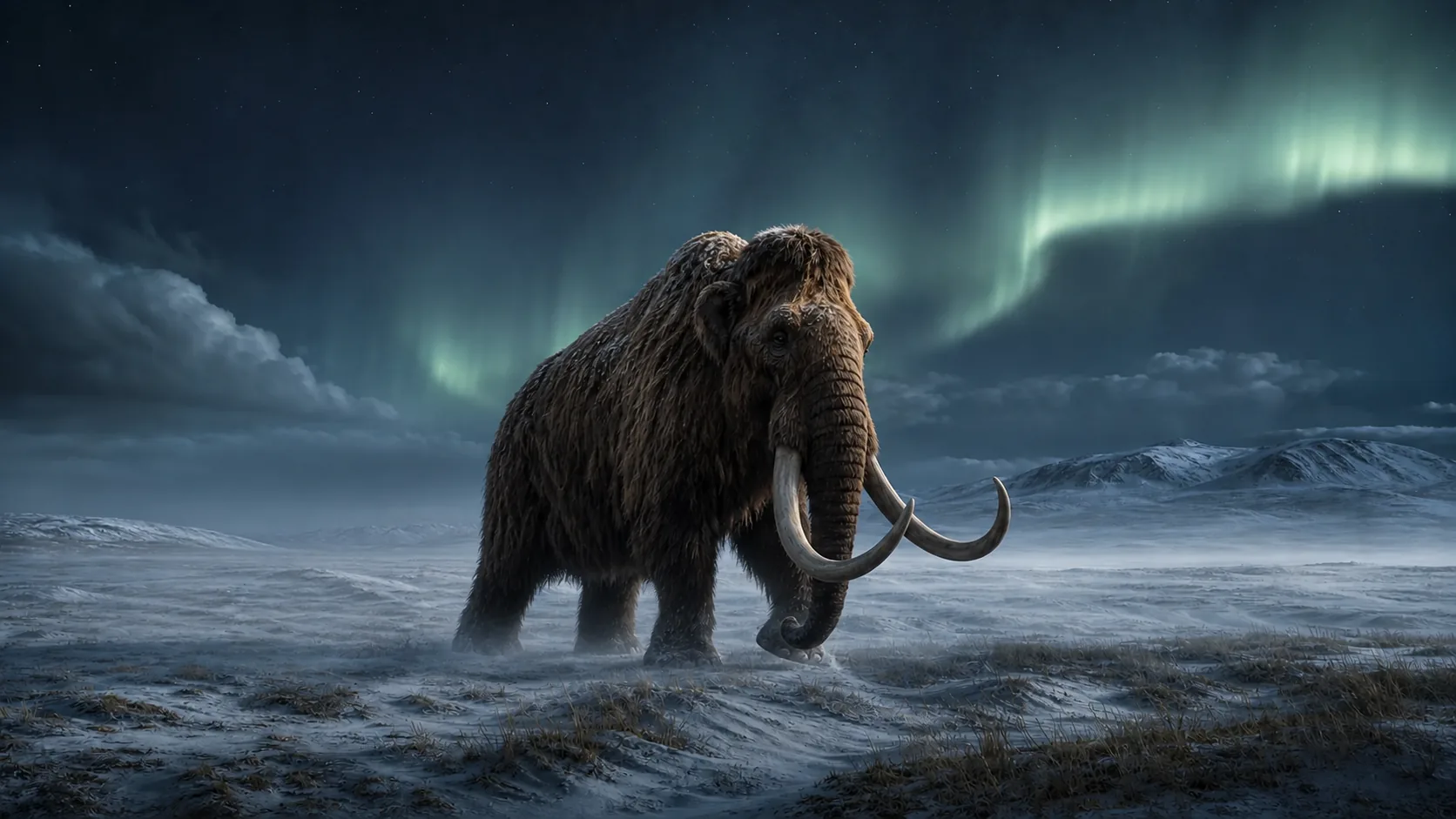 View original image · 1672 × 941
- Time range
- About 400,000–4,000 years ago
- Final stage
- Holocene
- Geographic range
- Northern Eurasia · North America
01 / ANSWER FIRST
What was a woolly mammoth?
The woolly mammoth (Mammuthus primigenius) was a cold-adapted elephant that lived across northern Eurasia and North America during the Pleistocene and survived on Wrangel Island until about 4,000 years ago.
It was not the largest mammoth and did not spend its life crossing empty ice sheets. Its characteristic world was the mammoth steppe: a dry, windswept and surprisingly productive grassland. Thick underwool, long guard hairs, small ears, a short tail and stored fat limited heat loss, while broad ridged molars processed abrasive plants. Frozen carcasses, skeletons, dung, cave art and ancient DNA make it one of the best-documented extinct animals.
02 / QUICK FACTS
Woolly mammoth at a glance
- Scientific name
- Mammuthus primigenius
- Time range
- About 400,000–4,000 years ago
- Shoulder height
- About 3–3.5 m (9.8–11.5 ft)
- Body mass
- About 4–6 tonnes
- Diet
- Herbivore; mainly grasses, sedges and herbs
- Biome
- Cold, dry mammoth steppe
- Range
- Northern Eurasia and northern North America
- Closest living relative
- Asian elephant
03 / SIZE
How big was a woolly mammoth?
Most adults were comparable to living elephants rather than towering over them. Natural History Museum mammoth specialist Adrian Lister gives a typical shoulder height of 3–3.5 metres and a mass of roughly 4–6 tonnes, with sex and individual variation. Adult males generally reached the upper end of the range; females were smaller.
The impression of extreme size comes partly from the high shoulders, domed skull, deep coat and spiralling tusks. Exceptional tusks could exceed 3.6 metres along the curve, but they should not be used as a direct proxy for body height.
Read the complete size, height and weight guideApproximate shoulder height
Ranges overlap. This is a scale comparison, not a claim that every individual reached the maximum.
04 / TIMELINE
From evolution to the last island population
Cold-adapted lineage emerges
Genetic and fossil evidence places the early woolly mammoth lineage in northeastern Siberia, developing from steppe-mammoth ancestors already adapted to northern conditions.
Range spans two continents
Populations occupied northern Eurasia and crossed Beringia into North America, moving through broad steppe-tundra landscapes as climate zones shifted.
Mainland populations disappear
As the last ice age ended, open habitat contracted and populations became fragmented. Human hunting overlapped with this environmental transition.
Island refuges vanish
St Paul Island retained mammoths until about 5,600 years ago. Wrangel Island supported the final known population until roughly 4,000 years ago.
05 / ANATOMY & TAXONOMY
Built for a cold, abrasive world
Coat and insulation
A dense undercoat trapped warm air beneath long guard hairs. Subcutaneous fat added insulation and energy storage. Preserved hair shows that coat colour varied rather than being uniformly black.
Ears, tail and body profile
Small ears and a short tail reduced exposed surface area. High shoulders, a domed head and a back sloping toward the pelvis produced the familiar silhouette.
Tusks
Both sexes carried tusks. Their spiral curve recorded annual growth and life history; wear suggests use in display, fighting, stripping vegetation or moving snow, although no single function explains every mark.
Molars
Closely packed enamel plates created a durable grinding surface for silica-rich grasses and grit. Successive molars moved forward through the jaw as older teeth wore out.
06 / DIET & BEHAVIOR
What did woolly mammoths eat?
Woolly mammoths were herbivores whose ridged teeth were especially effective at grinding grasses and sedges. Preserved stomach contents and dung also contain flowering herbs, twigs and shrubs, showing that diet changed with season and region rather than following a single rigid menu.
Direct evidence for social structure is limited, but comparison with living elephants and age patterns at fossil sites support family groups centred on females and young. Tusks grew throughout life and preserved chemical signals from food, water and geology. One 1.7-metre tusk allowed researchers to reconstruct the changing movements of a male across roughly 28 years.
07 / HABITAT
Where did woolly mammoths live?
The mammoth steppe stretched from western Europe through Siberia and Beringia into North America. It was cold and dry, but it was not an endless snowfield. Grasses and forbs supported mammoths, bison, horses, reindeer, woolly rhinoceroses and the predators that followed them.
Woolly mammoths tracked suitable habitat as glacial climates expanded and contracted. Deep snow and dense forest limited grazing, so the distribution was patchy even inside the broad northern range.
08 / RANGE & FOSSIL RECORD
A fossil archive across the Northern Hemisphere
These regions summarize major areas of evidence; dots are not presented as a complete occurrence map.
Western Europe
Teeth, skeletons and archaeological sites document shifting refuges from Britain to continental Europe.
Siberia
Permafrost preserves carcasses, hair, stomach contents and DNA with exceptional anatomical detail.
Beringia and Alaska
Tusks, teeth and isotope records reveal movement through cold grasslands that once connected Asia and North America.
Wrangel Island
Bones and genomes record the final isolated population, its bottleneck and persistence long after mainland extinction.
09 / EXTINCTION
Why did woolly mammoths go extinct?
The best-supported explanation is a sequence, not a single event: post-glacial warming reduced mammoth-steppe habitat, human hunting added pressure in parts of the range, and the surviving island populations became vulnerable to local environmental and demographic shocks.
Mainland extinction does not prove that climate or hunting acted alone. Mammoths survived earlier warm intervals, while archaeological evidence confirms at least occasional hunting. Geography matters: St Paul Island appears to have lost reliable freshwater, whereas the final Wrangel Island population remained demographically stable for millennia after a severe bottleneck. A 2024 genome study found that highly harmful mutations were purged even as milder harmful variants accumulated, making a simple “genetic meltdown” story inadequate.
Read the evidence-led extinction guide11 / FREQUENTLY ASKED QUESTIONS
Woolly mammoth FAQ
How big was a woolly mammoth?
Typical adults stood about 3–3.5 metres (9.8–11.5 feet) at the shoulder and weighed roughly 4–6 tonnes. Males generally occupied the upper end of that range and females the lower end; individual estimates vary with specimen and method.
What did woolly mammoths eat?
They were herbivores adapted mainly to grazing. Grasses, sedges and herbaceous flowering plants formed much of the diet, with shrubs and other browse varying by region and season.
Where did woolly mammoths live?
Their range extended across northern Eurasia and into northern North America. Much of it was mammoth steppe: a cold, dry and productive grassland rather than a landscape of permanent deep snow.
When did the last woolly mammoths die?
Most mainland populations were gone by roughly 10,500 years ago. Island survivors persisted on St Paul Island until about 5,600 years ago and on Wrangel Island until about 4,000 years ago.
Did humans cause woolly mammoth extinction?
Humans hunted mammoths, but no single cause explains the full geographic pattern. The leading interpretation combines post-glacial habitat loss, human pressure and the vulnerability of small isolated populations, with the final Wrangel Island disappearance still unresolved.
Are woolly mammoths dinosaurs?
No. Woolly mammoths were mammals in the elephant family. They lived tens of millions of years after non-avian dinosaurs disappeared, and their closest living relatives are Asian elephants.
04 / SOURCES & FURTHER READING
Check the source record
Use the scientific name to compare taxonomy, occurrence records and the fossil record. Database coverage and classifications may differ.
05 / REVISION HISTORY
How has this record changed?
- Verified authoritative entity sources and added three responsive reconstruction sizes.
- Initial bilingual species record published.
06 / CORRECTIONS & ADDITIONS