
Explore this animal in Size of Extinct Animals ↗
13 / Mesozoic
Quetzalcoatlus
Quetzalcoatlus northropi
One of the largest known flying animals stood as tall as a giraffe on the ground.
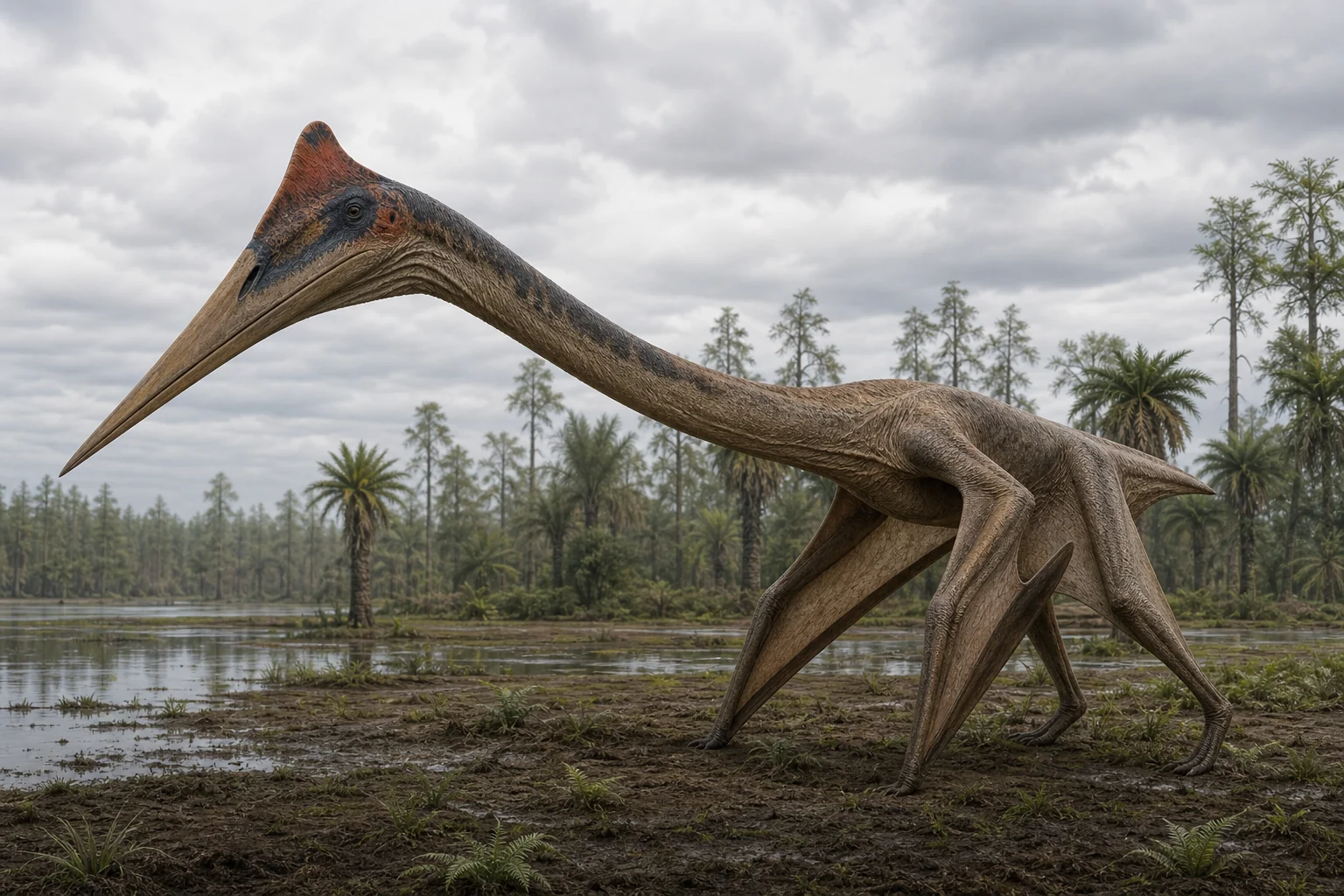 View original image · 1536 × 1024
- Time range
- About 68–66 million years ago
- Final stage
- End of the Cretaceous
- Geographic range
- Inland wetlands of North America
01 / ANSWER FIRST
What was Quetzalcoatlus?
Quetzalcoatlus was a giant azhdarchid pterosaur—not a dinosaur—that lived in latest-Cretaceous Texas and ranked among the largest animals ever capable of powered flight.
The huge species Q. northropi is known mainly from incomplete wing bones. More complete smaller material, now named Q. lawsoni, supplies much of the skull and body anatomy used in reconstructions. Scaling between them is informative but cannot fill every missing feature.
02 / QUICK FACTS
Quetzalcoatlus at a glance
- Scientific name
- Quetzalcoatlus northropi
- Age
- About 68–66 million years ago
- Wingspan
- About 10–11 m; estimate
- Mass
- Uncertain; often modelled around 200–250 kg
- Standing height
- Comparable to a giraffe
- Locomotion
- Quadrupedal walker and active flier
- Diet
- Small terrestrial and aquatic prey; debated
- Range
- Big Bend region, Texas
03 / CORE QUESTION
How did such a giant animal launch into flight?
Pterosaur tracks and limb anatomy support four-limbed walking. A widely used launch model has the powerful forelimbs vaulting the body into the air before the first full downstroke, distributing launch work differently from birds.
A 2021 functional study of Quetzalcoatlus instead reconstructed a standing bipedal jump before wing deployment and emphasized constraints imposed by long wings. Both approaches are models built from incomplete material; flight capability is strongly supported, while the exact launch sequence remains debated.
Read the complete size and flight guideHow to read the numbers
This page separates direct evidence, comparative inference and unresolved debate.
04 / LIFE & DISCOVERY TIMELINE
How the Texas giant entered science
First giant wing bones found
Douglas Lawson found thin-walled pterosaur bones in Big Bend National Park.
Quetzalcoatlus named
The giant species was named after the Mesoamerican deity Quetzalcoatl.
Smaller skull described
More complete material clarified the extremely long, toothless skull.
Major monograph published
A multi-paper memoir revised species, geology, anatomy and functional interpretations.
05 / ANATOMY
A terrestrial giant engineered for flight
Long toothless skull
A spear-like beak and elongated jaws lacked teeth; crest shape is incompletely known in Q. northropi.
Stiff neck
Elongated cervical vertebrae formed a relatively stiff beam rather than a snake-like flexible neck.
Membrane wings
An enormous fourth finger supported the main wing membrane while the forelimbs also bore weight on land.
Light skeleton
Hollow, thin-walled bones and air spaces reduced mass but complicate fossil preservation.
06 / DIET & BEHAVIOUR
What did Quetzalcoatlus eat?
Terrestrial-stalking models compare it with a giant ground hornbill or stork taking small vertebrates and carrion. Fish and aquatic prey remain possible, but habitual skim-feeding is poorly supported.
Read the complete guide07 / DIET & BEHAVIOUR
How did it walk?
Pterosaurian anatomy indicates an erect quadrupedal gait using hind feet and folded wing fingers. The long limbs could cover ground efficiently without requiring dinosaur-like bipedal running.
08 / RANGE & HABITAT
Where did Quetzalcoatlus live?
Its confirmed fossils come from latest-Cretaceous deposits in and around Big Bend National Park, Texas, far inland from the open sea.
Javelina Formation
River-channel and floodplain deposits preserve both giant and smaller Quetzalcoatlus material.
Big Bend, Texas
The type locality anchors the genus geographically and historically.
Inland floodplains
The depositional setting favours terrestrial foraging rather than an exclusively marine lifestyle.
Shared fauna
It lived among Alamosaurus, tyrannosaurs and diverse smaller vertebrates near the end of the Cretaceous.
09 / FOSSIL EVIDENCE
What is directly known?
Giant wing elements
The Q. northropi holotype preserves incomplete but unmistakably enormous wing bones.
Smaller associated skeletons
Q. lawsoni specimens provide skull, neck, trunk and limb anatomy absent from the giant holotype.
Geological context
Sedimentology and taphonomy place the animals on inland river floodplains.
Functional models
Bone proportions and joint limits test walking, launch and flight, but missing soft tissues create uncertainty.
10 / DISAPPEARANCE & DEBATE
Why did Quetzalcoatlus go extinct?
Quetzalcoatlus disappeared in the K–Pg mass extinction 66 million years ago with all other pterosaurs.
Impact-driven darkness, cooling and food-web collapse eliminated non-avian dinosaurs and many other large vertebrates. Flight alone could not protect a giant specialist from a global productivity crisis.
12 / FREQUENTLY ASKED QUESTIONS
Quetzalcoatlus FAQ
Was Quetzalcoatlus a dinosaur?
No. It was a pterosaur, a separate branch of flying reptiles.
What was its wingspan?
The giant species is commonly estimated at roughly 10–11 metres.
Could it really fly?
Wing anatomy strongly supports flight, although launch method and performance remain debated.
Did it skim fish from the sea?
Habitual skim-feeding is poorly supported; inland terrestrial foraging is a leading model.
How tall was it on the ground?
Its head could reach roughly giraffe-like height, depending on posture and the individual.
Why are giant fossils incomplete?
Thin-walled flight bones break easily and the original giant specimen preserved mostly a detached wing.
04 / SOURCES & FURTHER READING
Check the source record
Use the scientific name to compare taxonomy, occurrence records and the fossil record. Database coverage and classifications may differ.
05 / REVISION HISTORY
How has this record changed?
- Upgraded to a bilingual S-tier topic hub with size-flight and locomotion-diet guides.
- Verified authoritative entity sources and added three responsive reconstruction sizes.
- Initial bilingual species record published.
06 / CORRECTIONS & ADDITIONS