
Explore this animal in Size of Extinct Animals ↗
07 / Mesozoic
Stegosaurus
Stegosaurus stenops
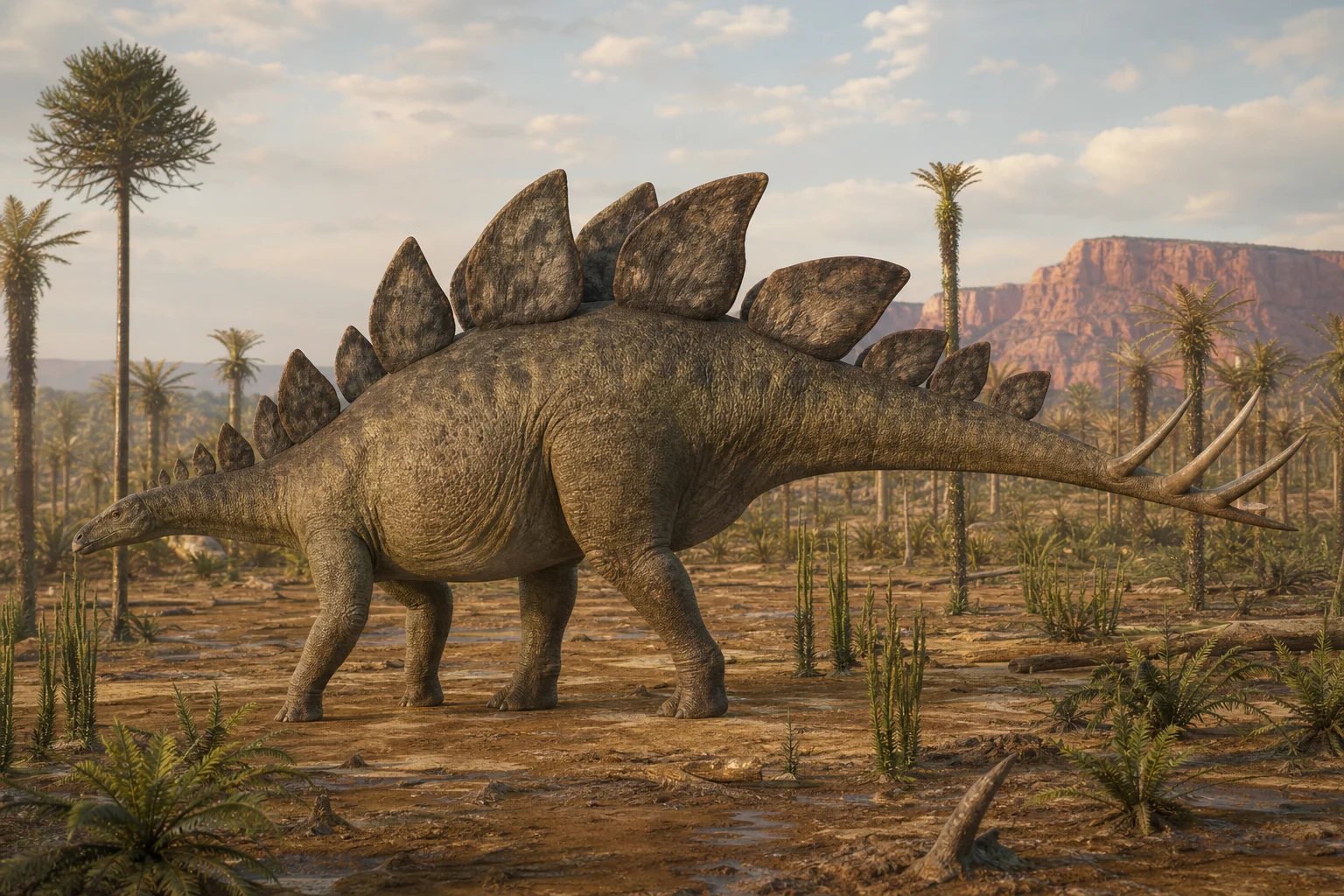
Tall back plates and a four-spiked tail made this low-browsing herbivore unmistakable.
 View original image · 1536 × 1024
- Time range
- About 155–145 million years ago
- Final stage
- Late Jurassic
- Geographic range
- Western North America
01 / ANSWER FIRST
What was Stegosaurus?
Stegosaurus was a large Late Jurassic armoured herbivore with two staggered rows of upright skin plates and four powerful tail spikes.
Its plates were not roof tiles and its tail was not passive decoration. Near-complete skeletons define a small head, arched back, short forelimbs and flexible weaponised tail, while plate colour, display and heat exchange remain uncertain.
02 / QUICK FACTS
Stegosaurus at a glance
- Scientific name
- Stegosaurus stenops
- Age
- About 155–145 million years ago
- Length
- Up to about 9 m
- Diet
- Low-growing Jurassic plants
- Plates
- Two staggered upright rows
- Tail weapon
- Four long spikes
- Range
- Western North America
- Extinction
- Late Jurassic turnover
03 / CORE QUESTION
What were Stegosaurus plates and tail spikes for?
The plates were osteoderms embedded in skin, not attached directly to vertebrae. Their thin structure, grooves and changing shapes through growth favour visual display and recognition, with heat exchange possible but not proven as the sole purpose.
Tail spikes have stronger weapon evidence: broken and healed Stegosaurus spikes plus an Allosaurus vertebra with a matching puncture show that forceful contact occurred. The exact swing speed and commonness of attacks remain modeled rather than filmed.
Read the complete size, plates and brain-myth guideHow to read the numbers
This page separates direct evidence, comparative inference and unresolved debate.
04 / LIFE & DISCOVERY TIMELINE
How the roof lizard was rebuilt
Stegosaurus named
O. C. Marsh initially imagined the detached plates lying flat.
Upright arrangement
Better articulated finds showed alternating plates standing above the back.
Weapon evidence
Predator–prey pathologies linked tail spikes and an Allosaurus puncture.
Sophie displayed
A highly complete skeleton enabled 3D mass and posture work.
05 / ANATOMY
A low head and a dangerous tail
Upright plates
Nineteen plates are preserved in the famous Sophie specimen; exact counts vary with completeness.
Thagomizer
Two pairs of spikes armed a laterally flexible tail.
Small skull
A narrow beak and simple teeth cropped vegetation without mammal-like chewing.
Unequal limbs
Longer hindlimbs and short forelimbs produced the high hips and arched profile.
06 / DIET & BEHAVIOUR
What did Stegosaurus eat?
Its low head and teeth suit ferns, cycads, horsetails and other low vegetation. Jaw mechanics indicate cropping and simple processing rather than powerful grinding.
Read the complete guide07 / DIET & BEHAVIOUR
Did Stegosaurus live in herds?
No large monospecific herd assemblage securely demonstrates permanent herding. Individuals may have gathered seasonally or in small groups, but social structure remains poorly recorded.
08 / RANGE & HABITAT
Where did Stegosaurus live?
Classic Stegosaurus comes from the Morrison Formation, a vast seasonal floodplain system in western North America.
Wyoming
Quarries preserve important articulated and partial skeletons.
Colorado
The type history and many classic remains come from Morrison rocks.
Utah
Floodplain deposits preserve stegosaurs among diverse dinosaurs.
Seasonal ecosystem
Ferns, cycads and conifers grew among river channels and dry intervals.
09 / FOSSIL EVIDENCE
What evidence tests the iconic reconstruction?
Sophie skeleton
More than 80% complete, it anchors 3D posture, mass and growth studies.
Plate position
Articulated burial established upright alternating rows rather than a flat roof.
Healed tail spikes
Remodelled broken tips show impacts occurred while animals were alive.
Allosaurus puncture
A partially healed vertebral wound matches the geometry of a stegosaur spike.
10 / DISAPPEARANCE & DEBATE
Why did Stegosaurus disappear?
Stegosaurus disappeared during Late Jurassic faunal turnover, long before the asteroid impact.
The Morrison record ends as environments and dinosaur communities changed. No single catastrophe is demonstrated for Stegosaurus, and its absence from younger rocks cannot alone specify whether climate, vegetation, competition or lineage replacement dominated.
12 / FREQUENTLY ASKED QUESTIONS
Stegosaurus FAQ
How big was Stegosaurus?
Large individuals reached about 9 metres; mass varies with specimen and maturity.
Were the plates flat?
No. Articulated evidence supports two staggered rows standing upright in the skin.
Did it have two brains?
No. The enlarged sacral space was not a second brain; comparable structures store glycogen in living birds.
Could the tail spikes injure Allosaurus?
Yes. A healed Allosaurus puncture and damaged Stegosaurus spikes support real weapon use.
What were the plates for?
Display and recognition are plausible; heat exchange may have contributed, but no single function is proven.
Did it meet T. rex?
No. Stegosaurus lived roughly 80 million years earlier; Allosaurus was a contemporary predator.
04 / SOURCES & FURTHER READING
Check the source record
Use the scientific name to compare taxonomy, occurrence records and the fossil record. Database coverage and classifications may differ.
05 / REVISION HISTORY
How has this record changed?
- Upgraded to a bilingual S-tier topic hub with two independent evidence guides.
- Verified authoritative entity sources and added three responsive reconstruction sizes.
- Initial bilingual species record published.
06 / CORRECTIONS & ADDITIONS