
TYRANNOSAURUS REX TOPIC HUB · DIET & PREDATION
What Did Tyrannosaurus rex Eat? Prey, Hunting and Bite Force
An evidence-led guide to T. rex diet: prey species, active predation, scavenging, bone-crushing bite force, coprolites and juvenile feeding.
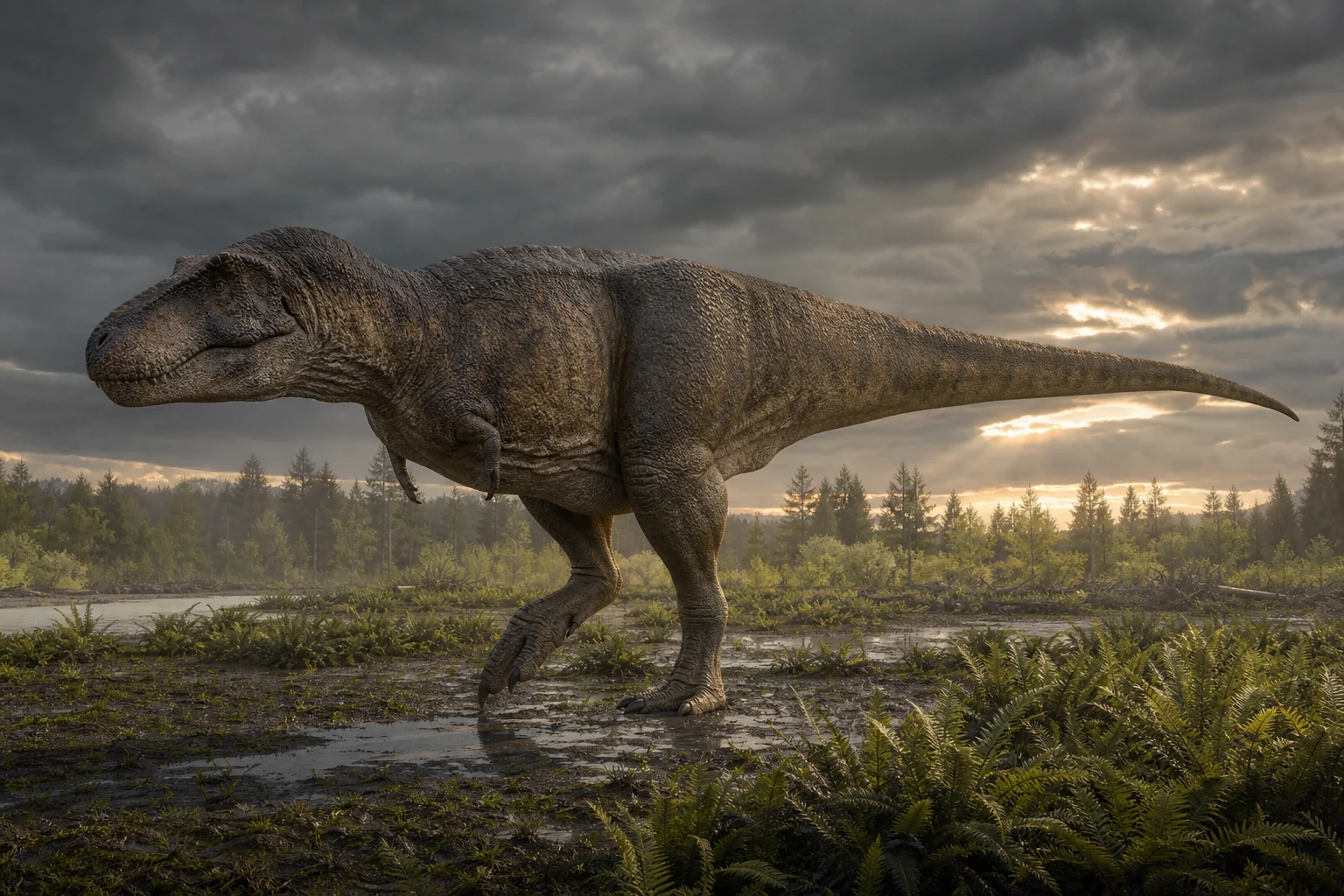 View full-resolution reconstruction ↗
This is an original generative reconstruction, not a photograph or scientific plate. Measurements and interpretations below are tied to named sources.
01 / PREY
Which dinosaurs did T. rex eat?
Its latest-Cretaceous ecosystems contained Edmontosaurus and other hadrosaurs, horned dinosaurs such as Triceratops, armoured ankylosaurs, pachycephalosaurs and many smaller vertebrates. Tooth marks attributable to large tyrannosaurids occur most often on abundant large herbivores, making hadrosaurs and ceratopsians the strongest direct candidates.
A food list is not a fixed menu. Availability changed with age, season, injury and local habitat. A giant adult could exploit large carcasses, while juveniles probably focused on smaller prey. Cannibalism is also possible because tyrannosaur bones carry feeding marks made by other large tyrannosaurids.
02 / ACTIVE PREDATION
What proves T. rex hunted living animals?
Most bite marks cannot distinguish hunting from feeding after death. The critical evidence is healing. An Edmontosaurus tail vertebra preserves a broken tyrannosaur tooth surrounded by new bone growth. The hadrosaur was alive when bitten and survived long enough to heal, so the attack was not feeding on an already dead carcass.
Other healed injuries on Triceratops and hadrosaurs are consistent with encounters, although assigning every mark to T. rex is more difficult. Forward-facing eyes, strong hindlimbs and a powerful bite fit predation, but anatomy alone is less decisive than a wound that healed.
03 / SCAVENGING
Did T. rex also eat carrion?
Almost certainly. Modern large predators regularly take carcasses, and a keen sense of smell would help locate them. Fossil bones covered in repeated tooth marks show that tyrannosaurs sometimes used carcasses thoroughly, including low-nutrition parts that became worthwhile only after preferred flesh was gone.
Scavenging is not evidence of weakness. A multi-tonne carnivore had enormous energy costs and would benefit from any safe meal. The old hunter-versus-scavenger debate creates a false choice: fossil evidence and living ecology both support opportunistic use of both strategies.
04 / BITE & BONE
How did T. rex crush bone?
A Scientific Reports model estimated maximum adult bite forces between about 18,000 and 34,500 newtons across seven specimens. Tooth pressures could reach levels high enough to crack cortical bone. The teeth were thick and rounded in cross-section compared with the flatter blades of many theropods, helping them resist bending.
Broken and worn teeth, deep punctures and coprolites containing pulverised bone confirm that extreme forces were used repeatedly in life. Bone consumption released marrow and mineral-rich tissue, broadening the usable portion of a carcass.
| Evidence | What it shows | Limitation |
|---|---|---|
| Healed Edmontosaurus bite | Attack on living prey | One direct event, not a hunting frequency |
| Carcass tooth marks | Intensive feeding and bone contact | Cannot identify how prey died |
| Bone-rich coprolites | Bone was swallowed and digested | Producer attribution depends on size and context |
| Bite-force model | Mechanical capacity for osteophagy | Depends on reconstructed muscles and geometry |
05 / GROWING PREDATORS
Did young T. rex eat different food?
Juvenile Tyrannosaurus had proportionally longer legs, slender jaws and narrower teeth. Bone histology shows they remained in this lighter body plan for years before the adolescent growth surge. That combination supports pursuit of smaller, more agile prey rather than attacking the heaviest adult herbivores.
As the skull widened and bite force increased, older animals could process larger prey and bone. Direct stomach contents from a juvenile Gorgosaurus—a close relative rather than T. rex itself—show small dinosaur remains and support the broader tyrannosaurid pattern. It is comparative evidence, not a preserved T. rex meal.
06 / EVIDENCE VERDICT
What is the best current picture of T. rex feeding?
Active attacks
A healed, tooth-bearing prey wound proves that a live hadrosaur escaped a tyrannosaur attack.
Bone consumption
Coprolites, punctures and worn teeth record swallowing and processing bone.
Scavenging
Senses, carcass traces and living predator behaviour support opportunistic carrion use.
Age-based diet shift
Juvenile anatomy and growth indicate different prey, but direct T. rex stomach contents remain rare.
Bottom line: T. rex was a capable predator and an efficient scavenger. Its feeding ecology changed as it grew, and no single label captures every meal across a lifetime.
FAQ
Questions readers ask
What animals did T. rex eat?
Evidence points especially to hadrosaurs such as Edmontosaurus and ceratopsians such as Triceratops. It probably consumed any suitably sized dinosaur or carcass it could safely exploit.
Did T. rex hunt living prey?
Yes. An Edmontosaurus tail vertebra healed around an embedded tyrannosaur tooth, showing that the hadrosaur survived an attack long enough for new bone to grow.
Did T. rex eat bones?
Yes. Deep punctures, broken teeth, heavily marked skeletons and bone fragments in coprolites show repeated bone consumption. Its thick teeth and extreme bite pressures were adapted to withstand it.
Did young T. rex eat different prey?
Probably. Juveniles were lighter, longer-legged and had narrower skulls and teeth. Growth studies support an ecological shift from smaller, faster prey toward the giant herbivores and bone-rich meals of adults.
SOURCES & FURTHER READING
Evidence used for this guide
Measurements and behavioural claims are tied to museum summaries or peer-reviewed research. External sources may update as new specimens and analyses are published.
- 01Investigating the running abilities of Tyrannosaurus rex ↗PeerJ · Sellers et al. (2017)
Movement and bone-stress modelling constrain adult running gaits.
- 02Natural Frequency Method: preferred walking speed of Tyrannosaurus rex ↗Royal Society Open Science · van Bijlert et al. (2021)
Tail-motion model estimates preferred walking, not maximum running speed.
- 03Tyrannosaurus ↗Natural History Museum, London
Museum overview of size, anatomy, discovery, diet, bite evidence, locomotion and uncertainty about feathers.
- 04Tyrannosaurus rex factsheet ↗Smithsonian Institution
Museum summary of growth, lifespan, size, forelimb hypotheses and its Late Cretaceous ecosystem.
- 05Seven questions about Tyrannosaurus rex ↗American Museum of Natural History
Evidence-led answers about feeding, movement, arms, discovery and the limits of the fossil record.
- 06The biomechanics behind extreme osteophagy in Tyrannosaurus rex ↗Scientific Reports · DOI 10.1038/s41598-017-02161-w
Peer-reviewed estimates of adult bite force and tooth pressure linked to repeated bone consumption.
- 07Physical evidence of predatory behavior in Tyrannosaurus rex ↗Proceedings of the National Academy of Sciences · PMC3732924
A healed hadrosaur tail injury containing a tyrannosaur tooth provides direct evidence of an unsuccessful attack on live prey.
- 08Age and growth dynamics of Tyrannosaurus rex ↗Proceedings of the Royal Society B · PMC1691809
Bone histology showing rapid adolescent growth and effective adult size before about twenty years of age.
- 09Growing up Tyrannosaurus rex ↗Science Advances · PMC6938697
Juvenile bone microstructure and evidence for a major shift in body size and ecological role during growth.
- 10Absolute abundance and preservation rate of Tyrannosaurus rex ↗Science · PubMed 33859033
A model of population abundance, generation count and the extreme rarity of fossil preservation, with wide uncertainty intervals.
- 11SUE the T. rex ↗Field Museum
Museum record of the exceptionally complete SUE specimen, its growth history, injuries and modern skeletal reconstruction.