
Explore this animal in Size of Extinct Animals ↗
10 / Mesozoic
Ankylosaurus
Ankylosaurus magniventris
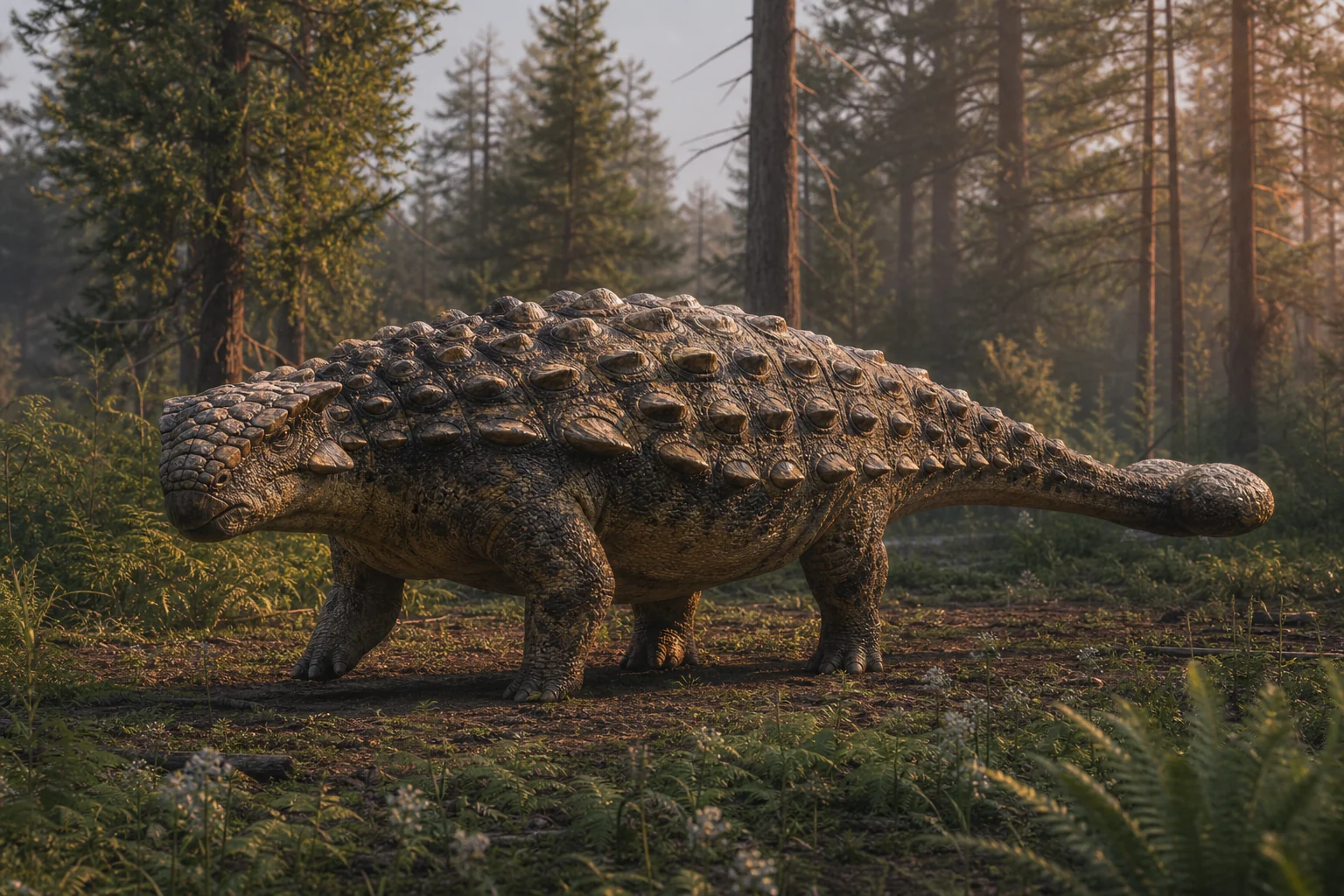
Body armor and a heavy tail club turned a plant-eater into a walking fortress.
 View original image · 1536 × 1024
- Time range
- About 68–66 million years ago
- Final stage
- End of the Cretaceous
- Geographic range
- Western North America
01 / ANSWER FIRST
What was Ankylosaurus?
Ankylosaurus was one of the largest tail-clubbed armoured dinosaurs, a broad low herbivore that lived in western North America during the final two million years of the Cretaceous.
Its famous image is more complete than its fossil record. No entire skeleton is known, and the arrangement of many back osteoderms is reconstructed from isolated pieces and better-preserved relatives. The skull, neck armour and tail club are real; precise plate placement, colour and behaviour remain uncertain.
02 / QUICK FACTS
Ankylosaurus at a glance
- Scientific name
- Ankylosaurus magniventris
- Age
- About 68–66 million years ago
- Length
- Large estimates around 8 m; incomplete record
- Mass
- Several tonnes; model-dependent
- Diet
- Low vegetation, shrubs and fruit
- Armor
- Osteoderms embedded in skin
- Tail
- Interlocking handle and terminal knob
- Range
- Western North America
03 / CORE QUESTION
Could an Ankylosaurus tail club break bone?
The club combined tightly interlocking terminal vertebrae with enlarged osteoderms forming the knob. This created a reinforced handle that could transmit a sideways strike rather than bend freely along its entire length.
Biomechanical models of better-preserved ankylosaurid clubs show that large examples could generate bone-damaging impacts. Those models are comparative, not a measured strike by Ankylosaurus itself; defence against predators, display and combat with rivals need not be mutually exclusive.
Read the complete size, armor and tail-club guideHow to read the numbers
This page separates direct evidence, comparative inference and unresolved debate.
04 / LIFE & DISCOVERY TIMELINE
How the fused lizard was reconstructed
Type skeleton discovered
Barnum Brown's team collected fragmentary bones and armour in Montana.
Ankylosaurus named
The name reflected the fused, reinforced construction of the skeleton.
Tail club recognized
A later specimen revealed the distinctive club absent from the type discovery.
Modern redescription
All major specimens were reassessed for size, skull, armour and tail anatomy.
05 / ANATOMY
A defensive system built into skin and skeleton
Broad skull
Bony ornament covered much of the skull surface while complex nasal passages wound through the snout.
Neck half-rings
Bands of fused osteoderms protected the vulnerable neck while retaining some movement.
Body osteoderms
Plates and nodules formed a mosaic in the skin, but their exact back arrangement is not preserved.
Tail club
Free anterior caudals powered the swing; interlocking posterior vertebrae formed a stiff handle ending in a knob.
06 / DIET & BEHAVIOUR
What did Ankylosaurus eat?
A wide muzzle, beak and many small teeth suit bulk cropping of ferns, shrubs, fruit and other low vegetation. It did not chew like a mammal; gut fermentation probably completed much of the processing.
Read the complete guide07 / DIET & BEHAVIOUR
Was Ankylosaurus slow?
Its broad heavy body and short limbs favour steady quadrupedal movement rather than prolonged speed. Fossils cannot provide a top speed, and a short defensive burst remains plausible.
08 / RANGE & HABITAT
Where did Ankylosaurus live?
Ankylosaurus fossils come from latest-Cretaceous river and floodplain deposits along the western interior of North America.
Hell Creek Formation
Montana and adjacent deposits preserve the type and a diverse terminal-Cretaceous ecosystem.
Lance Formation
Wyoming material extends the record across connected lowlands.
Scollard Formation
Alberta fossils mark the northern part of its known range.
Seasonal floodplains
Woodlands, rivers and open patches supported abundant low browse and large dinosaurs.
09 / FOSSIL EVIDENCE
What evidence supports the reconstruction?
Fragmentary individuals
Several partial skeletons overlap enough to establish the skull, limbs, armour types and tail club.
2017 redescription
Direct reassessment separated Ankylosaurus anatomy from assumptions borrowed from smaller relatives.
CT and mechanics
Scans of ankylosaurid clubs reveal internal cancellous bone and inform impact models.
Relative comparisons
Zuul and Euoplocephalus preserve armour positions and tails more completely, but are not interchangeable with Ankylosaurus.
10 / DISAPPEARANCE & DEBATE
Why did Ankylosaurus go extinct?
Ankylosaurus disappeared in the K–Pg mass extinction 66 million years ago, together with all other non-avian dinosaurs.
The impact triggered darkness, cooling, fires and food-web collapse. Armour and a tail club could deter predators but could not protect a large herbivore from prolonged loss of plant productivity and ecosystem failure.
12 / FREQUENTLY ASKED QUESTIONS
Ankylosaurus FAQ
How big was Ankylosaurus?
Large reconstructions are around 8 metres, but all skeletons are incomplete and mass estimates vary by model.
Was its whole body covered in solid shell?
No. Separate osteoderms sat in skin with flexible tissue between them; the belly was less protected.
Could the tail club break a T. rex leg?
Large ankylosaurid clubs could model bone-damaging impacts, but no Tyrannosaurus fracture is directly tied to an Ankylosaurus strike.
Did Ankylosaurus fight others of its own kind?
Possible. A related ankylosaur preserves flank injuries consistent with rival tail blows, but direct Ankylosaurus evidence is absent.
Did Ankylosaurus live with Tyrannosaurus?
Yes. Both occur in latest-Cretaceous western North American formations such as Hell Creek.
Why is no complete skeleton known?
Fossilization is rare, bodies disarticulate, and osteoderms separate from the skeleton after death.
04 / SOURCES & FURTHER READING
Check the source record
Use the scientific name to compare taxonomy, occurrence records and the fossil record. Database coverage and classifications may differ.
05 / REVISION HISTORY
How has this record changed?
- Upgraded to a bilingual S-tier topic hub with two independent evidence guides.
- Verified authoritative entity sources and added three responsive reconstruction sizes.
- Initial bilingual species record published.
06 / CORRECTIONS & ADDITIONS