
Explore this animal in Size of Extinct Animals ↗
06 / Mesozoic
Triceratops
Triceratops horridus
Triceratops ate plants, clipping vegetation with its beak and slicing it with dental batteries. Fossils reveal feeding mechanics more clearly than a precise plant menu.
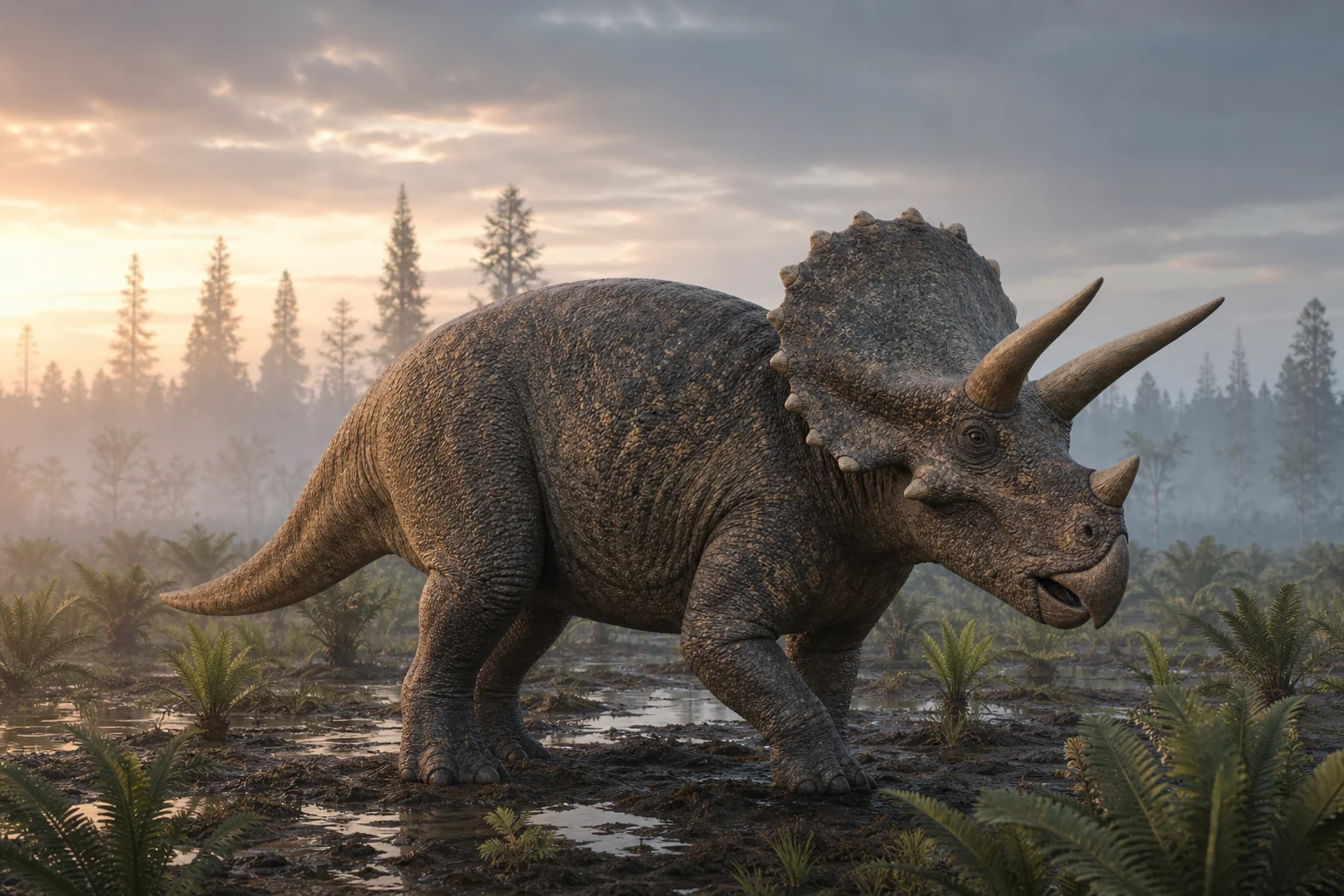 View original image · 1536 × 1024
- Time range
- About 68–66 million years ago
- Final stage
- End of the Cretaceous
- Geographic range
- Western North America
Triceratops diet: plants, teeth and the evidence
Triceratops ate plants. Its beak gathered vegetation and its dental batteries sliced it. The fossils establish a herbivore more securely than a list of its favourite plants.
Direct anatomical evidence
Beak shape, packed replacement teeth and microscopic tooth wear document food processing. A 2015 study explains how different dental tissues wore into efficient cutting surfaces.
Possible foods
Ferns, cycads and flowering plants are plausible candidates, not a confirmed daily menu. Plant fossils from the habitat show availability, not proof that each plant was eaten.
Questions fossils cannot settle
An exact daily food intake, a preferred plant species and how feeding changed with season remain uncertain. These require evidence beyond having a large body and many teeth.
01 / ANSWER FIRST
What was Triceratops?
Triceratops was a giant four-legged herbivore with a beak, two long brow horns, a shorter nasal horn and a solid bony frill. It lived in western North America during the final two million years of the Cretaceous.
The familiar skull was not a fixed adult helmet from birth. Juveniles had short, backward-curving brow horns and a scalloped frill; the horns rotated and the skull bones fused as the animal matured. Fossils support several roles for the adult display—recognition, visual signalling and physical combat—while simple stories about permanent herds or guaranteed victory over Tyrannosaurus go beyond the evidence.
02 / QUICK FACTS
Triceratops at a glance
- Scientific name
- Triceratops horridus
- Age
- About 68–66 million years ago
- Length
- Large adults about 8–9 m
- Body mass
- Several tonnes; model-dependent
- Diet
- Herbivorous plant slicer
- Range
- Western North America
- Recognised species
- T. horridus and T. prorsus
- Closest famous predator
- Tyrannosaurus rex
03 / SIZE
How big was Triceratops?
Large adults reached roughly 8–9 metres from beak to tail. Mass estimates often fall in the several-tonne range and can approach or exceed ten tonnes in especially broad reconstructions. The uncertainty is real: skulls are abundant, but complete articulated bodies are uncommon.
The skull alone could exceed two metres, making it one of the largest heads among land animals. Brow horn cores of large adults could approach one metre, and a keratin sheath would have extended beyond the fossilised bone.
Read the complete size, horns and frill guideApproximate body length
Length is better constrained than mass; muscle depth and torso width strongly change a volumetric estimate.
04 / GROWTH & SPECIES
A skull transformed through life and time
Short horns and a scalloped frill
Brow horns curved backward, frill-edge bones were pointed and many skull sutures remained open.
Horns rotated forward
The brow horns lengthened, the nasal horn fused and ornamental bones flattened against the frill margin.
A fused, robust skull
Bone texture and fusion record maturity, while horn and frill shape still varied among individuals.
Lineage changed over 1–2 million years
T. horridus morphology dominates lower strata; transitional skulls lead toward T. prorsus higher in the formation.
05 / ANATOMY
More than three horns
Beak
A toothless, keratin-covered beak clipped stems and leaves before food reached the cheek teeth.
Dental batteries
Columns of replacement teeth formed self-wearing blades with multiple tissues, producing a durable slicing surface.
Frill
The solid parietal-squamosal frill expanded the skull outline. Thin areas and surface blood supply favour display alongside other roles.
Quadrupedal body
Heavy limbs supported a broad torso and enormous head. The forelimbs stood beneath the body rather than sprawling like a lizard.
06 / DIET & CHEWING
What did Triceratops eat?
Triceratops ate plants. It was a herbivore that clipped vegetation with its beak and sliced it with tightly packed rows of teeth. Low-growing plants were easy to reach, although it could raise its head to feed higher, according to the Natural History Museum.
Which plants were on its menu?
Ferns, cycads and flowering plants are possible foods, not a confirmed shopping list. Fossil feeding equipment tells us more securely how Triceratops processed vegetation than which plant species it selected. Claims about an exact daily food intake or a favourite plant go beyond that evidence.
How did its teeth cut tough plants?
The beak collected food; tooth batteries farther back in the jaws cut it. A 2015 tooth-wear study found that uneven wear among dental tissues created recessed cutting surfaces, reducing friction as the teeth sliced bulky plants. This is evidence for specialised plant processing, not a direct record of a particular meal.
07 / SOCIAL LIFE
Sometimes together, not proven permanent herds
Most Triceratops remains occur as isolated individuals. A small number of multi-animal bonebeds demonstrate aggregation, including juveniles together, but a death assemblage cannot by itself reveal a lifelong herd structure.
Adults may have met for breeding, seasonal movement or access to resources. Combat evidence indicates direct social interaction; it does not establish that the animals travelled continuously in large groups.
08 / HORNS & COMBAT
Did Triceratops use its horns to fight?
Patterns of healed damage on Triceratops frills match the geometry expected when brow horns contacted an opponent. Compared with the related Centrosaurus, lesions occur in different skull regions, supporting real physical combat rather than random disease alone.
Display was not an alternative to combat. Large visual structures can advertise identity, maturity or condition and still become weapons during close encounters.
Read the complete defense and combat guide09 / TRICERATOPS & T. REX
A dangerous encounter, not a scripted duel
Tyrannosaur tooth traces occur on Triceratops skulls. One damaged horn and frill show healing, evidence that an animal survived an aggressive encounter. Other bite patterns may record carcass feeding rather than a live attack.
Horns, beak and body mass offered meaningful defense, but fossils cannot provide a win-loss record. Ecology replaced cinematic symmetry: predators chose risks, prey turned or fled, and many encounters probably ended without a kill.
10 / RANGE & HABITAT
Where did Triceratops live?
Fossils come from the latest Cretaceous of western North America, especially river and coastal-plain deposits laid down along the retreating Western Interior Seaway.
Hell Creek
Montana, the Dakotas and Wyoming preserve abundant skulls with Tyrannosaurus, Edmontosaurus and a diverse floodplain community.
Lance
Wyoming deposits record comparable rivers, woodland and coastal lowlands.
Frenchman and Scollard
Canadian records extend the genus north into Saskatchewan and Alberta.
Changing landscape
Channels, flood basins, forests and wetlands shifted through time, so no single habitat painting represents the whole range.
11 / FOSSIL EVIDENCE
How do scientists reconstruct Triceratops?
Its unusually rich skull record makes growth and evolutionary change testable, while rarer skeletons, skin and trace evidence fill in the body and behaviour.
Skull growth series
Juveniles through adults reveal horn rotation, frill-edge change and progressive bone fusion.
Stratigraphic census
More than fifty placed skulls record morphology changing from lower to upper Hell Creek strata.
Injuries and bite traces
Healing separates events during life from post-mortem feeding, though the attacker is not always certain.
Teeth and skin
Microscopic wear reconstructs cutting mechanics; preserved impressions document pebbled scales.
12 / EXTINCTION
Why did Triceratops go extinct?
Triceratops disappeared in the end-Cretaceous mass extinction about 66 million years ago, when the Chicxulub impact disrupted sunlight, climate, vegetation and terrestrial food webs.
It remained abundant close to the boundary and did not vanish because its horns became obsolete or Tyrannosaurus overhunted it. The global crisis eliminated every non-avian dinosaur lineage, while only birds survived among dinosaurs.
14 / FREQUENTLY ASKED QUESTIONS
Triceratops FAQ
What did Triceratops eat?
Triceratops was a herbivore. It clipped plants with its beak and sliced them with tooth batteries. Low vegetation was accessible; ferns, cycads and flowering plants are possible foods, but its exact plant menu is uncertain.
How big was Triceratops?
Large adults were about 8–9 metres long and several tonnes in mass. Published estimates vary widely because complete articulated skeletons are rarer than skulls and body volume must be reconstructed.
How long were Triceratops horns?
The brow horn cores of large adults could approach one metre. In life a keratin sheath extended beyond the preserved bone, but its exact length and shape are not fossilised.
What was the Triceratops frill for?
The frill probably combined visual display, recognition and a role in combat. It covered part of the neck, but some areas were too thin to function as simple armour, and bite marks show it could be punctured.
Did Triceratops fight each other?
Probably. The distribution of healed lesions on Triceratops frills differs from related horned dinosaurs and is consistent with locking or striking with the brow horns.
Could Triceratops defend itself from T. rex?
Its size, beak and horns made it dangerous, and one damaged horn and frill preserve partially healed tyrannosaur bite traces. That shows survival of an encounter, not how often either animal won.
Did Triceratops live in herds?
Permanent large herds are not demonstrated. Most specimens are isolated, but rare bonebeds with several individuals show that Triceratops sometimes gathered, perhaps seasonally or by age.
Are Triceratops and Torosaurus the same dinosaur?
The proposal that Torosaurus was an old Triceratops remains debated, but several morphological and growth studies retain them as distinct genera. Triceratops itself includes T. horridus and T. prorsus.
04 / SOURCES & FURTHER READING
Check the source record
Use the scientific name to compare taxonomy, occurrence records and the fossil record. Database coverage and classifications may differ.
05 / REVISION HISTORY
How has this record changed?
- Expanded answers to reader questions, clarified the scope of fossil evidence and improved routes to related explanations.
- Upgraded to a bilingual S-tier topic hub with new size-anatomy and defense-behaviour guides.
- Verified authoritative entity sources and added three responsive reconstruction sizes.
- Initial bilingual species record published.
06 / CORRECTIONS & ADDITIONS