
Explore this animal in Size of Extinct Animals ↗
02 / Cenozoic
Saber-toothed Cat
Smilodon fatalis
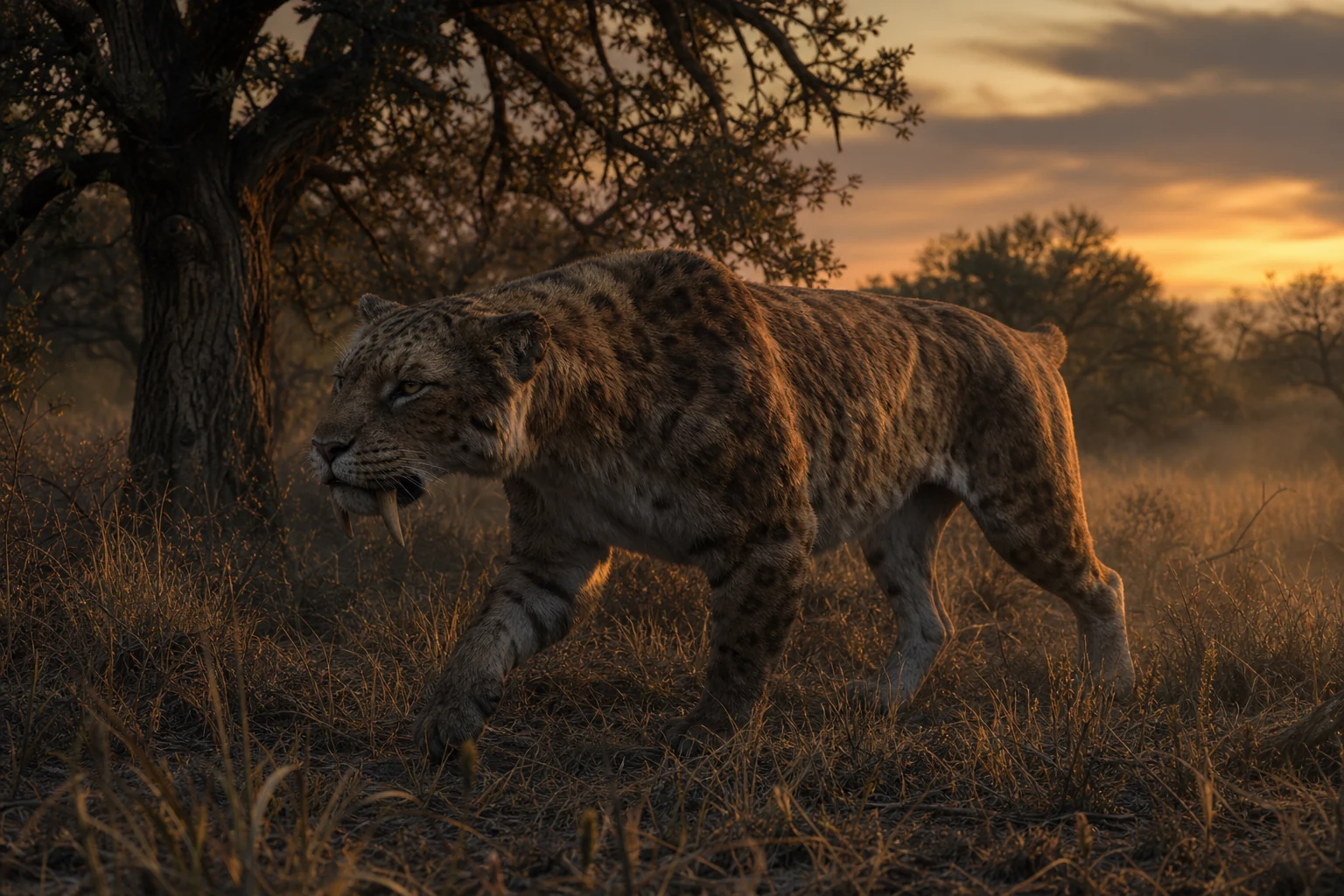
Its enormous canines were only part of the weapon; the real power lay in exceptionally strong forelimbs.
 View original image · 1536 × 1024
- Time range
- About 700,000–11,000 years ago
- Final stage
- End of the Pleistocene
- Geographic range
- North America · South America
Which dates and animal does this record describe?
This record focuses on Smilodon fatalis. The genus Smilodon includes other species with different ages and body sizes.
Species-level fossil record
Florida Museum summarizes its age range as roughly 700,000–11,000 years ago. This is an approximate fossil range, not a precise origin or extinction date.
Florida Museum · Smilodon fatalis ↗01 / ANSWER FIRST
What was Smilodon?
Smilodon fatalis was a robust American saber-toothed cat that restrained large prey with powerful forelimbs and killed with elongated upper canines.
This record focuses on Smilodon fatalis. The genus Smilodon includes other species with different ages and body sizes.
02 / QUICK FACTS
Smilodon at a glance
- Scientific name
- Smilodon fatalis
- Age
- About 700,000–11,000 years ago
- Mass
- Often about 160–280 kg
- Upper canine
- Up to about 28 cm including root
- Range
- North and South America
- Hunting style
- Ambush, grapple and precision bite
- Key site
- La Brea Tar Pits
- Extinction
- End of the Pleistocene
03 / CORE QUESTION
How did Smilodon use such long canine teeth?
Smilodon had a wider gape than living big cats, but its long, flattened canines were vulnerable to sideways bending. Robust shoulders and forelimbs likely pinned prey before a controlled bite targeted soft throat or abdominal tissue.
Canine length, body mass and coat colour vary by species, sex and specimen. S. fatalis was lion-sized but proportionally more muscular, with a short tail and sloping back unlike a modern tiger.
Read the complete size, saber and body-shape guideHow to read the numbers
This page separates direct evidence, comparative inference and unresolved debate.
04 / LIFE & DISCOVERY TIMELINE
A famous cat recorded by asphalt
Genus-level background
This older date concerns the genus Smilodon, not the first record of S. fatalis.
Megafauna hunter
S. fatalis hunted bison, camels and other large herbivores.
Thousands of bones
Natural asphalt trapped prey and attracted repeated waves of carnivores.
Extinction
Smilodon vanished amid rapid ecological change and megafaunal loss.
05 / ANATOMY
Built to overpower, not to chase far
Saber canines
Long flattened upper canines delivered deep controlled wounds but resisted front-to-back force better than sideways stress.
Powerful forequarters
Broad shoulders and heavy forelimbs suited grappling with large prey.
Wide gape
Jaw and neck geometry cleared the canines for a precision bite.
Short tail
Reduced balancing length fits ambush and close combat better than prolonged pursuit.
06 / DIET & BEHAVIOUR
What did Smilodon eat?
Isotopes, tooth wear and prey abundance point to large herbivores including bison, camels and horses, with regional differences.
Read the complete guide07 / DIET & BEHAVIOUR
Was Smilodon social?
Healed severe injuries and La Brea abundance are compatible with social care, but neither proves pride-like groups; solitary cats can also survive injury and gather at carcasses.
08 / RANGE & HABITAT
Where did Smilodon live?
Smilodon occupied varied American habitats; S. fatalis is especially well represented in North American late-Pleistocene deposits.
California woodlands
La Brea preserves a predator-rich mosaic rather than a permanent tar lake.
Open grasslands
Large grazing prey supported ambush opportunities near cover and water.
Southern North America
Caves and river deposits extend the record beyond Los Angeles.
South American relatives
Other Smilodon species occupied tropical to temperate ecosystems farther south.
09 / FOSSIL EVIDENCE
What reveals Smilodon’s life?
La Brea skeletons
Large samples show variation, injuries and population structure but are biased by asphalt trapping.
Tooth wear and isotopes
Microscopic wear and chemistry test prey type and habitat use.
Pathology
Healed pelvis, spine and limb injuries constrain survival and hunting stress.
Biomechanics
Skull and canine models test loading but depend on reconstructed muscles and behaviour.
10 / DISAPPEARANCE & DEBATE
Why did Smilodon go extinct?
Smilodon disappeared during the end-Pleistocene reorganisation of American ecosystems.
Rapid climate and vegetation change, loss of large prey and growing human effects overlapped. Its specialised large-prey hunting system may have reduced flexibility, but the fossil record does not identify one universal cause.
12 / FREQUENTLY ASKED QUESTIONS
Smilodon FAQ
Was Smilodon a tiger?
No. It was a machairodontine cat on a separate extinct branch of Felidae.
How long were its saber teeth?
Large upper canines could reach about 28 cm including the root; the exposed crown was shorter.
How big was S. fatalis?
Often estimated around 160–280 kg, broadly lion-sized but more heavily built.
Did it hunt in groups?
Possible, but not proven. Injury survival and fossil abundance have multiple explanations.
What did it eat?
Large herbivores such as bison, camels and horses, varying by region and time.
Why did it disappear?
Prey loss, habitat change and human effects probably interacted; no single cause is established.
04 / SOURCES & FURTHER READING
Check the source record
Use the scientific name to compare taxonomy, occurrence records and the fossil record. Database coverage and classifications may differ.
05 / REVISION HISTORY
How has this record changed?
- Clarified the scope of the dates and taxon; linked the supporting records and separated exact identity from related references.
- Separated verified taxon identity from related references; aligned the dated record with its stated scope.
- Upgraded to a bilingual S-tier topic hub with two independent evidence guides.
- Verified authoritative entity sources and added three responsive reconstruction sizes.
- Initial bilingual species record published.
06 / CORRECTIONS & ADDITIONS