
TYRANNOSAURUS REX TOPIC HUB · SIZE & GROWTH
How Tall Was T. rex? Size, Height & Weight
How tall and heavy was Tyrannosaurus rex? Compare adult hip height, length and weight in feet, metres, pounds and tonnes, with specimen evidence.
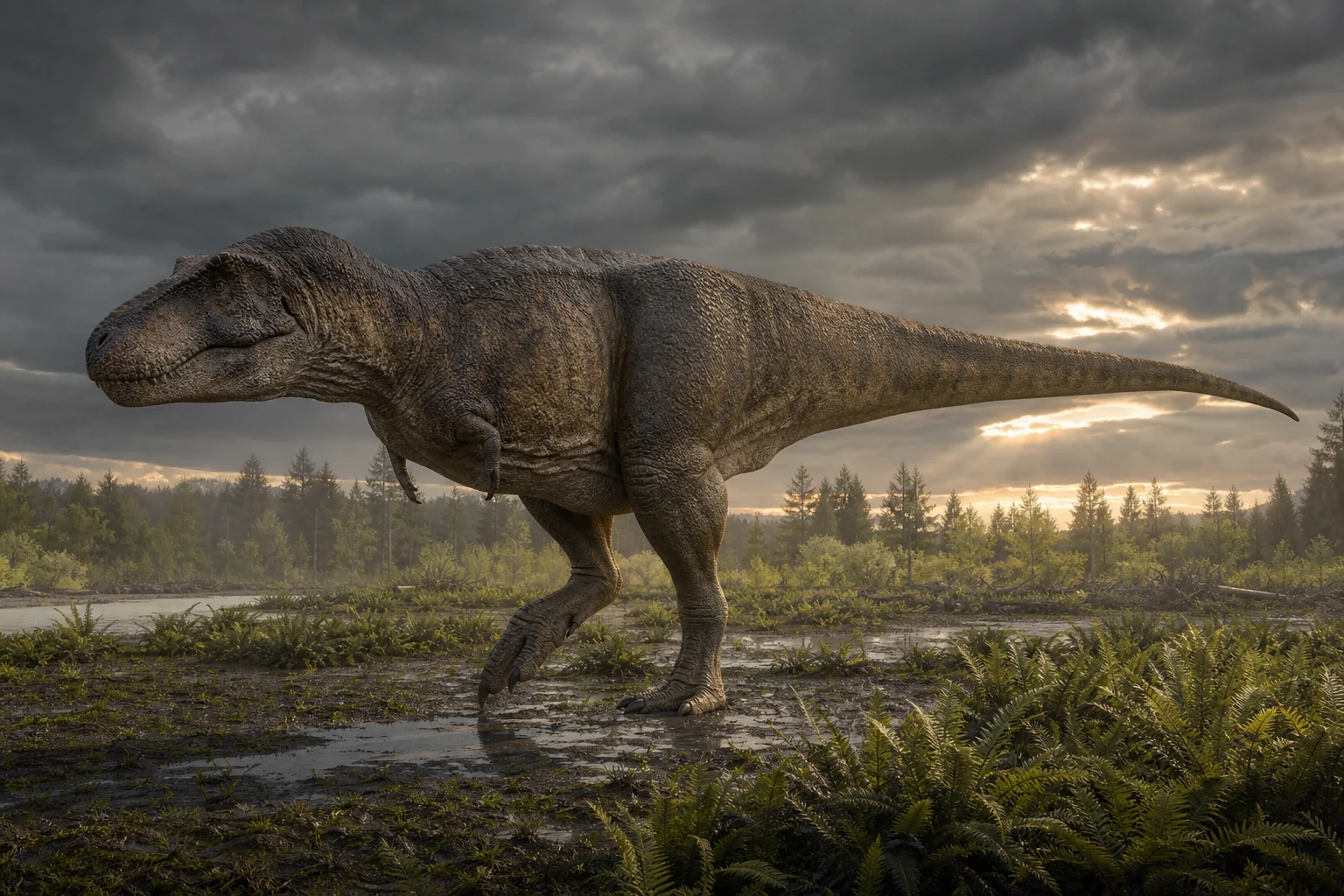 View full-resolution reconstruction ↗
This is an original generative reconstruction, not a photograph or scientific plate. Measurements and interpretations below are tied to named sources.
01 / MEASUREMENTS
How tall was T. rex in feet and metres?
The Natural History Museum summarises a common adult at close to 12 metres long, 3.5–4 metres high at the hips and 5,000–7,000 kilograms. These values describe the central adult range, not the biggest skeleton ever found.
Hip height is more useful than total standing height because T. rex held its backbone and tail approximately horizontal, and head height changed as the neck moved. Length is measured along a reconstructed spine, where missing tail vertebrae and cartilage must be estimated. Mass is inferred from a body volume around the skeleton.
| Measurement | Evidence-led value | How to read it |
|---|---|---|
| Typical adult length | About 12 m (39 ft) | Varies with tail reconstruction |
| Hip height | About 3.5–4 m (11.5–13 ft) | More stable than head height |
| Typical adult mass | About 5–7 tonnes (11,000–15,400 lb) | Volumetric and skeletal estimates |
| Exceptional adults | Over 8 tonnes (17,600 lb) | SUE, Scotty and other large specimens |
02 / LARGE SPECIMENS
Were SUE and Scotty the largest T. rex?
SUE is among the most complete adult T. rex skeletons and provides an unusually reliable body framework. Scotty is less complete but exceptionally robust and mature. Modern studies often place both above eight tonnes, with exact rankings changing according to which bones, body outline and statistical method are used.
“Largest” can mean longest, heaviest, most robust or most complete. A specimen may preserve a massive femur but lack much of the tail; another may be longer but more slender. Guinness-style rankings are attractive, yet science gains more from treating these animals as data points within a variable population.
How should you compare SUE, Scotty and the “biggest T. rex”?
The Field Museum describes SUE at more than 40 feet long and 13 feet high at the hips. Those are specimen-based reconstruction dimensions, not an average for all adults. Mass estimates for specimens such as Scotty need their own limb-scaling or volume method; values produced by different methods should not be turned into an exact league table.
Identify the specimen
Record its museum number or nickname, preserved bones and missing parts. Separate original fossils from the reconstructed elements in a mount.
Choose one measurement
Length includes the tail, hip height depends on limbs and posture, and mass depends on a model. Skeletal completeness is a different measure again.
Check the method
Limb scaling uses relationships between bone dimensions and weight. Volume models add soft tissue and density around a skeleton. Small numerical differences need not establish a biological winner.
Field Museum’s SUE specimen account ↗ · Compare giant sauropod lengths ↗
03 / GROWTH
How did T. rex reach giant size?
Annual growth marks in bone show that T. rex remained relatively light through much of its early teens, then entered an enormous growth surge. Classic histological work found effective adult size before about age twenty, with the oldest sampled individuals dying in their late twenties.
Later studies of immature skeletons show that thirteen- to fifteen-year-olds were still actively growing. They had longer legs and lighter skulls, and probably occupied a different hunting role. Adult proportions did not simply scale up from a miniature version; the animal changed shape and ecology as mass accumulated.
Slender juvenile
Long legs and narrow teeth suited smaller, faster prey.
Half-grown predator
Bone tissue still records active, resource-sensitive growth.
Major growth surge
Body mass and skull strength increase rapidly.
Large adult
Growth slows, but mature individuals continue to vary in robustness.
04 / COMPARISON
Was T. rex bigger than an elephant or other carnivorous dinosaurs?
A typical T. rex overlapped in mass with a large African elephant while being much longer because of its head and tail. It was one of the heaviest terrestrial predators known. Spinosaurus and Giganotosaurus could rival or exceed it in length, but their incomplete skeletons and different body proportions make direct mass rankings uncertain.
Length, height and mass answer different questions. T. rex was not the longest dinosaur overall—giant sauropods were vastly longer and heavier.
05 / METHOD & UNCERTAINTY
How do scientists estimate T. rex size?
Mounted skeleton
Associated vertebrae and limbs constrain length and hip height; missing cartilage and tail bones still require correction.
Limb scaling
Femur circumference is compared with relationships between limb dimensions and mass in living animals.
3D volume
A digital flesh envelope is placed around the skeleton and assigned tissue density. Torso width strongly affects the result.
Population context
Age, maturity and individual robustness matter. The largest mature specimen should not define every adult.
Editorial rule: EXTINCT ATLAS reports specimen-specific estimates as ranges, identifies exceptional animals and avoids presenting small differences between models as biological certainty.
FAQ
Questions readers ask
How long was a full-grown T. rex?
A representative adult was around 12 metres long. The largest well-studied skeletons approached 13 metres, but tail completeness and reconstruction make small differences between published values inevitable.
How tall was T. rex?
Adults stood about 3.5–4 metres (11.5–13 feet) high at the hips. Total head height changed with posture, so hip height is the more reproducible scientific comparison.
How much did T. rex weigh?
Typical adults are often summarised at roughly 5–7 tonnes. Large, mature individuals such as SUE and Scotty exceeded eight tonnes in published body-mass estimates.
Was T. rex bigger than an elephant?
It was longer and stood higher at the hips than most living elephants, but typical mass overlapped with large African elephants. Exceptional T. rex specimens were heavier than an average elephant.
SOURCES & FURTHER READING
Evidence used for this guide
Measurements and behavioural claims are tied to museum summaries or peer-reviewed research. External sources may update as new specimens and analyses are published.
- 01Investigating the running abilities of Tyrannosaurus rex ↗PeerJ · Sellers et al. (2017)
Movement and bone-stress modelling constrain adult running gaits.
- 02Natural Frequency Method: preferred walking speed of Tyrannosaurus rex ↗Royal Society Open Science · van Bijlert et al. (2021)
Tail-motion model estimates preferred walking, not maximum running speed.
- 03Tyrannosaurus ↗Natural History Museum, London
Museum overview of size, anatomy, discovery, diet, bite evidence, locomotion and uncertainty about feathers.
- 04Tyrannosaurus rex factsheet ↗Smithsonian Institution
Museum summary of growth, lifespan, size, forelimb hypotheses and its Late Cretaceous ecosystem.
- 05Seven questions about Tyrannosaurus rex ↗American Museum of Natural History
Evidence-led answers about feeding, movement, arms, discovery and the limits of the fossil record.
- 06The biomechanics behind extreme osteophagy in Tyrannosaurus rex ↗Scientific Reports · DOI 10.1038/s41598-017-02161-w
Peer-reviewed estimates of adult bite force and tooth pressure linked to repeated bone consumption.
- 07Physical evidence of predatory behavior in Tyrannosaurus rex ↗Proceedings of the National Academy of Sciences · PMC3732924
A healed hadrosaur tail injury containing a tyrannosaur tooth provides direct evidence of an unsuccessful attack on live prey.
- 08Age and growth dynamics of Tyrannosaurus rex ↗Proceedings of the Royal Society B · PMC1691809
Bone histology showing rapid adolescent growth and effective adult size before about twenty years of age.
- 09Growing up Tyrannosaurus rex ↗Science Advances · PMC6938697
Juvenile bone microstructure and evidence for a major shift in body size and ecological role during growth.
- 10Absolute abundance and preservation rate of Tyrannosaurus rex ↗Science · PubMed 33859033
A model of population abundance, generation count and the extreme rarity of fossil preservation, with wide uncertainty intervals.
- 11SUE the T. rex ↗Field Museum
Museum record of the exceptionally complete SUE specimen, its growth history, injuries and modern skeletal reconstruction.