
Explore this animal in Size of Extinct Animals ↗
09 / Mesozoic
Spinosaurus
Spinosaurus aegyptiacus
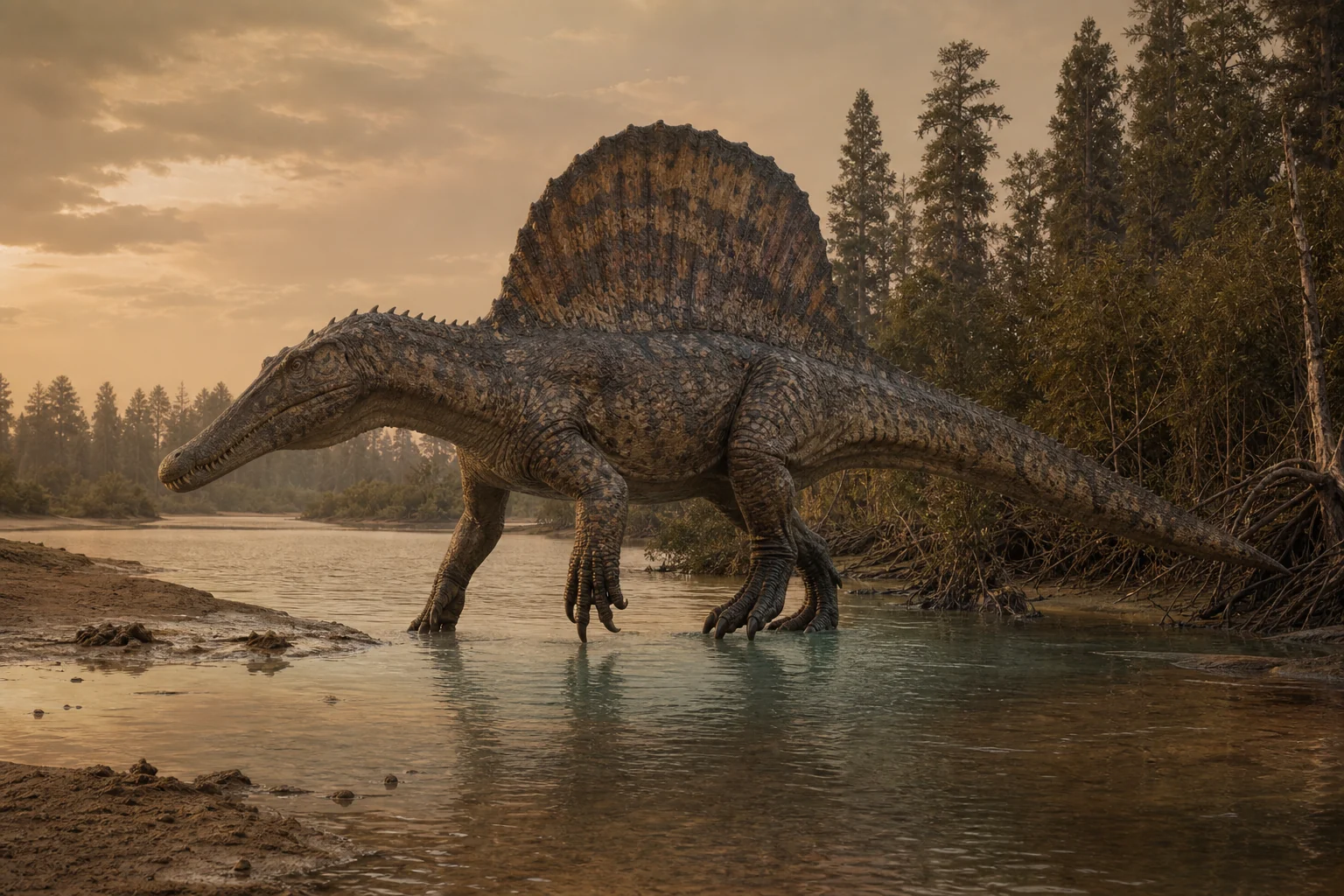
A sail-backed predator with dense bones and a paddle-like tail, adapted to life around water.
 View original image · 1536 × 1024
- Time range
- About 100–93.5 million years ago
- Final stage
- Early Late Cretaceous
- Geographic range
- North African rivers and deltas
01 / ANSWER FIRST
What was Spinosaurus?
Spinosaurus was a giant North African theropod with a long crocodile-like snout, conical teeth, a tall back sail, shortened hindlimbs and a deep fin-shaped tail.
These features tie it closely to rivers and fish, but they do not settle whether it actively pursued prey underwater, swam mainly at the surface or hunted while wading. Spinosaurus is a case study in changing science because its first skeleton was destroyed and newer fossils remain incomplete and contested.
02 / QUICK FACTS
Spinosaurus at a glance
- Scientific name
- Spinosaurus aegyptiacus
- Age
- About 99–93.5 million years ago
- Length
- Often reconstructed near 14 m; uncertain
- Mass
- Several tonnes; model-dependent
- Diet
- Fish and other animals
- Range
- North Africa
- Habitat
- Large river and delta systems
- Key debate
- Underwater pursuit or shoreline hunter
03 / CORE QUESTION
How big and unusual was Spinosaurus?
Museum summaries commonly reconstruct Spinosaurus near 14 metres and roughly seven tonnes, placing it among the longest known theropods. Exact totals remain weakly constrained because no single specimen preserves a complete skull, trunk, limbs and tail.
The animal combined a long low skull, metre-high neural spines, short hindlimbs and a vertically expanded tail. Those proportions make comparisons based only on one bone unreliable and explain why reconstructions have changed repeatedly.
Read the complete size, sail and body-shape guideHow to read the numbers
This page separates direct evidence, comparative inference and unresolved debate.
04 / LIFE & DISCOVERY TIMELINE
A reconstruction repeatedly rebuilt
First Egyptian skeleton
Ernst Stromer described distinctive jaws and very tall back spines from the Bahariya Oasis.
Type material destroyed
A bombing raid destroyed the Munich fossils, leaving photographs, notes and drawings.
Short-legged reconstruction
Moroccan material shifted the animal toward a low-bodied, water-associated form.
Tail and swimming debate
A deep tail and dense bones support aquatic capacity; hydrodynamic critiques dispute a specialised pursuit-diving lifestyle.
05 / ANATOMY
A theropod assembled around water
Long narrow snout
Interlocking conical teeth and a terminal jaw expansion trapped slippery prey rather than slicing like a tyrannosaur.
Tall dorsal sail
Neural spines supported a thin sail or deeper soft-tissue structure used most plausibly in display, with thermal and aquatic roles debated.
Reduced hindlimbs
Shorter legs shifted the centre of mass and complicate both terrestrial and aquatic locomotion models.
Deep flexible tail
Tall tail spines formed a paddle-like profile that generated more thrust than ordinary theropod tails in model tests.
06 / DIET & BEHAVIOUR
What did Spinosaurus eat?
Its jaws and teeth strongly support fish capture, including large coelacanths, lungfish and sawfish-like rays in its ecosystem. It could also take carrion or terrestrial prey when available.
Read the complete guide07 / DIET & BEHAVIOUR
Was it fully aquatic?
No evidence supports a whale-like life unable to function on land. The live debate is narrower: how often it entered deep water and whether it pursued prey while submerged or mainly waded and surface-swarmed.
08 / RANGE & HABITAT
Where did Spinosaurus live?
Fossils come from a very different Sahara: humid river basins rich in fishes, crocodile relatives, turtles and giant theropods.
Bahariya Formation
Egyptian rocks yielded the original species and a river-delta fauna.
Kem Kem Group
Moroccan deposits preserve much of the material behind modern reconstructions.
Fish-rich channels
Sawfish, coelacanths and lungfish made aquatic prey unusually abundant.
Predator-rich ecosystem
Carcharodontosaurus and large crocodile-line reptiles reduced simple one-predator narratives.
09 / FOSSIL EVIDENCE
What evidence changes the Spinosaurus picture?
Skulls and teeth
Cranial mechanics and tooth form directly support fish capture.
Dense limb bones
Reduced internal cavities resemble ballast in some subaqueous foragers, but density is not a perfect lifestyle label.
Deep tail series
Associated caudal vertebrae reveal a fin-like profile and measurable aquatic thrust.
Hydrodynamic models
Competing digital and physical tests disagree over stability, drag and pursuit performance.
10 / DISAPPEARANCE & DEBATE
Why did Spinosaurus disappear?
Spinosaurus disappears from the record around 93.5 million years ago, but no single extinction mechanism is demonstrated.
North African river systems, coastlines and prey communities changed through the mid-Cretaceous. Because specimens and formations are discontinuous, disappearance from known rocks cannot yet be turned into a detailed population-collapse story.
12 / FREQUENTLY ASKED QUESTIONS
Spinosaurus FAQ
Was Spinosaurus bigger than T. rex?
It was probably longer, often reconstructed near 14 metres, but likely lighter than the heaviest T. rex. Both estimates depend on incomplete fossils and different body plans.
Could Spinosaurus swim?
Almost certainly at some level. The unresolved question is whether it was an efficient underwater pursuit predator or mainly a wader and surface swimmer.
What was the sail for?
Display and recognition are plausible; thermoregulation, fat storage and aquatic roles have also been proposed. Fossils do not preserve colour or the complete soft-tissue outline.
What did Spinosaurus eat?
Its snout and teeth are specialised for seizing fish, but it was probably an opportunistic carnivore capable of eating other animals and carrion.
Why was the first skeleton lost?
The Munich museum collection holding it was destroyed in a 1944 Allied bombing raid. Stromer's descriptions and photographs remain important evidence.
Did Spinosaurus walk on four legs?
A permanently quadrupedal gait is not established. Forelimbs were robust, but the hands and shoulder anatomy were not built like normal weight-bearing feet.
04 / SOURCES & FURTHER READING
Check the source record
Use the scientific name to compare taxonomy, occurrence records and the fossil record. Database coverage and classifications may differ.
05 / REVISION HISTORY
How has this record changed?
- Rewrote an extinction cause that presented environmental or faunal turnover as established; it is now given as context the record does not prove.
- Upgraded to a bilingual S-tier topic hub with two independent evidence guides.
- Verified authoritative entity sources and added three responsive reconstruction sizes.
- Initial bilingual species record published.
06 / CORRECTIONS & ADDITIONS