
VELOCIRAPTOR TOPIC HUB · APPEARANCE & MYTHS
Velociraptor Size, Feathers and Movie Myths
The real Velociraptor: measured size, mass, quill-knob feather evidence, winged arms, flight limits and why the movie animal resembles Deinonychus.
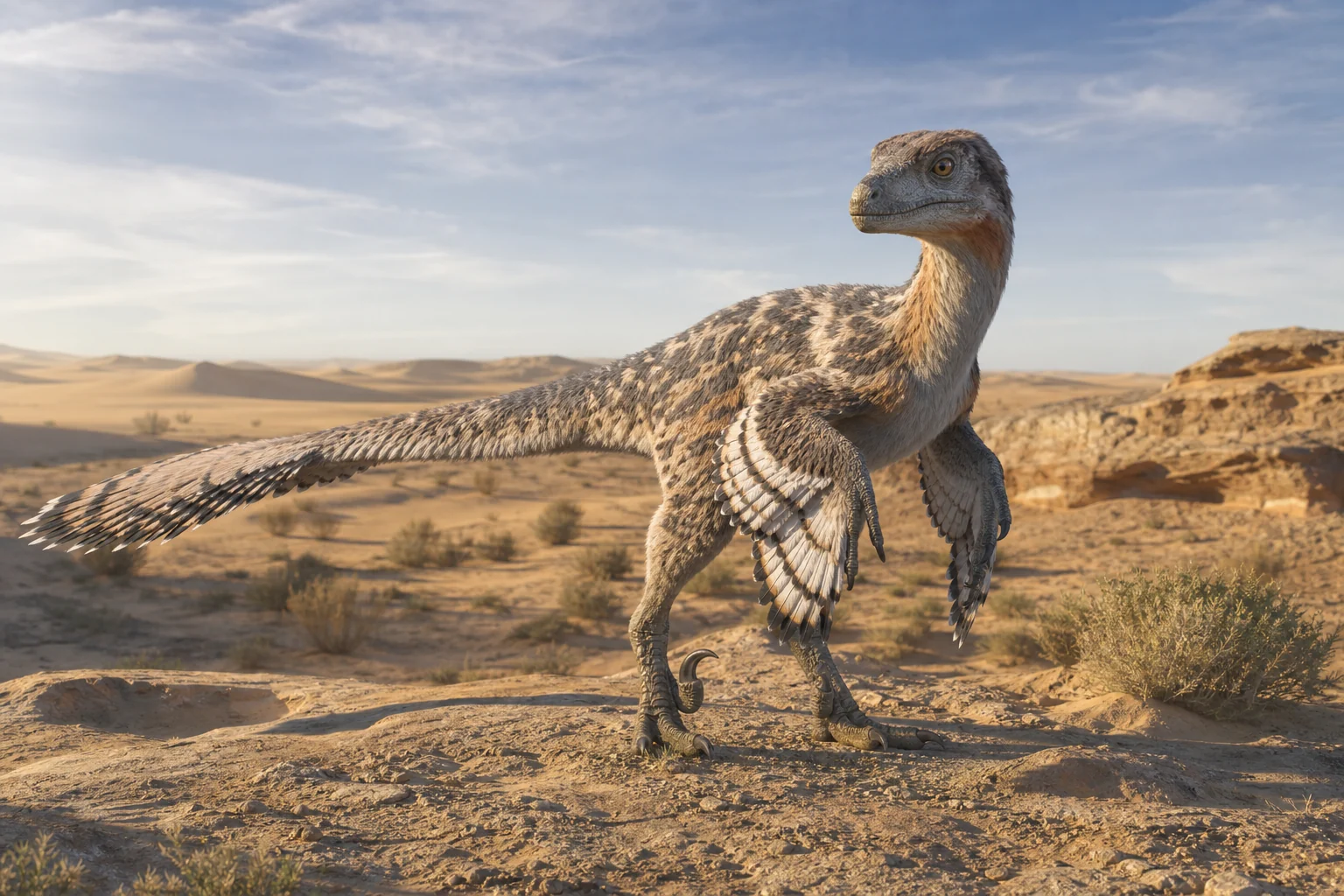 View full-resolution reconstruction ↗
This is an original generative reconstruction, not a photograph or scientific plate. Measurements and interpretations below are tied to named sources.
01 / REAL SIZE
How big was Velociraptor?
Associated skeletons support a total length near 1.8 metres, but a long stiff tail makes the number sound larger than the torso. Hip height was far below an adult human's waist.
Mass estimates span roughly 7–18 kilograms because skeleton completeness and soft-tissue models differ. Even the upper value is closer to a large turkey or small dog than a movie monster.
02 / DIRECT FEATHER EVIDENCE
How do we know Velociraptor had feathers?
A Velociraptor ulna bears regularly spaced bumps matching quill knobs in living birds. These scars anchor the ligaments of large secondary feathers and provide direct evidence even though feather impressions are absent.
Close dromaeosaur relatives preserve body plumage, so a feathered body is the parsimonious reconstruction. Bare scaly skin across the torso is not supported.
03 / WINGED ARMS
Did it have wings if it could not fly?
Large feathers made the arms wing-like, but the forelimbs were too short and the animal too heavy for powered flight. Evolution can retain wings for display, balance, brooding and shielding prey.
Juvenile abilities remain unknown because no growth series preserves feathers and limb proportions together. Claims of gliding should be separated from evidence in smaller four-winged relatives.
04 / COLOUR & SOFT TISSUE
What colour was Velociraptor?
No Velociraptor feather preserves melanosomes, so its colour pattern is unknown. Camouflage, display patches and barred wings are plausible artistic options, not measured facts.
Lips covering the teeth, facial scales and a keratin sheath on the toe claw also require comparative reconstruction. Palaeoart should label these choices rather than present one as a photograph.
05 / MOVIE COMPARISON
Why is the movie Velociraptor so different?
The cinematic animal was enlarged and modelled largely on Deinonychus, a related North American dromaeosaur. At the time, popular naming and dramatic design favoured the better-known Velociraptor label.
It also predates broad public acceptance of feathered non-avian dinosaurs. The result is culturally influential but anatomically closer to a featherless Deinonychus-sized composite.
06 / ACCURATE RECONSTRUCTION
What should a modern Velociraptor look like?
Use a small low-slung body, long stiff tail, feathered torso, large arm feathers and one raised sickle claw on each foot. Keep colour, facial soft tissue and feather display speculative, and avoid scaling it to human height.
FREQUENTLY ASKED QUESTIONS
Questions readers ask
How big was Velociraptor?
About 1.8 metres long including a long tail, and roughly 7–18 kilograms across published estimates. It was much smaller than its movie counterpart.
Did Velociraptor have feathers?
Yes. Quill knobs on a forearm bone directly show attachment points for large feathers, and close relatives preserve body feathers.
Could Velociraptor fly?
No evidence supports powered flight. Its feathered arms may have helped display, brood, balance or control prey.
Did the sickle claw slash prey open?
The claw could puncture, but its curvature and dromaeosaur foot mechanics also fit gripping and restraining. A dramatic disembowelling stroke is not directly demonstrated.
Did Velociraptor hunt in packs?
There is no direct evidence of coordinated Velociraptor packs. Group behaviour in related species does not automatically prove cooperative hunting.
What happened in the Fighting Dinosaurs fossil?
A Velociraptor and Protoceratops were buried together during close combat, with the predator's claw near the neck and its arm held by the herbivore's beak.
SOURCES & FURTHER READING
Evidence used in this guide
Measurements and interpretations are tied to museum resources or peer-reviewed studies; disputed conclusions include evidence on both sides.
- 01Velociraptor ↗Natural History Museum, London
Museum summary of real size, age, range and feathered appearance.
- 02Velociraptor mongoliensis ↗American Museum of Natural History
AMNH specimen history, measurements and anatomy.
- 03Fighting Dinosaurs ↗American Museum of Natural History
Direct fossil evidence of Velociraptor and Protoceratops in combat.
- 04Feather quill knobs in the dinosaur Velociraptor ↗Science · PMID 17885130
Direct forearm evidence for large feathers.
- 05The predatory ecology of Deinonychus ↗PLOS ONE
Comparative dromaeosaurid model for foot-based prey restraint, clearly separated from direct Velociraptor evidence.