
VELOCIRAPTOR TOPIC HUB · HUNTING EVIDENCE
How Did Velociraptor Hunt and Use Its Sickle Claw?
Fighting Dinosaurs evidence, the raised second-toe claw, prey restraint, biting, scavenging and why coordinated pack hunting is not demonstrated.
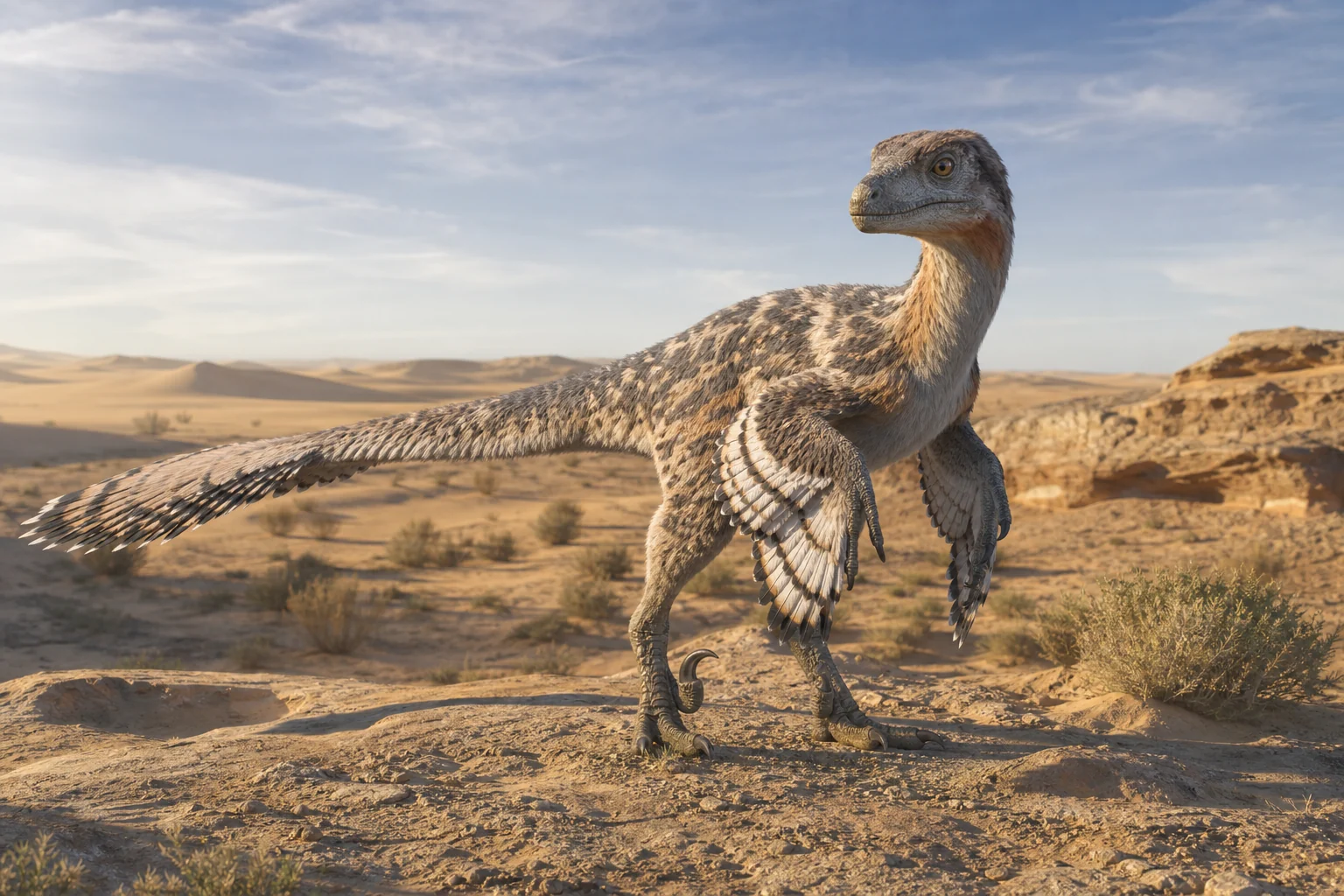 View full-resolution reconstruction ↗
This is an original generative reconstruction, not a photograph or scientific plate. Measurements and interpretations below are tied to named sources.
01 / DIRECT ENCOUNTER
What does the Fighting Dinosaurs fossil show?
A Velociraptor and Protoceratops are preserved intertwined. The predator's sickle-clawed foot lies near the herbivore's neck, while the Protoceratops beak grips or breaks the Velociraptor forearm.
Rapid sand burial froze a moment of close combat. It proves these species fought, not whether the encounter began as predation, defence around a carcass or another conflict, nor which would have survived without burial.
02 / SICKLE CLAW
Was the claw a slashing knife?
The enlarged second-toe claw was strongly curved and held clear of the ground. It could puncture tissue, but curvature, joint range and comparison with raptor talons also favour hooking and maintaining contact.
A long sweeping disembowelling cut requires movement and edge sharpness that are not directly demonstrated. Keratin made the living claw longer and sharper than the bony core, but its exact cross-section is unknown.
03 / PREY RESTRAINT
Could Velociraptor pin prey like a bird of prey?
The raptor-prey-restraint model proposes that dromaeosaurs jumped onto prey, used body weight and feet to hold it, stabilised with wing movements and delivered bites. The model fits foot anatomy and living bird comparisons.
It was developed mainly from Deinonychus and living raptors, so it is comparative rather than direct Velociraptor observation. Different prey sizes likely demanded different tactics.
04 / DIET & SCAVENGING
What animals did Velociraptor eat?
Protoceratops is the best direct large-prey association. Small reptiles, mammals, hatchling dinosaurs and carrion were also available in the Gobi ecosystem. A pterosaur bone in a related or referred dromaeosaur gut shows opportunistic feeding.
Predation and scavenging are not alternatives. Like living carnivores, Velociraptor probably hunted when profitable and used carcasses when available.
05 / SOCIAL HUNTING
Did Velociraptor hunt in packs?
No Velociraptor trackway, mass-death assemblage or prey fossil records coordinated hunting. The Fighting Dinosaurs contains one predator.
Other dromaeosaur sites show several individuals together, but carcasses, drought and waterholes can aggregate animals without cooperation. Pack hunting remains possible but unproven.
06 / EVIDENCE VERDICT
What is the best-supported hunting picture?
Velociraptor was a flexible small predator that combined feet, sickle claws, jaws, tail balance and feathered arms at close range. Gripping and restraint fit the anatomy better than a single cinematic slash, while cooperative packs lack direct evidence.
FREQUENTLY ASKED QUESTIONS
Questions readers ask
How big was Velociraptor?
About 1.8 metres long including a long tail, and roughly 7–18 kilograms across published estimates. It was much smaller than its movie counterpart.
Did Velociraptor have feathers?
Yes. Quill knobs on a forearm bone directly show attachment points for large feathers, and close relatives preserve body feathers.
Could Velociraptor fly?
No evidence supports powered flight. Its feathered arms may have helped display, brood, balance or control prey.
Did the sickle claw slash prey open?
The claw could puncture, but its curvature and dromaeosaur foot mechanics also fit gripping and restraining. A dramatic disembowelling stroke is not directly demonstrated.
Did Velociraptor hunt in packs?
There is no direct evidence of coordinated Velociraptor packs. Group behaviour in related species does not automatically prove cooperative hunting.
What happened in the Fighting Dinosaurs fossil?
A Velociraptor and Protoceratops were buried together during close combat, with the predator's claw near the neck and its arm held by the herbivore's beak.
SOURCES & FURTHER READING
Evidence used in this guide
Measurements and interpretations are tied to museum resources or peer-reviewed studies; disputed conclusions include evidence on both sides.
- 01Velociraptor ↗Natural History Museum, London
Museum summary of real size, age, range and feathered appearance.
- 02Velociraptor mongoliensis ↗American Museum of Natural History
AMNH specimen history, measurements and anatomy.
- 03Fighting Dinosaurs ↗American Museum of Natural History
Direct fossil evidence of Velociraptor and Protoceratops in combat.
- 04Feather quill knobs in the dinosaur Velociraptor ↗Science · PMID 17885130
Direct forearm evidence for large feathers.
- 05The predatory ecology of Deinonychus ↗PLOS ONE
Comparative dromaeosaurid model for foot-based prey restraint, clearly separated from direct Velociraptor evidence.