
Explore this animal in Size of Extinct Animals ↗
45 / Mesozoic
Deinonychus
Deinonychus antirrhopus
A stiff tail, grasping hands and enlarged foot claw made an agile feathered hunter.
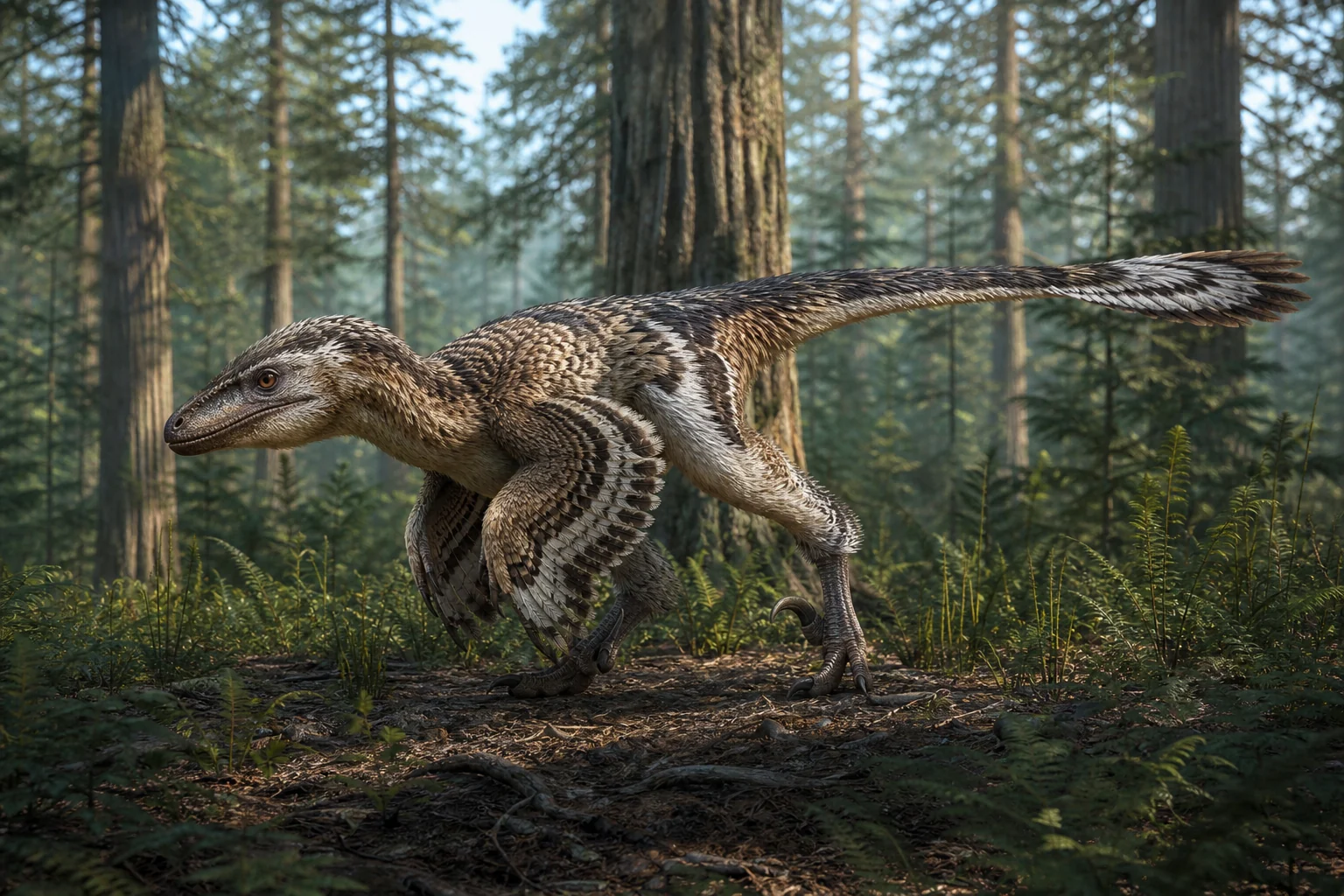 View original image · 1536 × 1024
- Time range
- About 115–108 million years ago
- Final stage
- Early Cretaceous
- Geographic range
- Western North America
01 / ANSWER FIRST
What was Deinonychus?
Deinonychus was a three-to-four-metre feathered dromaeosaur whose athletic skeleton helped trigger the dinosaur renaissance and reshape the dinosaur–bird connection.
Its enlarged second toe claw was held above the ground, while a stiffened tail balanced rapid movements. Several sites associate Deinonychus teeth and skeletons with Tenontosaurus, but aggregation is not automatic proof of coordinated packs.
02 / QUICK FACTS
Deinonychus at a glance
- Scientific name
- Deinonychus antirrhopus
- Age
- ~115–108 million years ago
- Length
- About 3–4 m
- Mass
- Roughly 60–100 kg
- Foot weapon
- Enlarged second-toe claw
- Covering
- Feathers strongly inferred
- Diet
- Carnivorous
- Range
- Western North America
03 / CORE QUESTION
Did Deinonychus hunt in coordinated packs?
At several Tenontosaurus sites, shed Deinonychus teeth and sometimes multiple individuals occur around one herbivore. This establishes feeding and repeated contact, but drought, carcass attraction or mobbing can also assemble predators.
Modern archosaurs do not require mammal-like social packs to exploit a large carcass. Cooperative hunting remains possible, yet claims about permanent hierarchy, assigned roles or family packs exceed the fossils.
Read the complete pack-hunting evidence guideHow to read the numbers
This page separates direct evidence, comparative inference and unresolved debate.
04 / LIFE & DISCOVERY TIMELINE
A fossil predator that changed the image of dinosaurs
Cloverly predator
Deinonychus shares floodplains with Tenontosaurus.
Major remains excavated
John Ostrom recovers associated skeletons in Montana.
Species described
Its agile anatomy challenges slow-dinosaur models.
Bird link renewed
Forelimbs, feet and tail strengthen theropod–bird comparisons.
05 / ANATOMY
A feathered grappler built around feet and balance
Sickle claw
A curved second-toe claw was carried off the ground.
Stiff tail
Elongated rods stabilised the tail while allowing base movement.
Grasping hands
Long three-fingered hands could hold prey at close range.
Feathered arms
Close relatives preserve feathers; wings aided display, balance or brooding.
06 / DIET & BEHAVIOUR
What did Deinonychus eat?
Tenontosaurus is directly associated, while smaller vertebrates and carrion were also available.
Read the complete guide07 / DIET & BEHAVIOUR
How did the claw work?
Curvature supports puncturing, hooking and prey restraint more strongly than a long disembowelling slash.
08 / RANGE & HABITAT
Where did Deinonychus live?
Fossils come mainly from the Cloverly Formation of Montana and Wyoming and equivalent rocks in the western United States.
Montana
Type localities preserve skeletons and prey associations.
Wyoming
Additional material expands individual variation.
Floodplains
Rivers supported conifers, cycads and diverse herbivores.
Seasonal habitats
Drought and carcass concentration may explain bonebeds.
09 / FOSSIL EVIDENCE
How do scientists know about Deinonychus?
Associated skeletons
Multiple individuals preserve much of the body.
Toe claws
Joint surfaces constrain posture and motion.
Tenontosaurus sites
Teeth and bones record feeding associations.
Bird comparison
Related feathers and wing anatomy guide soft-tissue reconstruction.
10 / DISAPPEARANCE & DEBATE
What did Deinonychus prove?
It showed that non-avian dinosaurs could be active, balanced and bird-like, but it did not prove cinematic pack tactics or a single use for the sickle claw.
The best reconstruction combines direct skeletal mechanics with feather evidence from close relatives and keeps social behaviour conditional.
12 / FREQUENTLY ASKED QUESTIONS
Deinonychus FAQ
How big was Deinonychus?
About 3–4 metres long and roughly 60–100 kilograms.
Did it have feathers?
No direct skin is known, but feathered close relatives make feathers strongly supported.
Was it Velociraptor?
No. Deinonychus was a larger North American relative.
Did it slash prey open?
Hooking and restraint fit the claw better than a long slicing stroke.
Did it hunt in packs?
Possible, but coordinated packs are not directly demonstrated.
Why is it important?
Its anatomy helped launch the dinosaur renaissance and renew the dinosaur–bird link.
04 / SOURCES & FURTHER READING
Check the source record
Use the scientific name to compare taxonomy, occurrence records and the fossil record. Database coverage and classifications may differ.
05 / REVISION HISTORY
How has this record changed?
- Rewrote an extinction cause that presented environmental or faunal turnover as established; it is now given as context the record does not prove.
- Expanded into a bilingual S-tier hub with two evidence-led guides.
- Verified authoritative entity sources and added three responsive reconstruction sizes.
- Initial bilingual species record published.
06 / CORRECTIONS & ADDITIONS