
Explore this animal in Size of Extinct Animals ↗
50 / Mesozoic
Protoceratops
Protoceratops andrewsi
Protoceratops was a small, beaked ceratopsian from Late Cretaceous Mongolia. Its neck frill and four-legged body distinguish it from its predator Velociraptor.
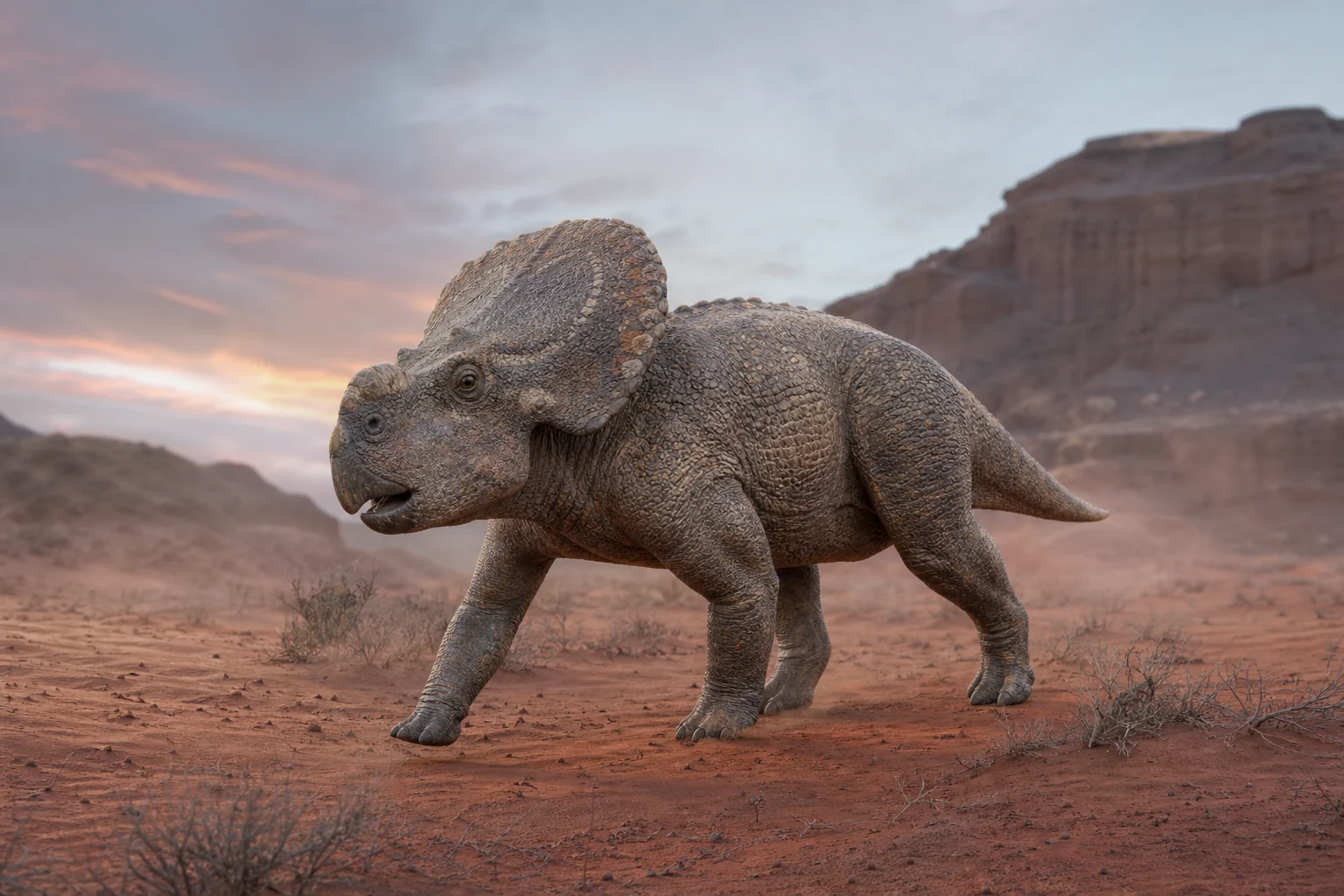 View original image · 1536 × 1024
Structured expansion · editorial review pending
- Time range
- About 75–71 million years ago
- Final stage
- Late Cretaceous
- Geographic range
- Mongolia · Northern China
01 / ANSWER FIRST
What does the evidence show about Protoceratops?
Protoceratops was a small, beaked ceratopsian from Late Cretaceous Mongolia. Its neck frill and four-legged body distinguish it from its predator Velociraptor.
Two discoveries make this animal especially useful for learning how fossil interpretations change: the Fighting Dinosaurs specimen and eggs once misidentified as its own.
02 / QUICK FACTS
Protoceratops at a glance
- Scientific name
- Protoceratops andrewsi
- Research focus
- Beak and frill
03 / ANATOMY
How was Protoceratops built?
Beak and frill
The beak cropped vegetation. The skull carried a bony frill, without the long brow horns familiar from Triceratops.
Growing skulls
AMNH illustrates skulls from different growth stages. An adult skull cannot stand in for the proportions of a hatchling.
04 / DIET & BEHAVIOUR
Plant eater
Jaw and tooth anatomy supports herbivory; a precise menu requires additional plant or dietary evidence.
05 / DIET & BEHAVIOUR
A recorded encounter
The Fighting Dinosaurs fossil preserves contact with Velociraptor. One encounter does not reveal how often such attacks happened.
06 / RANGE & HABITAT
Where and when did Protoceratops live?
The specimens discussed here come from Mongolia's Gobi region. Fossil localities document occurrences, not a complete map of its living range.
07 / FOSSIL EVIDENCE
What evidence supports reconstructions of Protoceratops?
Fighting Dinosaurs, 1971
The associated skeletons preserve a Protoceratops and a Velociraptor together. Their positions underpin the combat interpretation.
Reassigned eggs
Eggs were first linked to Protoceratops because its bones were abundant nearby. Embryo evidence later connected that egg type to oviraptorosaurs.
08 / DISAPPEARANCE & DEBATE
What remains uncertain?
These sources do not identify a single cause of this animal's disappearance. Its record predates the end-Cretaceous impact; that event should not be assigned automatically.
The linked sources support the specific observations above. An occurrence record alone does not identify an extinction mechanism.
09 / FREQUENTLY ASKED QUESTIONS
Protoceratops FAQ
Did it have three horns?
No. A frill does not make Protoceratops a small Triceratops.
Were the famous eggs really its eggs?
The original attribution was revised after oviraptorosaur embryo evidence became available.
04 / SOURCES & FURTHER READING
Check the source record
Use the scientific name to compare taxonomy, occurrence records and the fossil record. Database coverage and classifications may differ.
05 / REVISION HISTORY
How has this record changed?
- Replaced repeated expansion text with specimen-specific evidence, linked research and explicit limits; independent editorial review is pending.
- Completed an AI-assisted bilingual audit of the archive record, corrected identified issues and clarified evidence limits; independent editorial review is pending.
- Expanded into a structured bilingual profile with anatomy, ecology, range, evidence, debate and FAQs; independent editorial review is pending.
- Verified authoritative entity sources and added three responsive reconstruction sizes.
- Initial bilingual species record published.
06 / CORRECTIONS & ADDITIONS