Extraordinary adaptations
Feathered Dinosaurs: 5 Examples & Their Fossil Evidence
Which dinosaurs had feathers, and how do we know? Compare preserved filaments, vaned feathers and quill attachment marks in five fossil examples, including an early bird. Feathered does not automatically mean able to fly.
Explore the animals 5 ↘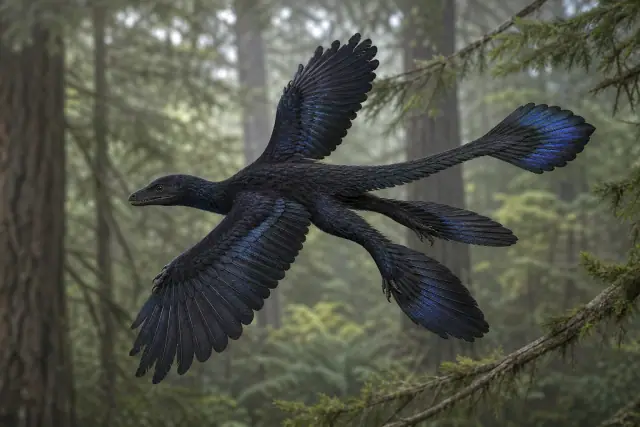
How this list was selected
These atlas examples were selected for published feather evidence, not for the appearance of their reconstruction images. Soft-tissue impressions provide a different kind of evidence from attachment marks on a bone. Archaeopteryx is included as an early avialan: birds belong within the dinosaur family tree. The list is neither exhaustive nor a claim that every body region was feathered. Compare the named specimen and evidence before extending a reconstruction to relatives.
Did all dinosaurs have feathers?
No single covering can be assigned to all dinosaurs. Feather-bearing fossils establish particular cases; other specimens preserve scales. Some animals may have combined different coverings on different body regions. The earliest origin of feathers remains debated, so neither a bare fossil slab nor a feathered relative settles the covering of every species.
Explore the animals
5 atlas records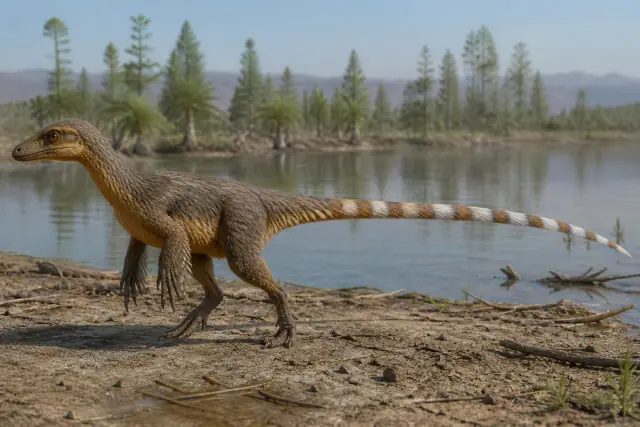
About 125 million years ago
Sinosauropteryx
Sinosauropteryx prima
A halo of simple filaments accompanies the skeleton. These are not the broad flight feathers of a modern wing. The fossil is useful for asking what counts as a feather and how simpler coverings relate to later forms, rather than treating every fuzzy reconstruction as equally well supported.
Volcanic lakes and woodland · Liaoning, China
Natural History Museum · sinosauropteryx ↗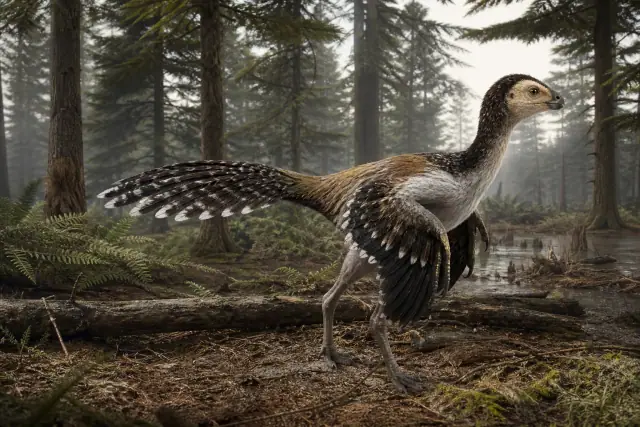
About 125 million years ago
Caudipteryx
Caudipteryx zoui
Arm and tail feathers preserve recognisable vanes around a central shaft. Caudipteryx was a non-flying dinosaur, making it an important counterexample to the idea that feathers evolved only as flight equipment. The distribution of preserved feathers is more informative than an imagined colour scheme.
Lakeside forest · Liaoning, China
AMNH · Figuring Out Feathers ↗About 125–120 million years ago
Microraptor
Microraptor gui
Long feathers occurred on the forelimbs and hindlimbs. This unusual arrangement is often described as four-winged, although it does not mean four independent bird-like arms. Fossils establish the feather arrangement; tests of gliding, take-off and manoeuvring additionally depend on aerodynamic models.
Northeastern China
AMNH · Figuring Out Feathers ↗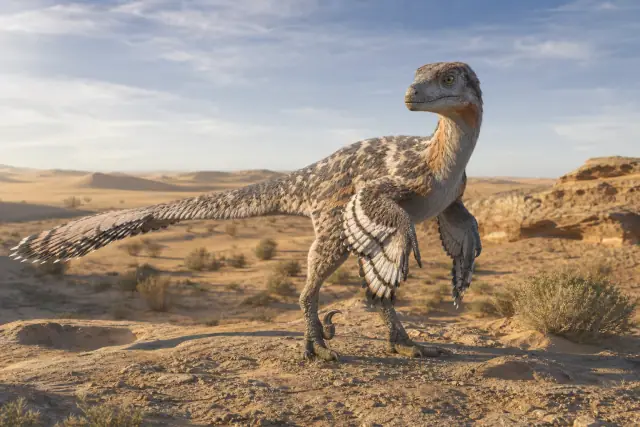
About 75–71 million years ago
Velociraptor
Velociraptor mongoliensis
Quill knobs on a forearm bone provide indirect evidence of large attached feathers. This differs from seeing an actual feather impression. The discovery supports a feathered arm without establishing powered flight, a complete coat pattern or an exact colour for the entire animal.
Mongolia · Northern China
Turner et al. (2007) · Feather quill knobs ↗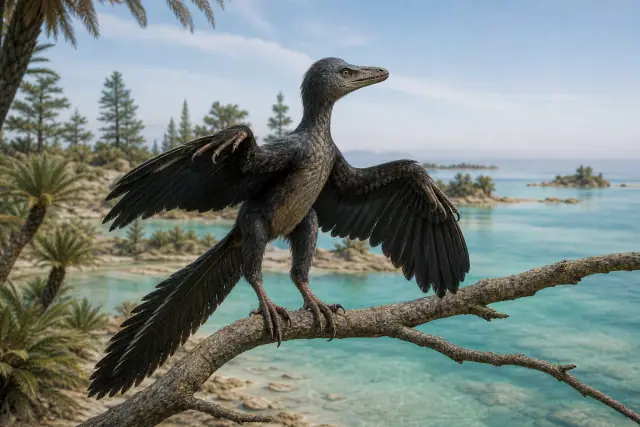
About 149–145 million years ago
Archaeopteryx
Archaeopteryx lithographica
Feather impressions accompany an early bird with teeth, clawed fingers and a long bony tail. It helps connect feather anatomy with the broader dinosaur skeleton. Its place here also explains why a list of feathered dinosaurs need not exclude birds simply because they can fly.
Present-day southern Germany
Natural History Museum · archaeopteryx ↗