
Explore this animal in Size of Extinct Animals ↗
54 / Mesozoic
Microraptor
Microraptor gui
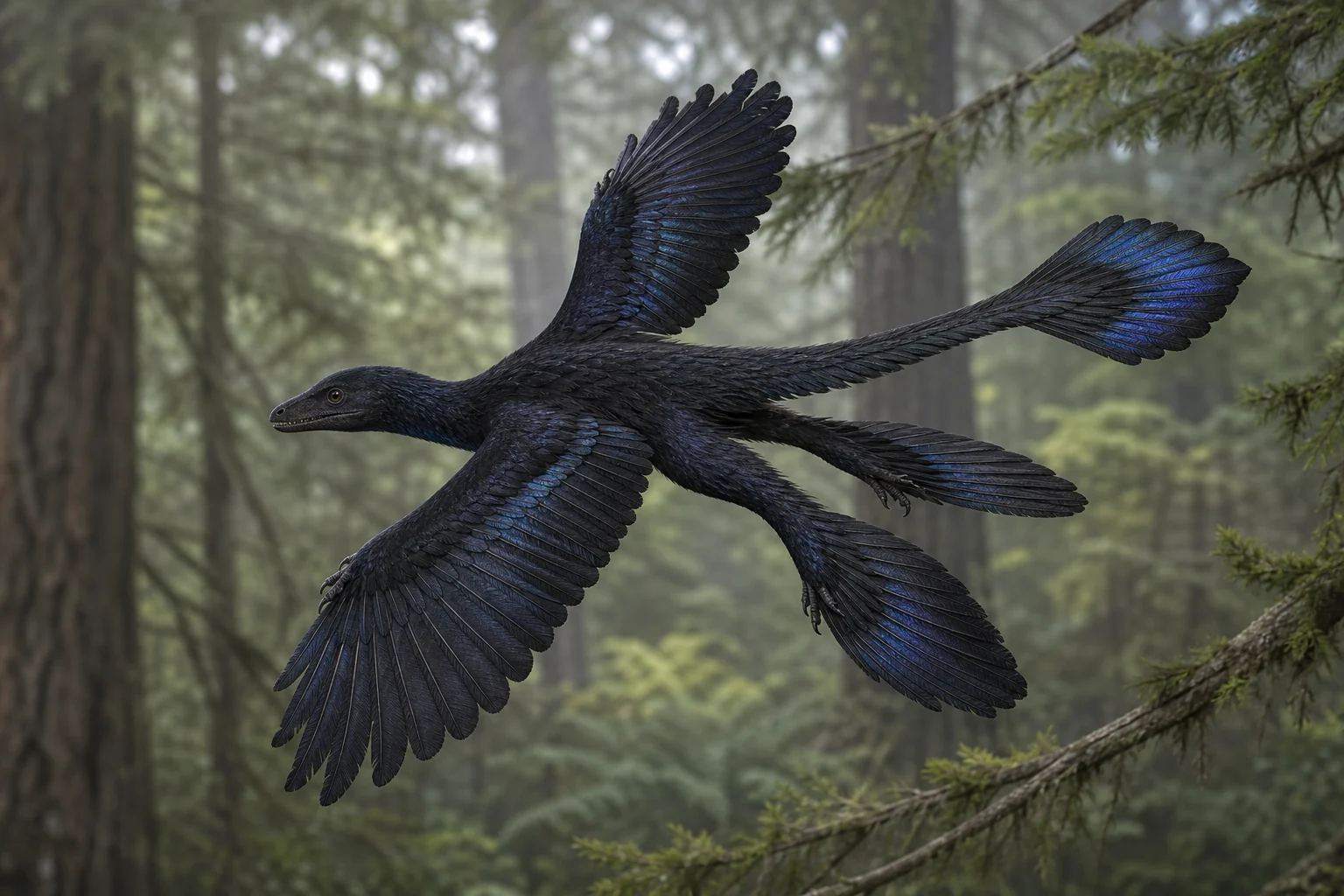
Microraptor was a small feathered theropod from Early Cretaceous China. Long feathers on both forelimbs and hind limbs created several aerodynamic surfaces.
 View original image · 1536 × 1024
Structured expansion · editorial review pending
- Time range
- About 125–120 million years ago
- Final stage
- Early Cretaceous
- Geographic range
- Northeastern China
01 / ANSWER FIRST
What does the evidence show about Microraptor?
Microraptor was a small feathered theropod from Early Cretaceous China. Long feathers on both forelimbs and hind limbs created several aerodynamic surfaces.
Its importance lies in the variety of early flight-related body plans, not in proving that modern birds descended directly from this particular genus.
02 / QUICK FACTS
Microraptor at a glance
- Scientific name
- Microraptor gui
- Research focus
- Hind-limb feathers
03 / ANATOMY
How was Microraptor built?
Hind-limb feathers
Xu and colleagues described long pennaceous feathers extending along the hind limbs in the 2003 specimens.
Tail surface
Tail feathers contributed another surface. Calling the animal four-winged is shorthand, not a claim that it had extra limbs.
04 / DIET & BEHAVIOUR
Gliding models
Dyke and colleagues tested reconstructed shapes in 2013 and found stable gliding configurations at high lift coefficients.
05 / DIET & BEHAVIOUR
Behavioral limits
A model's aerodynamic performance depends on its posture and feather reconstruction. It does not record a living animal's complete flight behavior.
06 / RANGE & HABITAT
Where and when did Microraptor live?
Exceptionally preserved fossils from northeastern China's Early Cretaceous deposits retain both skeletons and feather outlines.
07 / FOSSIL EVIDENCE
What evidence supports reconstructions of Microraptor?
Visible feather traces
The 2003 description provides fossil observations for the limb feather arrangement.
Experiment versus observation
The 2013 study tests performance of reconstructions. Its conclusions should be distinguished from structures directly visible in a fossil.
08 / DISAPPEARANCE & DEBATE
What remains uncertain?
The precise balance of gliding and flapping remains a reconstruction question. These flight studies do not determine the cause of Microraptor's disappearance.
The linked sources support the specific observations above. An occurrence record alone does not identify an extinction mechanism.
09 / FREQUENTLY ASKED QUESTIONS
Microraptor FAQ
Did it have four limbs or six?
Four limbs. Long feathers on the hind limbs explain the phrase four-winged.
Does a glide model prove it could not flap?
No. Testing a glide is not a complete test of every possible flight behavior.
04 / SOURCES & FURTHER READING
Check the source record
Use the scientific name to compare taxonomy, occurrence records and the fossil record. Database coverage and classifications may differ.
05 / REVISION HISTORY
How has this record changed?
- Replaced repeated expansion text with specimen-specific evidence, linked research and explicit limits; independent editorial review is pending.
- Completed an AI-assisted bilingual audit of the archive record, corrected identified issues and clarified evidence limits; independent editorial review is pending.
- Expanded into a structured bilingual profile with anatomy, ecology, range, evidence, debate and FAQs; independent editorial review is pending.
- Verified authoritative entity sources and added three responsive reconstruction sizes.
- Initial bilingual species record published.
06 / CORRECTIONS & ADDITIONS