
Explore this animal in Size of Extinct Animals ↗
22 / Cenozoic
Irish Elk
Megaloceros giganteus
The largest deer antlers known were seasonal structures for display and competition.
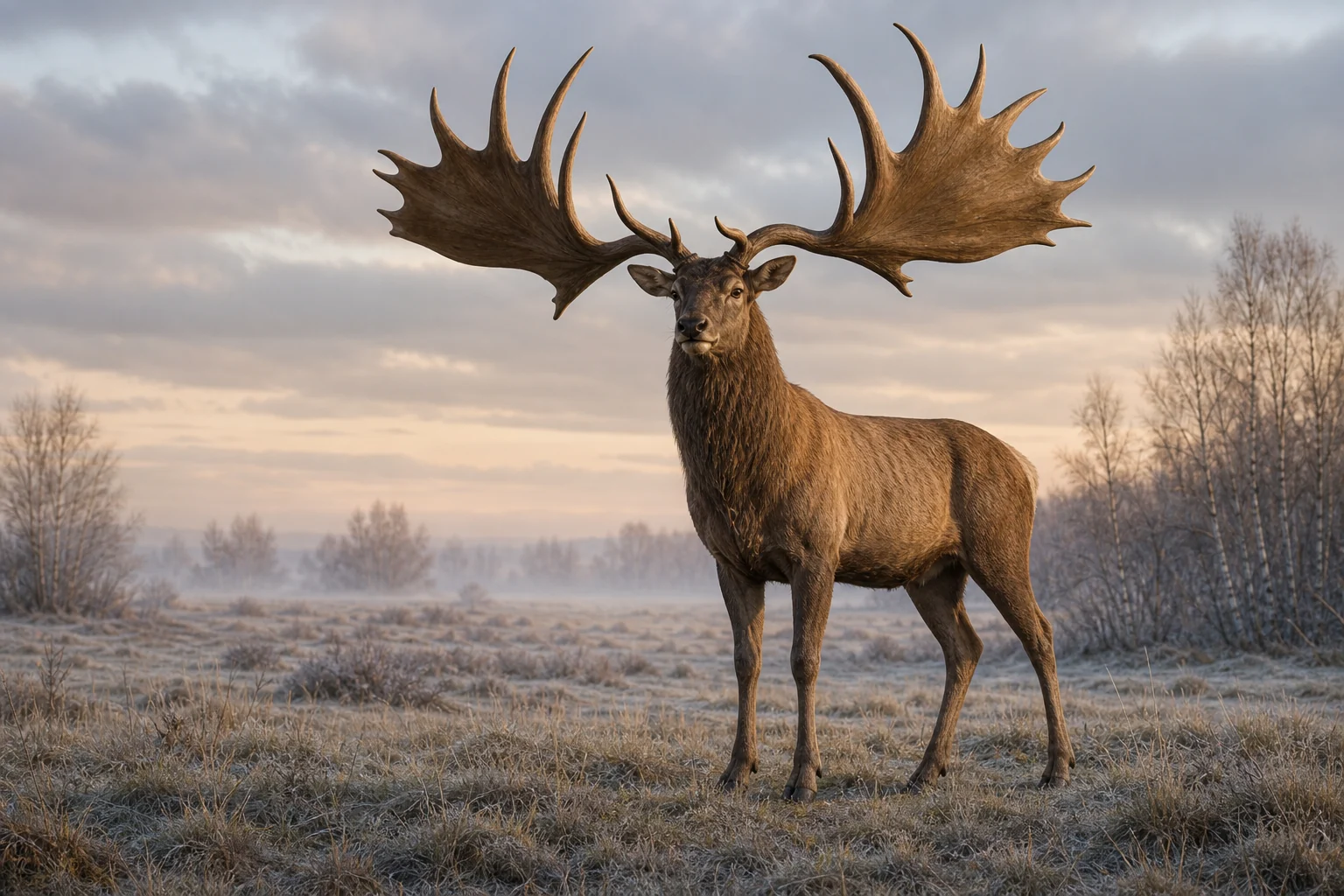 View original image · 1536 × 1024
- Time range
- About 400,000–7,700 years ago
- Final stage
- Early Holocene
- Geographic range
- Europe · Northern Asia
01 / ANSWER FIRST
What was the giant deer?
Megaloceros giganteus was a very large Eurasian deer whose males carried the widest known deer antlers, spanning up to about 3.5 metres.
It was neither confined to Ireland nor a true elk. Irish bogs preserved famous skeletons, while fossils and cave art show a range from western Europe into northern Asia and a deer-like body adapted for running.
02 / QUICK FACTS
Giant deer at a glance
- Scientific name
- Megaloceros giganteus
- Age
- ~400,000–7,700 years ago
- Shoulder height
- Up to about 2 m
- Antler span
- Up to about 3.5 m
- Antler mass
- Up to roughly 40 kg
- Diet
- Mixed browsing and grazing
- Identity
- Giant deer, not an elk
- Range
- Europe to northern Asia
03 / CORE QUESTION
Did giant antlers cause its extinction?
The antlers were expensive to grow and required calcium and phosphorus each year, but they scaled with a very large male body and functioned in display and competition. They were not a pathological evolutionary mistake.
Habitat opening and closing changed forage quality and movement space, while populations survived thousands of years later in parts of Russia and Siberia than in Ireland. Extinction unfolded regionally through climate, nutrition and human pressure rather than one antler-driven collapse.
Read the complete antler and extinction guideHow to read the numbers
This page separates direct evidence, comparative inference and unresolved debate.
04 / LIFE & DISCOVERY TIMELINE
A widespread deer remembered through Irish skeletons
Species appears
Large deer spread across Eurasian grassland and woodland mosaics.
Cave artists record it
European images show shoulder hump, neck marking and antler posture.
Western collapse
Populations disappear from Ireland, Britain and much of Europe.
Last dated populations
Western Siberian records extend survival into the Holocene.
05 / ANATOMY
A running deer with seasonally rebuilt weapons
Palmate antlers
Broad beams carried projecting tines and were shed and regrown annually.
Large running body
Long limbs and joint proportions support effective locomotion despite antler width.
Shoulder hump
Cave art and vertebral anatomy support a raised shoulder profile.
Sexual dimorphism
Giant antlers belonged to males; females lacked the same display structure.
06 / DIET & BEHAVIOUR
What did giant deer eat?
Dental wear and isotopes indicate flexible browsing and grazing across seasons and regions.
Read the complete guide07 / DIET & BEHAVIOUR
Could they move through forests?
Yes, but dense closed woodland could constrain broad-antlered males; open woodland and grassland edges offered better forage and clearance.
08 / RANGE & HABITAT
Where did giant deer live?
Megaloceros ranged from Atlantic Europe through the Eurasian steppe into Siberia, with distributions shifting through glacial cycles.
Ireland
Lake marl and bog deposits preserve spectacular adult males.
Continental Europe
Caves, river deposits and art record changing populations.
Central Asia
Steppe corridors connected eastern and western habitats.
Western Siberia
Young dates document the final known refuge.
09 / FOSSIL EVIDENCE
How do scientists know about giant deer?
Irish skeletons
Large samples preserve sex, age and antler variation.
Radiocarbon dates
Direct dates reconstruct regional disappearance rather than one global date.
Dental proxies
Wear and isotopes reveal diet and habitat.
Cave art
Contemporary outlines add soft-tissue markings with interpretive caution.
10 / DISAPPEARANCE & DEBATE
Why did giant deer go extinct?
Giant deer disappeared region by region as warming transformed open habitats and mineral-rich forage while human pressure affected small surviving populations.
The late Siberian survival disproves a single abrupt European event. Antlers increased nutritional demand, but acted as one life-history cost within changing ecosystems rather than an evolutionary suicide mechanism.
12 / FREQUENTLY ASKED QUESTIONS
Giant deer FAQ
Was the Irish elk an elk?
No. It was a giant deer, not a close member of the elk genus Cervus.
Did it live only in Ireland?
No. Its range extended across Europe and northern Asia.
How wide were the antlers?
The largest spans approached about 3.5 metres.
Could giant deer run?
Yes. Limb anatomy indicates capable running despite the antlers.
Did antlers cause extinction?
Not alone; they added nutritional cost within broader environmental and human pressures.
When did the last giant deer live?
Dated western Siberian remains are about 7,700 years old.
04 / SOURCES & FURTHER READING
Check the source record
Use the scientific name to compare taxonomy, occurrence records and the fossil record. Database coverage and classifications may differ.
05 / REVISION HISTORY
How has this record changed?
- Expanded into a bilingual S-tier hub with two evidence-led guides.
- Verified authoritative entity sources and added three responsive reconstruction sizes.
- Initial bilingual species record published.
06 / CORRECTIONS & ADDITIONS