
Explore this animal in Size of Extinct Animals ↗
19 / Paleozoic
Lystrosaurus
Lystrosaurus murrayi
A beaked, tusked survivor became extraordinarily common after Earth’s greatest mass extinction.
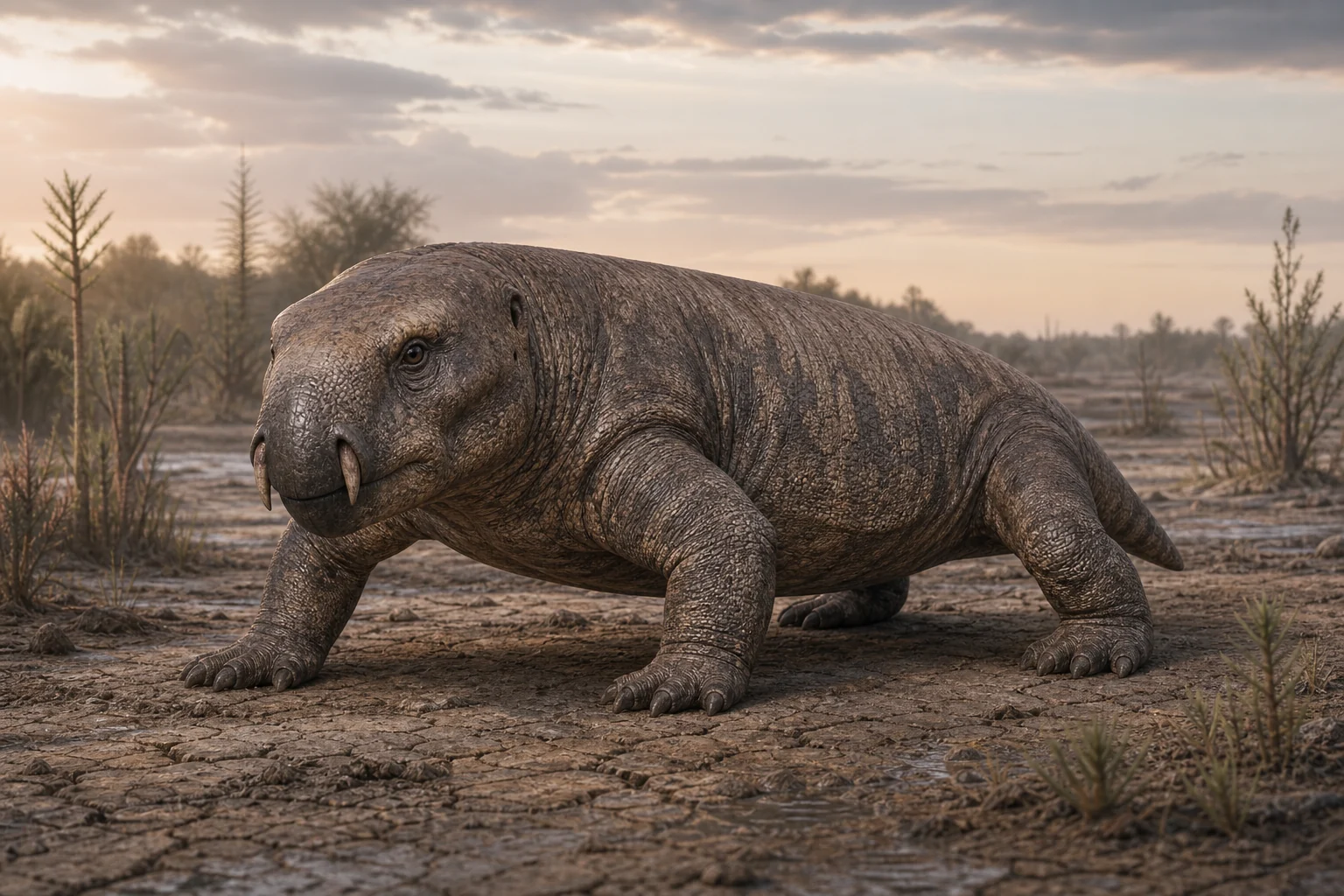 View original image · 1536 × 1024
- Time range
- About 255–248 million years ago
- Final stage
- Early Triassic
- Geographic range
- Southern Africa · India · Antarctica
01 / ANSWER FIRST
What was Lystrosaurus?
Lystrosaurus was a pig-sized tusked dicynodont synapsid that survived the end-Permian mass extinction and became one of the most abundant land vertebrates of the earliest Triassic.
It was neither a dinosaur nor a direct mammal ancestor, but a relative on the broader mammal-line branch. Its success probably reflects flexible feeding, rapid growth, broad range and tolerance of harsh seasonal conditions rather than one miracle adaptation.
02 / QUICK FACTS
Lystrosaurus at a glance
- Scientific name
- Lystrosaurus murrayi
- Age
- ~255–247 million years ago
- Length
- Usually ~0.6–2.5 m by species
- Identity
- Dicynodont therapsid
- Mouth
- Horny beak and two tusks
- Diet
- Herbivorous
- Behaviour
- Burrowing plausible; torpor evidence
- Range
- Africa, India, Antarctica and beyond
03 / CORE QUESTION
How did Lystrosaurus survive the mass extinction?
The end-Permian crisis brought extreme warming, aridity, wildfire and food-web collapse. Lystrosaurus crossed the boundary and rapidly dominated many Early Triassic assemblages, suggesting ecological flexibility and a capacity to recover quickly.
Robust forelimbs support digging, continuously growing tusks preserve seasonal growth, and Antarctic records show prolonged stress or torpor-like intervals. No single trait is proven to explain survival everywhere.
Read the complete survival-evidence guideHow to read the numbers
This page separates direct evidence, comparative inference and unresolved debate.
04 / LIFE & DISCOVERY TIMELINE
A disaster survivor that reshaped the earliest Triassic
Dicynodont herbivore
Several Lystrosaurus species occupy southern Pangaea.
Mass extinction
Most terrestrial lineages collapse across the boundary.
Ecological dominance
Lystrosaurus becomes exceptionally common in recovering faunas.
Torpor signal tested
Antarctic tusks reveal repeated growth interruptions.
05 / ANATOMY
A compact herbivore with a beak, tusks and digging limbs
Horny beak
A toothless cutting edge cropped tough vegetation.
Two tusks
Continuously growing canines recorded life history.
Barrel trunk
A broad ribcage housed a fermenting gut.
Strong forelimbs
Broad hands and muscle attachments suit digging.
06 / DIET & BEHAVIOUR
What did Lystrosaurus eat?
Its beak cropped low vegetation and roots in disturbed landscapes; jaw motion and gut volume support bulk herbivory.
Read the complete guide07 / DIET & BEHAVIOUR
Did it hibernate?
Antarctic tusk growth shows repeated stress intervals consistent with torpor, but it does not reveal exact body temperature, duration or whether every population behaved alike.
08 / RANGE & HABITAT
Where did Lystrosaurus live?
Fossils occur across former southern Pangaea, including South Africa, Antarctica, India and Russia, helping confirm continental connections.
Karoo Basin
Dense boundary records document survival and recovery.
Antarctica
Polar tusks preserve seasonal physiology.
India
Shared species helped support Gondwanan correlations.
Floodplains
Disturbed river landscapes supplied hardy plants.
09 / FOSSIL EVIDENCE
How do scientists know about Lystrosaurus?
Bonebeds
Thousands of specimens reveal abundance and variation.
Boundary sections
Stratigraphy tracks survival across the extinction.
Tusk histology
Growth layers record stress and seasonality.
Limb anatomy
Muscle and joint form test digging behaviour.
10 / DISAPPEARANCE & DEBATE
Was Lystrosaurus the only survivor?
No. Many plants and animals crossed the boundary, but Lystrosaurus became unusually dominant in several regions during a simplified recovery ecosystem.
Its dominance is evidence of ecological filtering, not a claim that one species covered the whole planet or caused other extinctions.
12 / FREQUENTLY ASKED QUESTIONS
Lystrosaurus FAQ
Was Lystrosaurus a dinosaur?
No, it was a dicynodont synapsid on the mammal side of the tree.
When did it live?
Across the latest Permian and Early Triassic.
How did it survive?
Flexible feeding, rapid recovery, broad range and stress tolerance probably combined.
Did it hibernate?
Antarctic tusks support torpor-like seasonal physiology.
What did it eat?
Low plants, roots and other tough vegetation.
Why is it so common?
It flourished in simplified post-extinction ecosystems.
04 / SOURCES & FURTHER READING
Check the source record
Use the scientific name to compare taxonomy, occurrence records and the fossil record. Database coverage and classifications may differ.
05 / REVISION HISTORY
How has this record changed?
- Rewrote an extinction cause that presented environmental or faunal turnover as established; it is now given as context the record does not prove.
- Expanded into a bilingual S-tier hub with two evidence-led guides.
- Verified authoritative entity sources and added three responsive reconstruction sizes.
- Initial bilingual species record published.
06 / CORRECTIONS & ADDITIONS