
Explore this animal in Size of Extinct Animals ↗
03 / Recently extinct
Dodo
Raphus cucullatus
A flightless Mauritian pigeon, about 70 cm tall and typically estimated at 10–14 kg. Compare its size, surviving evidence and extinction history.
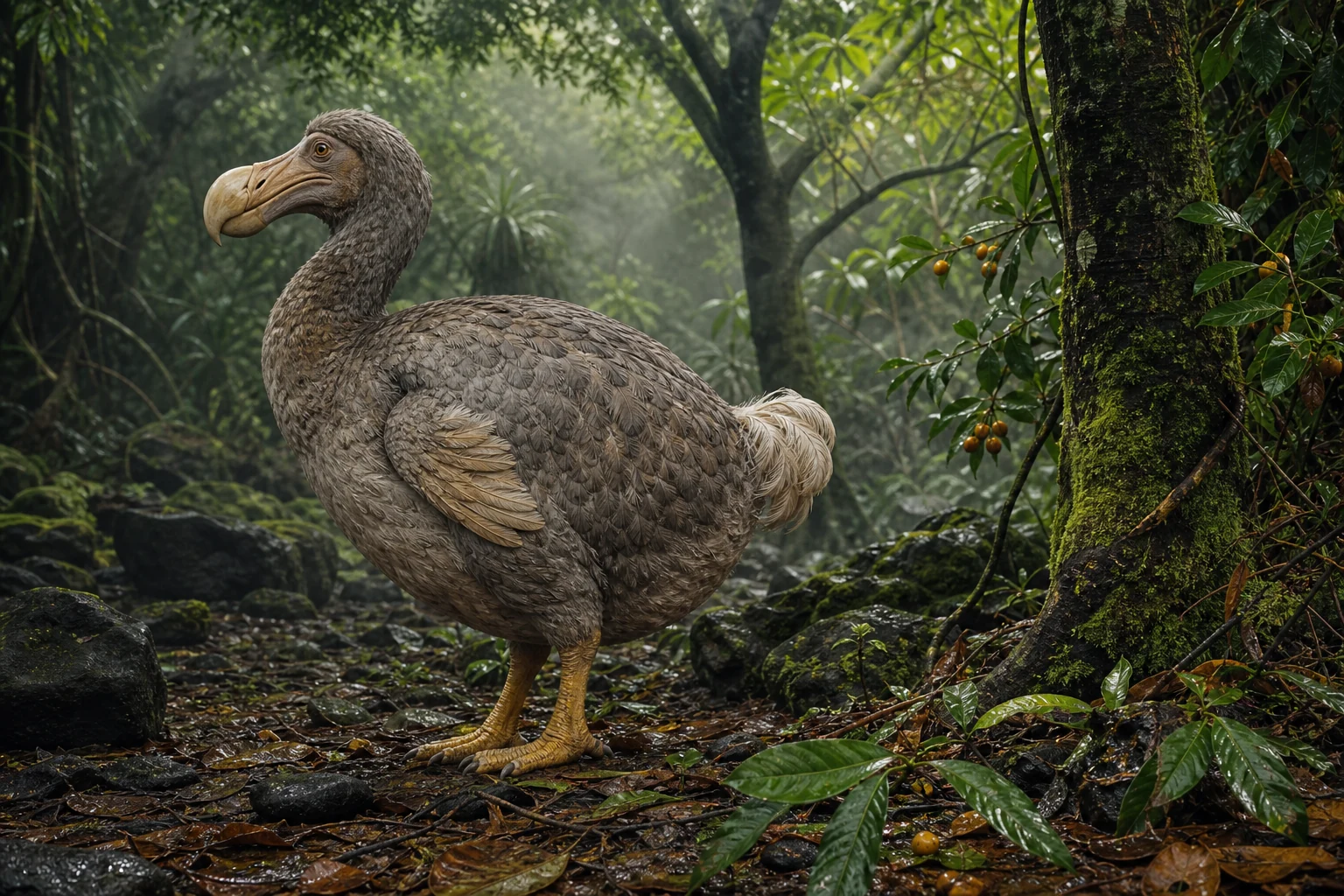 View original image · 1536 × 1024
- Time range
- Historical records: 1598–1662; extinct in the 17th century
- Final stage
- Human historical period
- Geographic range
- Mauritius
Dodo size: height, weight and a human comparison
A dodo stood about 70 cm (28 in, or 2.3 ft) tall. A useful typical mass range is about 10–14 kg (22–31 lb); these are reconstructions, not measurements of a living population.
Height versus weight
Head posture changes standing height. Skeletal proportions and body-volume assumptions affect mass estimates; a plump painting cannot supply a reliable weight.
Compared with a person
At 70 cm, a dodo reaches about 41% of the height of a 170-cm adult. The scaled illustration below compares height, not body mass or body length.
Which dates and animal does this record describe?
These dates describe historical observations, not the origin or complete lifespan of the species.
Historical records
First described by sailors in 1598; the last widely accepted reliable sighting was in 1662.
Oxford University Museum of Natural History ↗Extinction and uncertainty
The species disappeared in the seventeenth century. Survival after 1662 is possible; the death of the last individual was not recorded.
Roberts & Solow (2003), Nature ↗01 / ANSWER FIRST
What was the dodo?
The dodo (Raphus cucullatus) was a large, flightless pigeon found only on Mauritius. It was well adapted to island life, but disappeared during the seventeenth century after people and introduced animals rapidly transformed its predator-free world.
Popular culture often shows a slow, obese and foolish bird. The evidence points elsewhere: a comparatively lean, upright animal with powerful legs, a deep hooked bill and reduced wings. It had evolved without native terrestrial mammal predators, so flight and fear of large approaching animals brought little advantage. Bones, early written accounts, a handful of life drawings and the unique Oxford soft-tissue specimen preserve an incomplete but increasingly testable record.
02 / QUICK FACTS
Dodo at a glance
- Scientific name
- Raphus cucullatus
- Family
- Columbidae · pigeons and doves
- Height
- About 70 cm (2.3 ft)
- Body mass
- Roughly 10–14 kg (22–31 lb)
- Diet
- Probably fruit and varied plant matter
- Habitat
- Dry and wet forest across Mauritius
- Last reliable sighting
- 1662
- Closest extinct relative
- Rodrigues solitaire
03 / SIZE & APPEARANCE
How big was a dodo?
A dodo stood roughly 70 centimetres (28 inches, or 2.3 feet) tall. The Natural History Museum estimates a body mass near 12 kilograms (26 pounds). Peer-reviewed bone and volumetric studies support a broader typical mass near 10–14 kilograms (22–31 pounds). The often-repeated 20-kilogram figure may reflect old scaling methods, seasonal condition or unusually well-fed captive birds rather than a normal wild adult.
No preserved skin reveals the full plumage. Contemporary descriptions and the few drawings made from life suggest grey-brown feathers, a bare face, a heavy hooked bill, small wings and a tuft of curled tail feathers. Molt and seasonal body condition may explain why historical accounts disagree.
Read the complete size and appearance guideDodo size compared to a human
Both bars use the same height scale: a 70 cm dodo stands about 41% as tall as this 170 cm adult. The human height is an illustrative reference, not a population average.
Dodo height source: Natural History Museum. This is a reconstruction estimate; individuals and posture varied.
04 / TIMELINE
From island evolution to extinction
A flying pigeon reaches Mauritius
Isolation, abundant ground food and the absence of native mammalian predators favoured larger bodies, stronger legs and the gradual loss of flight.
Dutch sailors record the dodo
European accounts describe a large ground bird that could be approached easily. Some birds were killed for food and a few were transported overseas alive.
Multiple pressures arrive
Settlement changed habitat while pigs, rats, dogs, cats and macaques disturbed nests, ate eggs or attacked birds. Hunting added further mortality.
The record falls silent
The last widely accepted reliable sighting dates to 1662. Historical and statistical analyses allow later survival, but the exact final year remains uncertain.
05 / ANATOMY & TAXONOMY
A pigeon reshaped by island life
Bill and skull
The deep bill ended in a strong hooked tip. Its exact feeding roles remain uncertain, but it could grasp and process fruit and other tough foods.
Wings and breastbone
Reduced wings and flight musculature made powered flight impossible. This was a successful energy-saving island adaptation before new predators arrived.
Pelvis and legs
A robust pelvis and stout hindlimbs supported an active terrestrial bird. Modern skeletal work contradicts the caricature of a helpless, shuffling animal.
Feathers and molt
Bone histology suggests adults molted after breeding. Seasonal feather condition may account for conflicting reports of downy, dark or better-groomed plumage.
06 / DIET & LIFE HISTORY
What did dodos eat?
Fruit and other plant material probably formed much of the diet, but no complete menu survives. A muscular gizzard and swallowed stones could have broken down hard food. Dodos may also have dispersed large seeds, although the famous claim that one tree could germinate only after passing through a dodo is too absolute.
Bone microstructure provides rare seasonal evidence. Researchers propose breeding around the austral winter, with chicks growing quickly before the cyclone season and adults molting after reproduction. These are evidence-led reconstructions, not direct behavioral observations.
07 / HABITAT
Where did dodos live?
The species was endemic to Mauritius, but not confined to one swamp or one forest type. Fossils and historical evidence place it near coasts, in lowlands and mountains, and across both dry and wet forests.
Mare aux Songes, a former wetland surrounded by forest, preserves thousands of dodo bones mixed with tortoises and other Mauritian wildlife. The concentration records a water-rich gathering place and environmental archive, not necessarily the bird's only preferred habitat.
08 / EVIDENCE RECORD
How do we know what the dodo was like?
No photograph, full skin or complete taxidermied bird survives. Every reconstruction combines sources with different strengths and limitations.
Mare aux Songes
Thousands of disarticulated subfossil bones reveal population variation and the wider Mauritian ecosystem.
Thirioux skeletons
Two exceptionally complete single-individual skeletons anchor modern anatomy and three-dimensional reconstruction.
The Oxford Dodo
A skull, skin, foot elements and tissue samples preserve the only known dodo soft tissue available for DNA research.
Historical records
Sailors' descriptions and rare life studies document colour, posture and encounters, but often contradict one another.
09 / EXTINCTION
Why did the dodo go extinct?
The dodo disappeared because human arrival rapidly introduced several pressures at once: hunting, habitat change and a new community of mammals that attacked birds, nests and eggs.
Hunting alone is an incomplete explanation. Historical refuse sites do not show dodos as a constant staple food, while pigs, rats, dogs, cats and macaques spread through an ecosystem that had evolved without comparable terrestrial predators. Ground nesting and slow reproduction amplified losses. The precise contribution of each animal and the exact last year are uncertain, but the direction of causation is not: this was a human-driven island extinction.
Read the evidence-led extinction guide11 / FREQUENTLY ASKED QUESTIONS
Dodo FAQ
How big was a dodo compared to a human?
At about 70 cm (2.3 ft), a dodo was roughly 41% of the height of a 170 cm (5 ft 7 in) adult used for comparison. This compares standing height, not body length or weight.
How big was a dodo?
Modern museum reconstructions place a typical dodo at roughly 70 centimetres tall and around 10–14 kilograms. Older popular estimates near 20 kilograms probably overstate the usual wild body mass.
Could dodos fly?
No. The dodo descended from flying pigeons but evolved reduced wings, a robust pelvis and powerful legs after long isolation on Mauritius without native terrestrial mammal predators.
What did dodos eat?
Fruit and other plant material were probably important, and their strong gizzard could process hard food. The exact diet remains uncertain; claims that dodos depended on one so-called dodo tree are not supported as an exclusive relationship.
Where did dodos live?
Dodos were endemic to Mauritius in the southwest Indian Ocean. Evidence places them in coastal areas, lowlands, mountains and both dry and wet forest zones.
When did the dodo go extinct?
The last widely accepted reliable sighting dates to 1662. Historical and statistical studies suggest small populations may have survived later in the seventeenth century, but no exact final date is known.
Why did the dodo go extinct?
Human hunting contributed, but introduced pigs, rats, dogs, cats and macaques threatened adults, nests and eggs while settlement altered habitat. A slow-breeding, ground-nesting island bird had little time to respond to these combined pressures.
Was the dodo stupid?
There is no evidence that dodos were unusually unintelligent. Their lack of fear was an adaptation to an island without large land predators, not proof of stupidity or evolutionary failure.
Are any complete dodo specimens preserved?
No taxidermied dodo survives. The Oxford Dodo preserves the only known soft tissue from the species, while nearly complete single-individual skeletons and large subfossil bone assemblages provide most anatomical evidence.
04 / SOURCES & FURTHER READING
Check the source record
Use the scientific name to compare taxonomy, occurrence records and the fossil record. Database coverage and classifications may differ.
05 / REVISION HISTORY
How has this record changed?
- Expanded answers to reader questions, clarified the scope of fossil evidence and improved routes to related explanations.
- Separated verified taxon identity from related references; aligned the dated record with its stated scope.
- Upgraded to a bilingual S-tier topic hub with new size and extinction evidence guides.
- Verified authoritative entity sources and added three responsive reconstruction sizes.
- Initial bilingual species record published.
06 / CORRECTIONS & ADDITIONS