
DODO TOPIC HUB · SIZE & APPEARANCE
Dodo Size Compared to Humans: Height, Weight & Appearance
How big was a dodo next to a human? See a to-scale height comparison, estimates in feet and pounds, and the evidence behind its appearance.
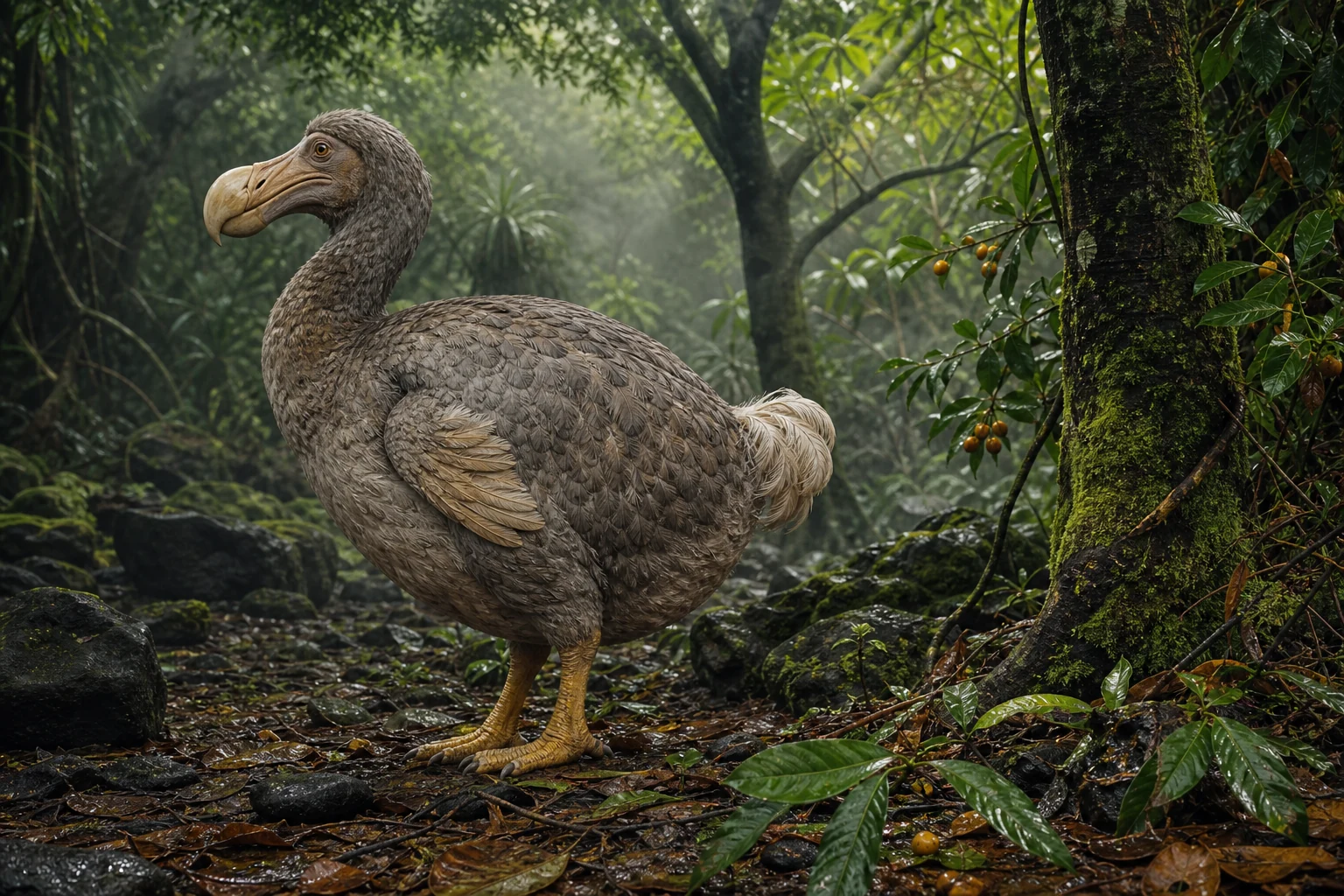 View full-resolution reconstruction ↗
This is an original generative reconstruction, not a photograph or scientific plate. Measurements and interpretations below are tied to named sources.
01 / MEASUREMENTS
How tall and heavy was a dodo?
The Natural History Museum's modern public reconstruction gives a standing height near 70 centimetres and a mass near 12 kilograms. That is a useful centre point rather than an exact measurement for every bird. Dodo fossils represent individuals of different ages, sexes and body condition, and no complete living animal was scientifically measured.
| Measurement | Evidence-led value | How to read it |
|---|---|---|
| Standing height | About 70 cm (2.3 ft) | Modern whole-body reconstruction |
| Typical body mass | About 10–14 kg (22–31 lb) | Bone scaling and 3D volume studies |
| Historic upper estimate | About 20 kg (44 lb) | Probably too high for a typical wild adult |
| Flight | Flightless | Reduced wings and flight musculature |
Dodo size compared to a human
Both bars use the same height scale: a 70 cm dodo stands about 41% as tall as this 170 cm adult. The human height is an illustrative reference, not a population average.
Dodo height source: Natural History Museum. This is a reconstruction estimate; individuals and posture varied.
02 / BODY MASS
Why do dodo weight estimates disagree?
A fossil skeleton cannot be placed on a scale. Researchers infer mass by comparing the dimensions of weight-bearing bones with living birds or by wrapping a three-dimensional body volume around digitised skeletons and assigning tissue density. One CT and convex-hull study reconstructed intact masses around 10.8–14.0 kilograms. A larger population-level analysis produced a mean near 14.1 kilograms while emphasising individual variation.
Older figures around 20 kilograms were repeated for decades. They may reflect scaling equations based on small samples, birds fattened in captivity or genuine seasonal gains before food-poor periods. A responsible description therefore gives a range and explains the method rather than presenting a falsely precise number.
03 / BODY SHAPE
Was the dodo a slow, fat bird?
The skeleton shows strong hindlimbs, a robust pelvis and an upright trunk adapted to terrestrial movement. Its wings and breastbone were reduced because powered flight was no longer useful on an island without native mammalian ground predators. Flightlessness was a successful adaptation for thousands of generations, not a defect.
Many familiar pictures descend from later European paintings rather than direct field observation. Artists sometimes copied other artists, exaggerated the belly or depicted transported birds in captivity. Modern reconstructions return to bones, rare life studies and early written accounts, producing a leaner and more athletic silhouette.
04 / PLUMAGE & COLOUR
What did a dodo look like?
Contemporary descriptions usually mention greyish or brownish body feathers, a pale tuft of curled tail feathers, a bare face and a heavy bill with coloured patches. Small wings carried feathers but could not generate flight. The feet were strong and the bill ended in a dark hooked tip.
No complete skin survives. The Oxford specimen retains head and foot material—the only known soft tissue—but cannot reveal the whole colour pattern. Bone histology suggests a seasonal molt after breeding, so different observers may have seen adults in fresh feathers, worn feathers or a downy transitional stage.
05 / METHOD & UNCERTAINTY
How is the dodo reconstructed?
Associated skeletons
The unusually complete Thirioux skeletons constrain posture, limb proportions and overall volume.
Bone assemblages
Thousands of Mare aux Songes bones show variation across more than one individual.
Historic images
Rare drawings made from life can preserve posture and colour, but artistic accuracy varies.
Soft tissue
The Oxford head and foot preserve unique anatomy and DNA, not a complete body surface.
Editorial rule: EXTINCT ATLAS separates measured bones, modelled estimates and artistic interpretation. Where evidence conflicts, we report a range and the reason for uncertainty.
FAQ
Questions readers ask
How big was a dodo compared to a human?
At about 70 cm (2.3 ft), a dodo was roughly 41% of the height of a 170 cm (5 ft 7 in) adult used for comparison. This compares standing height, not body length or weight.
How tall was a dodo?
Modern museum reconstructions commonly place a standing dodo at about 70 centimetres tall. It was much taller and heavier than a rock pigeon, but still below an adult human's hip.
How much did a dodo weigh?
Several modern skeletal and volumetric studies support a typical adult mass of roughly 10–14 kilograms. The often-repeated 20-kilogram estimate probably does not represent an average wild bird.
Was the dodo really fat?
Probably not in the exaggerated way familiar from later art. Early images vary, and captive birds or seasonal condition may have looked heavier. Skeleton-based reconstructions show a more upright, active animal.
What colour was a dodo?
Historical descriptions generally suggest grey or brownish plumage, a paler tail tuft, a bare face and a coloured bill. No full skin survives, so exact shades remain uncertain.
SOURCES & FURTHER READING
Evidence used for this guide
Measurements and causal claims are tied to museum accounts or peer-reviewed research. External sources may update as new specimens and analyses are published.
- 01The Oxford Dodo ↗Oxford University Museum of Natural History
Museum account of the only surviving dodo soft tissue, historic images, island life and the specimen record.
- 02The dodo bird: the real facts about this icon of extinction ↗Natural History Museum, London
Evidence-led overview of anatomy, habitat, historical sightings, human pressure and introduced animals.
- 03Bone histology sheds new light on the ecology of the dodo ↗Scientific Reports · DOI 10.1038/s41598-017-08536-3
Peer-reviewed evidence for growth, breeding season, molt and life history from bone microstructure.
- 04Neither slim nor fat: estimating the mass of the dodo ↗PeerJ · PMC5721909
Population-level body-mass estimates based on the largest comparative sample of dodo bones then available.
- 05Convex-hull mass estimates of the dodo ↗PeerJ · PMC4715441
CT-based volumetric reconstruction producing an intact body-mass range of roughly 10.8–14.0 kilograms.
- 06When did the dodo become extinct? ↗Nature · DOI 10.1038/426245a
Statistical analysis separating the last confirmed sighting in 1662 from a later estimated extinction date.