
Explore this animal in Size of Extinct Animals ↗
15 / Paleozoic
Dunkleosteus
Dunkleosteus terrelli
Sharpened jaw plates replaced teeth in this heavily armored apex fish.
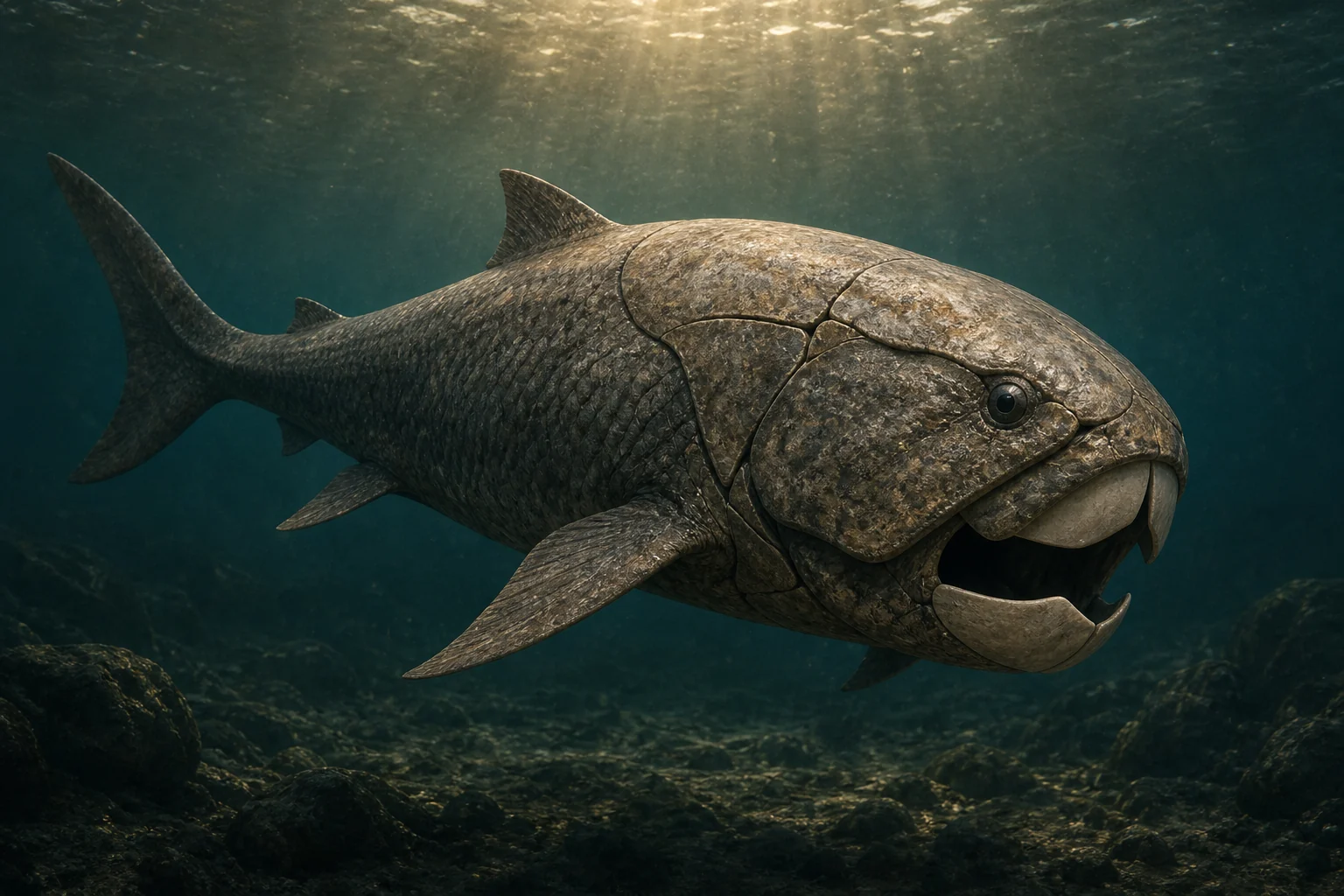 View original image · 1536 × 1024
- Time range
- About 382–358 million years ago
- Final stage
- Late Devonian
- Geographic range
- Seas of North America · Europe · North Africa
01 / ANSWER FIRST
What was Dunkleosteus?
Dunkleosteus was a large arthrodire placoderm with an armoured head and thorax that hunted in Late Devonian seas about 382–358 million years ago.
Its skull armour fossilizes readily, but most of the body was unarmoured and is rarely preserved. Traditional long shark-like restorations reached 8–10 metres; a 2023 analysis based on head-to-body proportions reconstructed D. terrelli as much shorter and deeper, around 3.4 metres for the largest well-known individuals.
02 / QUICK FACTS
Dunkleosteus at a glance
- Scientific name
- Dunkleosteus terrelli
- Age
- About 382–358 million years ago
- Revised length
- About 3.4 m for the largest measured skulls
- Body shape
- Deep, compact; still model-dependent
- Jaws
- Self-sharpening bony blades, not teeth
- Armor
- Articulated head and thoracic plates
- Diet
- Large fish and armoured prey; opportunistic
- Range
- North America, Europe and North Africa
03 / CORE QUESTION
Why did Dunkleosteus suddenly get smaller?
The fossils did not change. Older estimates multiplied jaw or head length using the proportions of elongated sharks, even though arthrodires had different body plans and Dunkleosteus lacks a complete preserved outline.
A 2023 study tested orbit-to-operculum length across nearly a thousand living and fossil fishes. That relationship places large D. terrelli near 3.4 metres with a deep body. The method is reproducible, but fin shape and exact mass remain inferred until better postcranial fossils appear.
Read the complete size and body-shape guideHow to read the numbers
This page separates direct evidence, comparative inference and unresolved debate.
04 / LIFE & DISCOVERY TIMELINE
How an armoured skull changed shape
Ohio material described
Early Cleveland Shale plates entered science under another arthrodire name.
Dunkleosteus established
The genus honoured pioneering Cleveland palaeontologist David Dunkle.
Jaw mechanics modelled
A four-bar linkage model quantified rapid opening and powerful blade closure.
Body and jaw revised
New scaling and anatomical studies challenged the long shark-like silhouette and older muscle assumptions.
05 / ANATOMY
A living guillotine with an uncertain body
Head shield
Large dermal plates formed a rigid protective skull roof and cheek region.
Neck joint
A movable joint between head and thoracic armour helped raise the skull during rapid mouth opening.
Gnathal plates
Sharp bony edges occluded like shears and renewed their cutting surfaces through wear.
Unarmoured trunk
The body behind the thoracic shield was lightly mineralised, making outline and fins difficult to reconstruct.
06 / DIET & BEHAVIOUR
What did Dunkleosteus eat?
Cutting plates could fragment large fish and other armoured prey. Regurgitated remains and damaged plates support hard-food processing, while exact prey preference varies by species and habitat.
Read the complete guide07 / DIET & BEHAVIOUR
Was it a fast pelagic hunter?
A shorter, deeper reconstruction changes swimming expectations. It may have accelerated powerfully over short distances, but sustained tuna- or shark-like speed is not demonstrated by preserved fins.
08 / RANGE & HABITAT
Where did Dunkleosteus live?
Dunkleosteus fossils occur in Late Devonian marine rocks around former tropical and subtropical basins, with D. terrelli especially well represented in Ohio's Cleveland Shale.
Cleveland Shale
Exceptional skull plates from Ohio form the principal D. terrelli sample.
Appalachian Basin
Anoxic bottom waters favoured preservation of mineralised armour.
Europe and North Africa
Other Dunkleosteus species show a wider genus-level distribution.
Devonian seas
Arthrodires shared food webs with early sharks, bony fishes and numerous invertebrates.
09 / FOSSIL EVIDENCE
What survives and what must be inferred?
Articulated armour
Skull and thoracic plates preserve joints, cutting edges and muscle landmarks in three dimensions.
Many individuals
Cleveland collections capture different sizes, pathologies and growth stages.
Comparative scaling
Cross-fish head proportions constrain length without assuming a great-white-like body.
Mechanical models
Linkage analyses estimate motion and force but must be updated when muscle attachments or body size change.
10 / DISAPPEARANCE & DEBATE
Why did Dunkleosteus go extinct?
Dunkleosteus disappeared during the prolonged Late Devonian extinction interval, when marine habitats and food webs repeatedly collapsed.
Widespread oxygen loss, climate and sea-level change, nutrient disruption and reef decline affected marine communities over several pulses. The record cannot isolate one direct killer for Dunkleosteus, but arthrodire diversity did not recover.
12 / FREQUENTLY ASKED QUESTIONS
Dunkleosteus FAQ
How big was Dunkleosteus?
A 2023 proportional analysis estimates the largest measured D. terrelli near 3.4 m, not the older 8–10 m image.
Did it have teeth?
No conventional teeth; sharpened bony jaw plates formed the cutting edges.
Was the whole body armoured?
No. Heavy armour covered the head and front of the trunk; the rear body was largely unarmoured.
Did it have the strongest fish bite?
A 2006 model produced very high values, but revised anatomy and smaller body estimates mean the numbers require re-evaluation.
Did it look like a shark?
The preserved armour does not determine a shark-like trunk; current evidence favours a deeper, more compact body.
Why is the body missing?
Most post-thoracic tissues and internal skeleton were weakly mineralised and decayed before fossilization.
04 / SOURCES & FURTHER READING
Check the source record
Use the scientific name to compare taxonomy, occurrence records and the fossil record. Database coverage and classifications may differ.
05 / REVISION HISTORY
How has this record changed?
- Rewrote an extinction cause that presented environmental or faunal turnover as established; it is now given as context the record does not prove.
- Upgraded to a bilingual S-tier topic hub with size-reconstruction and bite-hunting guides.
- Verified authoritative entity sources and added three responsive reconstruction sizes.
- Initial bilingual species record published.
06 / CORRECTIONS & ADDITIONS