
DODO TOPIC HUB · EXTINCTION EVIDENCE
When and Why Did the Dodo Go Extinct?
When did the dodo bird go extinct? Explore the 1662 sighting, the uncertain final date, and evidence for hunting, introduced animals and habitat change.
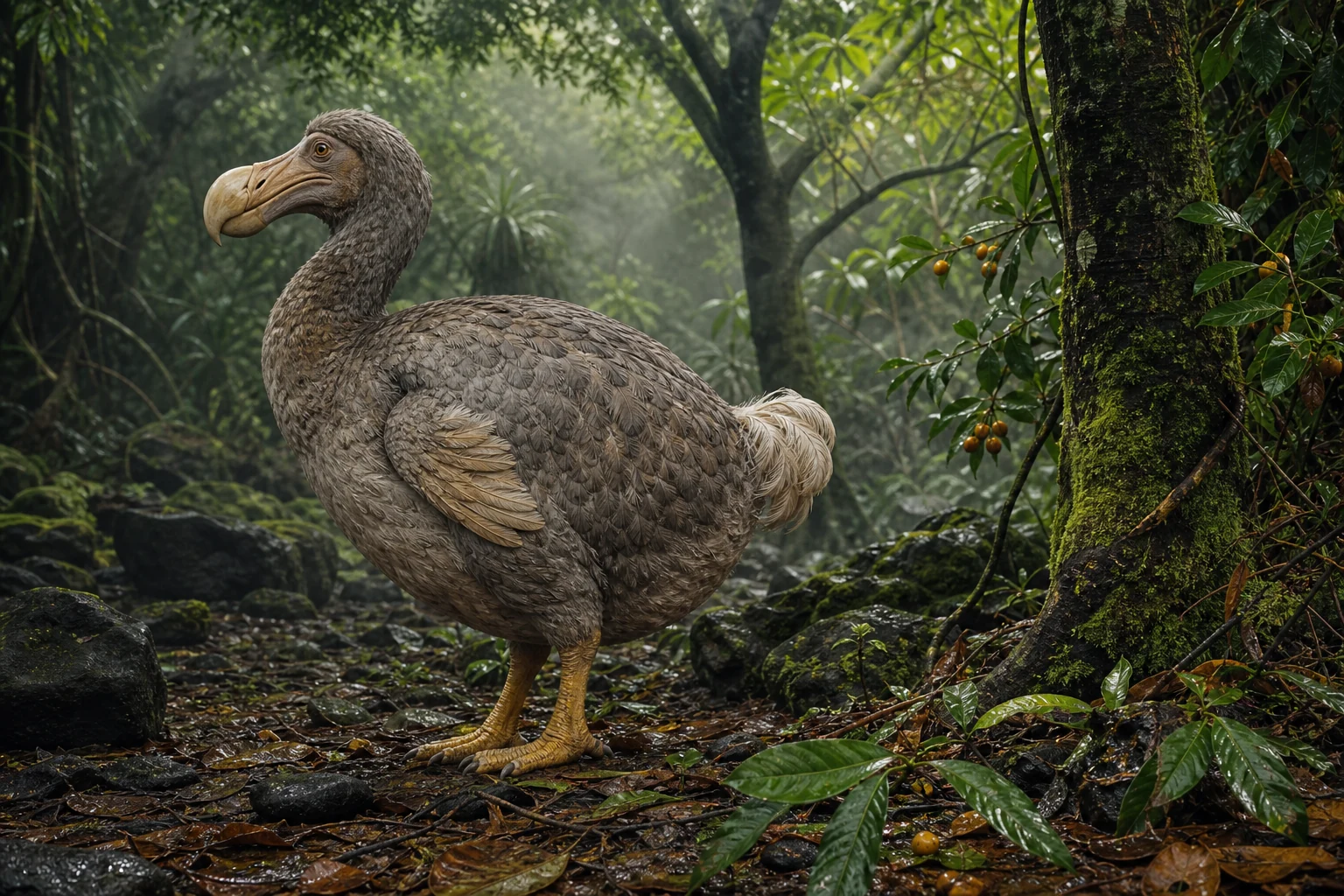 View full-resolution reconstruction ↗
This is an original generative reconstruction, not a photograph or scientific plate. Measurements and interpretations below are tied to named sources.
01 / TIMELINE
When did the dodo bird go extinct?
The documented decline occupied less than a century. Dutch ships reached Mauritius in 1598, permanent settlement and introduced animals expanded during the seventeenth century, and the last widely accepted reliable observation comes from 1662. Sparse reporting means the last sighting is not automatically the exact extinction date.
First detailed Dutch records
Sailors encounter an abundant-seeming, approachable ground bird and begin a written and illustrated record.
Permanent settlement
People alter forests and transport livestock, commensal rodents, pets and macaques into the island ecosystem.
Last reliable sighting
A shipwreck account is generally treated as the last well-supported direct observation.
Possible hidden survival
Statistical and historical work allows later persistence, but no exact final year can be verified.
02 / HUNTING
Did people hunt dodos to extinction?
Sailors and settlers killed dodos, and a bird with little fear of humans was easy to approach. Some early accounts describe their meat unfavourably, while others record consumption. This confirms direct hunting pressure but does not show that dodos were continuously slaughtered as a staple food across Mauritius.
Large ground birds with limited reproductive output do not require industrial-scale hunting to decline. Removing adults from a small island population matters. Even so, hunting alone cannot account for the full ecological transformation that followed colonisation.
03 / INTRODUCED ANIMALS
How did pigs, rats and other mammals affect dodos?
Ships and settlements brought pigs, rats, dogs, cats and macaques into an ecosystem without comparable native terrestrial mammal predators. Pigs and macaques could disturb or consume ground nests, rats could take eggs or chicks, and larger mammals could attack birds or compete for seasonal food.
No surviving observation assigns an exact percentage of mortality to each species. The important point is cumulative exposure: a flightless, ground-nesting bird faced several unfamiliar predators and competitors at the same time. Its inherited lack of fear became dangerous only after the ecological rules changed.
04 / HABITAT CHANGE
Did forest loss contribute?
Settlement cleared and fragmented parts of the Mauritian landscape, while introduced grazers and rooting pigs altered vegetation. Dodos used more than one habitat, so it is misleading to imagine a single forest patch disappearing overnight. Habitat pressure instead reduced nesting security, food and refuge while invasive species spread.
This interaction matters: habitat change can concentrate remaining birds, make nests easier to encounter and reduce recovery after hunting or predation. Extinction was a combined process, not a contest between one correct cause and several irrelevant ones.
05 / LAST SIGHTING
Did the dodo die out in 1662?
1662 is the last widely accepted reliable sighting, not a witnessed death of the final individual. Rare species become harder to find as they decline, and Mauritius was not surveyed systematically. A Nature analysis of sighting intervals estimated that the species might have persisted toward 1690, while other disputed reports have been proposed.
The best wording is therefore precise but cautious: dodos were certainly extinct by the end of the seventeenth century, and 1662 marks the last reliable direct record. The exact final year remains unknown.
06 / EVIDENCE VERDICT
What is the best current explanation?
Human hunting
Written accounts establish capture and consumption, but not hunting as the sole cause.
Introduced mammals
Ground nests and naïve birds were exposed to pigs, rats, macaques, dogs and cats.
Habitat and ecosystem change
Settlement and introduced animals altered food, cover and nesting security.
The exact final year
1662 is the last reliable sighting; later survival is plausible but unconfirmed.
Bottom line: the dodo was not an evolutionary failure. A successful island specialist disappeared when human activity changed its environment faster than natural selection and population recovery could respond.
FAQ
Questions readers ask
When did dodo birds go extinct?
Dodos disappeared in the seventeenth century. The last widely accepted reliable sighting dates to 1662, but that is not an observed extinction date; the exact final year remains uncertain.
Did sailors eat all the dodos?
No. Sailors and settlers did hunt dodos, but historical and archaeological evidence does not support a simple story of people eating every bird. Introduced mammals and habitat change were also major pressures.
Which introduced animals harmed dodos?
Pigs, rats, dogs, cats and macaques are all implicated. They could eat eggs, disturb nests, compete for food or attack birds, although the exact share of damage caused by each species is unknown.
When was the last dodo seen?
The last widely accepted reliable sighting is from 1662. Statistical work allows the possibility that a small population survived later, perhaps toward the end of the seventeenth century.
Could dodos have survived on another island?
Dodos were native only to Mauritius. A few were transported alive, but no self-sustaining population is known to have been established elsewhere.
SOURCES & FURTHER READING
Evidence used for this guide
Measurements and causal claims are tied to museum accounts or peer-reviewed research. External sources may update as new specimens and analyses are published.
- 01The Oxford Dodo ↗Oxford University Museum of Natural History
Museum account of the only surviving dodo soft tissue, historic images, island life and the specimen record.
- 02The dodo bird: the real facts about this icon of extinction ↗Natural History Museum, London
Evidence-led overview of anatomy, habitat, historical sightings, human pressure and introduced animals.
- 03Bone histology sheds new light on the ecology of the dodo ↗Scientific Reports · DOI 10.1038/s41598-017-08536-3
Peer-reviewed evidence for growth, breeding season, molt and life history from bone microstructure.
- 04Neither slim nor fat: estimating the mass of the dodo ↗PeerJ · PMC5721909
Population-level body-mass estimates based on the largest comparative sample of dodo bones then available.
- 05Convex-hull mass estimates of the dodo ↗PeerJ · PMC4715441
CT-based volumetric reconstruction producing an intact body-mass range of roughly 10.8–14.0 kilograms.
- 06When did the dodo become extinct? ↗Nature · DOI 10.1038/426245a
Statistical analysis separating the last confirmed sighting in 1662 from a later estimated extinction date.