
Explore this animal in Size of Extinct Animals ↗
24 / Recently extinct
Thylacine
Thylacinus cynocephalus
Australia’s striped marsupial predator survived longest in Tasmania.
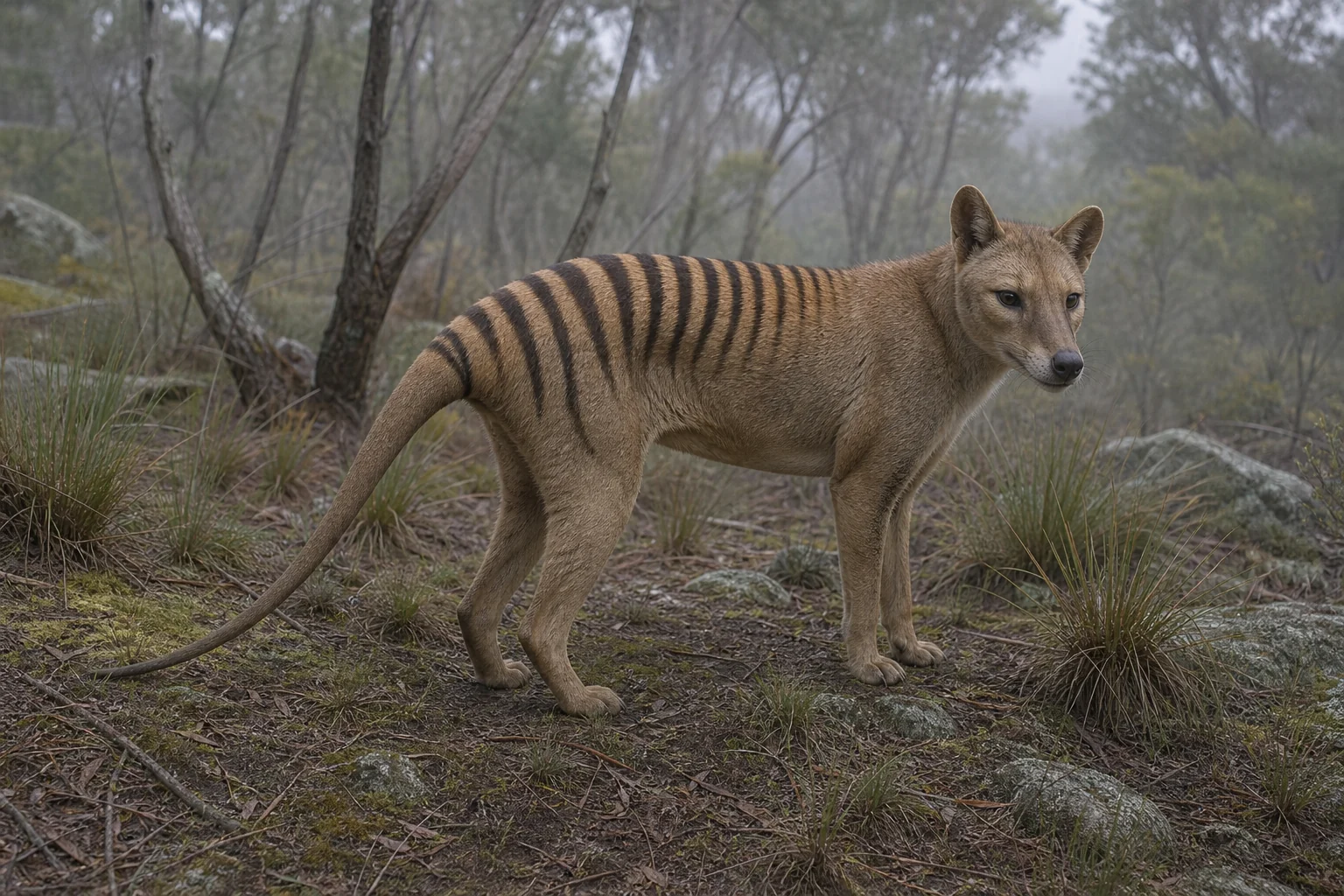 View original image · 1536 × 1024
- Time range
- About 4 million years ago–1936
- Final stage
- 20th century
- Geographic range
- Mainland Australia · Tasmania
01 / ANSWER FIRST
What was the thylacine?
The thylacine was a dog-shaped carnivorous marsupial and the last surviving member of the family Thylacinidae.
Its stripes inspired the name Tasmanian tiger, but it was neither a tiger nor a wolf. Similar skull and body proportions evolved independently in marsupial and placental predators.
02 / QUICK FACTS
Thylacine at a glance
- Scientific name
- Thylacinus cynocephalus
- Body length
- About 1.0–1.3 m, plus a stiff tail
- Mass
- Usually about 15–30 kg
- Identity
- Carnivorous marsupial, not a canid
- Stripes
- Usually 15–20 across the rear body
- Diet
- Small to medium vertebrates and carrion
- Last confirmed captive
- Died 7 September 1936
- Final range
- Tasmania, Australia
03 / CORE QUESTION
Why did the thylacine go extinct?
European settlers treated the thylacine as a livestock pest. Government and private bounties, shooting, trapping and live collection imposed direct mortality on a naturally sparse predator while farming changed its habitat and prey base.
Models show that documented persecution and landscape change can explain the collapse without requiring an unproven epidemic. Dogs, disease and low genetic diversity may have added pressure, but their relative importance remains uncertain.
Read the complete extinction evidence guideHow to read the numbers
This page separates direct evidence, comparative inference and unresolved debate.
04 / LIFE & DISCOVERY TIMELINE
From continental predator to twentieth-century endling
Mainland populations disappear
Thylacines vanished from mainland Australia after a multi-cause decline; Tasmania remained a refuge.
Government bounty
Tasmania paid for carcasses, institutionalising persecution of the species.
Last confirmed wild killing
Wilf Batty shot the last well-documented wild individual near Mawbanna.
Last known captive dies
The Beaumaris Zoo endling died only weeks after legal protection began.
05 / ANATOMY
A marsupial shaped by convergent evolution
Striped hindquarters
Dark bands crossed the back and tail base; preserved skins show that pattern and colour varied.
Stiff tail
The thick tail merged gradually with the rump, unlike the more flexible tail of most dogs.
Marsupial pouch
Females carried young in a rear-opening pouch; males also possessed a partial protective pouch.
Wide gape
The jaws opened widely, but gape alone does not prove an exceptionally powerful bite or giant prey.
06 / DIET & BEHAVIOUR
What did thylacines eat?
Historical observations, stomach remains and skull mechanics favour small and medium prey, birds and carrion rather than routine attacks on healthy adult sheep.
Read the complete guide07 / DIET & BEHAVIOUR
Were they pack hunters?
Reports describe solitary animals, pairs and family groups, but there is no robust evidence for wolf-like coordinated packs.
08 / RANGE & HABITAT
Where did thylacines live?
Fossils, mummies, rock art and historical specimens trace a former distribution across New Guinea, mainland Australia and Tasmania.
New Guinea
Prehistoric remains document an older northern part of the range.
Mainland Australia
Cave mummies, bones and rock art show a widespread Holocene presence.
Tasmanian plains
Open woodland and grassland mosaics supported prey but were rapidly converted for farming.
Remote west and south
Late records clustered in rugged country, though absence of proof after 1936 remains decisive.
09 / FOSSIL EVIDENCE
How do scientists know about the thylacine?
Museum bodies and skeletons
Skins, mounted skeletons, wet specimens and pouch young preserve anatomy and DNA.
Photographs and film
Captive footage records gait, posture and behaviour, though zoo conditions constrain interpretation.
Bounty archives
Payments, skins and newspaper reports document the geography and intensity of persecution.
Genomes and radiocarbon dates
Ancient and museum DNA reconstruct relationships and diversity; dated mainland remains constrain disappearance.
10 / DISAPPEARANCE & DEBATE
When did the thylacine truly disappear?
The last confirmed individual died in captivity on 7 September 1936; no later sighting has produced a verifiable body, photograph or genetic sample.
Statistical work on quality-rated sightings allows survival into later decades as a probability, not a rediscovery. The responsible wording separates the confirmed record from modelled possibilities.
12 / FREQUENTLY ASKED QUESTIONS
Thylacine FAQ
Was the thylacine a wolf?
No. It was a carnivorous marsupial; its dog-like shape evolved independently.
When did the last thylacine die?
The last confirmed captive died on 7 September 1936 at Beaumaris Zoo in Hobart.
Are thylacines still alive?
No verified evidence has appeared after 1936, despite many reported sightings.
Why did thylacines have stripes?
Their function is unknown; camouflage or recognition are plausible but untested.
Did thylacines attack sheep?
Some attacks likely occurred, but historical blame and bounty policy greatly exceeded firm evidence.
Could a thylacine be cloned?
Museum DNA is fragmented; no living cell or validated cloning route currently recreates the extinct species.
04 / SOURCES & FURTHER READING
Check the source record
Use the scientific name to compare taxonomy, occurrence records and the fossil record. Database coverage and classifications may differ.
05 / REVISION HISTORY
How has this record changed?
- Upgraded to a bilingual S-tier topic hub with new anatomy, identity and extinction evidence guides.
- Verified authoritative entity sources and added three responsive reconstruction sizes.
- Initial bilingual species record published.
06 / CORRECTIONS & ADDITIONS