
Explore this animal in Size of Extinct Animals ↗
26 / Recently extinct
Great Auk
Pinguinus impennis
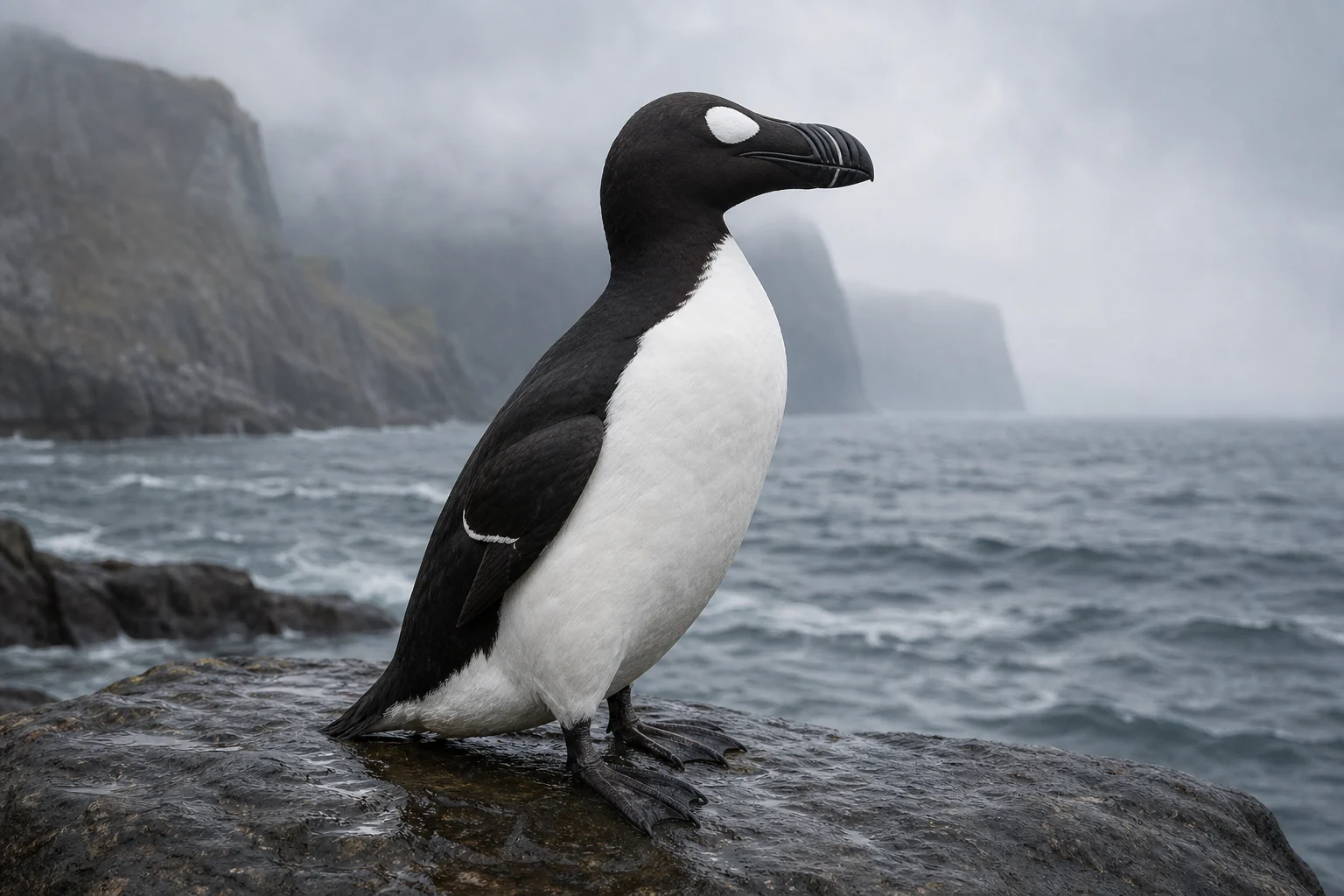
This flightless North Atlantic seabird used its wings as powerful underwater paddles.
 View original image · 1536 × 1024
- Time range
- About 5 million years ago–1844
- Final stage
- 19th century
- Geographic range
- Rocky islands of the North Atlantic
01 / ANSWER FIRST
What was the Great Auk?
The Great Auk was a large flightless seabird of the North Atlantic, about 75–85 centimetres tall, whose short wings powered pursuit dives rather than flight.
It was the original bird called a penguin, though unrelated to Southern Hemisphere penguins. Dense colonies on a small number of exposed islands made adults, eggs and down easy to harvest.
02 / QUICK FACTS
Great Auk at a glance
- Scientific name
- Pinguinus impennis
- Extinction
- 1844
- Height
- About 75–85 cm
- Mass
- About 5 kg
- Flight
- Flightless
- Diet
- Fish and marine invertebrates
- Breeding
- One large egg on rocky islands
- Range
- North Atlantic
03 / CORE QUESTION
Why did the Great Auk go extinct?
People killed adults for meat, bait, oil and feathers and collected their single eggs. Because the birds could not fly and nested in dense coastal groups, harvest removed breeding adults faster than colonies could replace them.
As numbers fell, museums and private collectors increased demand for skins and eggs. The last widely accepted breeding pair was killed on Eldey, Iceland, in 1844; later sightings are unverified.
Read the complete extinction-evidence guideHow to read the numbers
This page separates direct evidence, comparative inference and unresolved debate.
04 / LIFE & DISCOVERY TIMELINE
From abundant Atlantic colonies to museum drawers
Atlantic abundance
Bones appear in coastal human sites across its range.
Commercial harvest
Ships take birds for food, bait, oil and feathers.
Colonies collapse
Collectors target surviving islands and eggs.
Last accepted pair killed
Two birds die on Eldey and their egg is broken.
05 / ANATOMY
A seabird whose wings became underwater propellers
Short wings
Reduced flight feathers and robust bones powered diving.
Deep body
Dense insulation and fat protected against cold water.
Grooved bill
A large laterally compressed bill gripped fish.
Webbed feet
Feet steered underwater and supported an upright land stance.
06 / DIET & BEHAVIOUR
How did the Great Auk live?
It fed at sea and returned to isolated rocks to breed in dense seasonal colonies, laying one large egg without a built nest.
Read the complete guide07 / DIET & BEHAVIOUR
Was it related to penguins?
No. Auks and penguins independently evolved black-and-white, wing-propelled diving bodies in opposite hemispheres.
08 / RANGE & HABITAT
Where did the Great Auk live?
It ranged across cold North Atlantic waters from eastern North America and Greenland to Iceland, Britain and northern Europe, but bred only on suitable predator-free rocks.
Newfoundland
Funk Island once held immense colonies.
Iceland
Geirfuglasker and Eldey held last breeders.
British Isles
Bones and historical records mark former range.
Open Atlantic
Adults migrated and foraged widely outside breeding.
09 / FOSSIL EVIDENCE
How do scientists know about the Great Auk?
Museum skins
Dozens preserve plumage, bill and body proportions.
Eggs
Surviving eggs record unique pattern variation.
Bones
Archaeological and natural deposits map range and use.
Historical testimony
Sailors and collectors document colonies and final killings.
10 / DISAPPEARANCE & DEBATE
Could the Great Auk have been saved?
Yes in principle: protecting its few breeding islands and ending commercial and collecting harvest before colonies collapsed could have removed the direct cause.
Its loss shows how rarity can raise specimen value and accelerate a preventable extinction.
12 / FREQUENTLY ASKED QUESTIONS
Great Auk FAQ
When did the Great Auk go extinct?
The last accepted breeding pair was killed in 1844.
Could it fly?
No, its short wings were adapted for diving.
Was it a penguin?
No, it was a North Atlantic auk.
How tall was it?
About 75–85 centimetres.
Why was it hunted?
For meat, bait, oil, feathers, skins and eggs.
Are specimens preserved?
Yes, skins, skeletons and eggs remain in museums.
04 / SOURCES & FURTHER READING
Check the source record
Use the scientific name to compare taxonomy, occurrence records and the fossil record. Database coverage and classifications may differ.
05 / REVISION HISTORY
How has this record changed?
- Expanded into a bilingual S-tier hub with two evidence-led guides.
- Verified authoritative entity sources and added three responsive reconstruction sizes.
- Initial bilingual species record published.
06 / CORRECTIONS & ADDITIONS