
Explore this animal in Size of Extinct Animals ↗
21 / Cenozoic
Glyptodon
Glyptodon clavipes
A domed shell of fused armor protected this car-sized relative of armadillos.
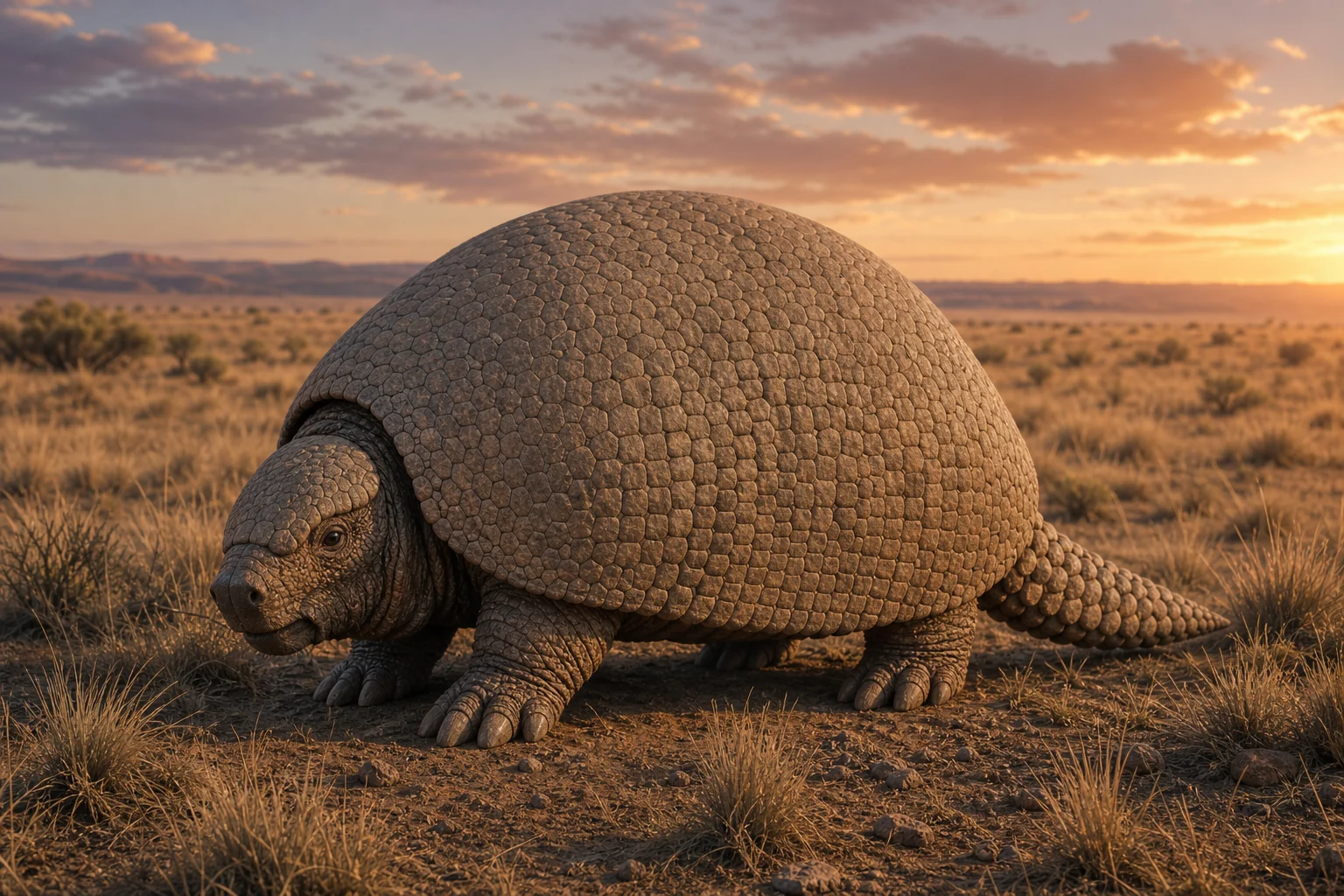 View original image · 1536 × 1024
- Time range
- About 2.6 million–11,000 years ago
- Final stage
- End of the Pleistocene
- Geographic range
- South America
01 / ANSWER FIRST
What was Glyptodon?
Glyptodon was a car-sized armoured xenarthran related to armadillos that lived in South America during the Pleistocene.
Its rigid shell was made from hundreds of fused osteoderms rather than a turtle shell. Glyptodon had a deep skull, massive limbs and an armoured tail, but lacked the specialised tail club of some other glyptodonts.
02 / QUICK FACTS
Glyptodon at a glance
- Scientific name
- Glyptodon clavipes
- Age
- Pleistocene to ~11,000 years ago
- Length
- About 3–3.5 m
- Mass
- Roughly 1–2 tonnes
- Armour
- Fused osteoderm carapace
- Diet
- Herbivorous mixed feeder
- Range
- South America
- Closest living comparison
- Armadillos
03 / CORE QUESTION
Was Glyptodon an armadillo or a turtle?
Ancient DNA and anatomy place glyptodonts within the armadillo branch of xenarthrans. Their shell evolved from skin bones, while turtle shells incorporate ribs and vertebrae and have a different evolutionary origin.
The carapace was rigid rather than banded, restricting trunk flexion but resisting large predators. Its mosaic pattern, thickness and repairs can be measured directly; colour and soft keratin covering remain reconstructed.
Read the complete armour and anatomy guideHow to read the numbers
This page separates direct evidence, comparative inference and unresolved debate.
04 / LIFE & DISCOVERY TIMELINE
An armadillo lineage transformed into a walking fortress
Large glyptodont radiation
Armoured herbivores diversified across South America.
Relatives move north
Some glyptodont lineages crossed into Central and North America.
Human overlap
People encountered and processed glyptodonts in southern South America.
Last populations disappear
Glyptodon vanished during the wider American megafaunal collapse.
05 / ANATOMY
A rigid shell on pillar-like limbs
Domed carapace
Hundreds of osteoderms fused into a continuous shield over the trunk.
Armoured head
A bony cap protected the skull while deep jaws processed vegetation.
Protected tail
Ring-like osteoderms enclosed a strong tail without a Doedicurus-style club.
Heavy limbs
Short robust bones supported mass and stabilised the shell.
06 / DIET & BEHAVIOUR
What did Glyptodon eat?
Teeth, jaw form and isotopes support grasses plus other low vegetation, varying with habitat.
Read the complete guide07 / DIET & BEHAVIOUR
Could predators penetrate the shell?
Armour reduced attack surfaces, but belly, limbs and head openings remained vulnerable; bite traces do not prove a routine hunting strategy.
08 / RANGE & HABITAT
Where did Glyptodon live?
Fossils are concentrated in South American grassland, savanna and open woodland deposits, especially the Pampas.
Argentine Pampas
Abundant shells and skeletons anchor the genus record.
Uruguay
Lowland deposits preserve additional adults and armour.
Brazil
Warmer habitats broaden the ecological range.
Open mosaics
Mixed C3 and C4 plants supplied a flexible herbivore menu.
09 / FOSSIL EVIDENCE
How do scientists know about Glyptodon?
Complete carapaces
Articulated shields reveal shape, growth and trauma.
Skeletons
Skulls, limbs and tails constrain posture and mass.
Stable isotopes
Tooth and bone chemistry reconstruct diet and habitat.
Archaeological context
Modified remains document human interaction without assigning every extinction cause.
10 / DISAPPEARANCE & DEBATE
Why did Glyptodon go extinct?
Glyptodon disappeared near the end of the Pleistocene as human hunting, warming climate and habitat change transformed South American megafaunal communities.
Human processing is documented, but the continental loss involved several species and environments. A multi-factor explanation is better supported than armour failure or one abrupt event.
12 / FREQUENTLY ASKED QUESTIONS
Glyptodon FAQ
How big was Glyptodon?
About 3–3.5 metres long and roughly 1–2 tonnes.
Was Glyptodon an armadillo?
It was an extinct glyptodont nested within the armadillo branch.
Was its shell like a turtle shell?
No. It formed from fused skin bones and did not incorporate the ribs like a turtle shell.
Did Glyptodon have a tail club?
Its tail was armoured, but not specialised into the large club seen in Doedicurus.
What did it eat?
Mostly grasses and low vegetation, with regional flexibility.
Did humans encounter Glyptodon?
Yes; archaeological remains document overlap and processing.
04 / SOURCES & FURTHER READING
Check the source record
Use the scientific name to compare taxonomy, occurrence records and the fossil record. Database coverage and classifications may differ.
05 / REVISION HISTORY
How has this record changed?
- Expanded into a bilingual S-tier hub with two evidence-led guides.
- Verified authoritative entity sources and added three responsive reconstruction sizes.
- Initial bilingual species record published.
06 / CORRECTIONS & ADDITIONS