
WOOLLY MAMMOTH TOPIC HUB · EXTINCTION EVIDENCE
Why Did Woolly Mammoths Go Extinct? Evidence and Debate
A research-led guide to woolly mammoth extinction: climate, habitat loss, human hunting, St Paul Island, Wrangel Island and ancient DNA.
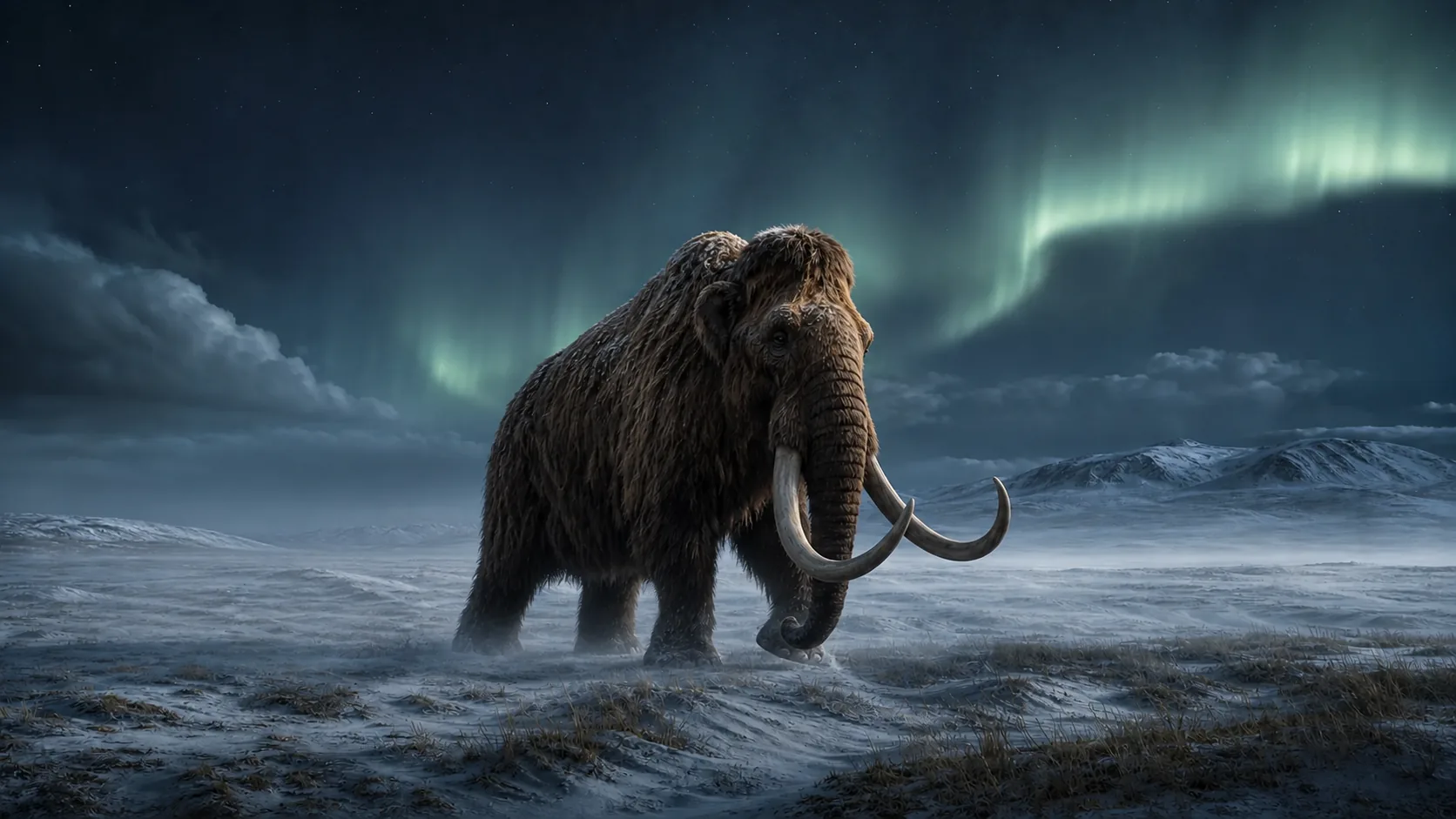 View full-resolution reconstruction ↗
This is an original generative reconstruction, not a photograph or scientific plate. Measurements and interpretations below are tied to named sources.
01 / TIMELINE
When did woolly mammoths go extinct?
Extinction was not one date. Populations contracted at different times as environments and human presence changed across Eurasia and North America. The last mainland records cluster near the beginning of the Holocene, while rising seas isolated small island populations from the continental decline.
Broad northern range
Woolly mammoths occupied a vast but shifting belt of mammoth steppe across Eurasia and northern North America.
Mainland contraction
Open grassland declined rapidly after the last glacial maximum. Regional populations disappeared rather than collapsing everywhere on the same day.
St Paul Island
The Bering Sea population vanished after climate and sea-level change reduced the island and degraded its limited freshwater supply.
Wrangel Island
The final known population disappeared after roughly six millennia of isolation. The immediate cause remains unknown.
02 / CLIMATE & HABITAT
How did warming affect mammoth habitat?
Woolly mammoths were adapted to cold, dry and open steppe-tundra. As the last ice age ended, temperature and precipitation patterns changed. Forest, shrub tundra, peatland and wetter ground replaced large parts of the herb-rich mammoth steppe. The result was not simply “too warm for fur”; it was less suitable food and a more fragmented landscape for a wide-ranging grazer.
Climate cannot be treated as a complete answer on its own. Mammoths had survived previous warm phases by retreating to favourable refuges and expanding again when cold grassland returned. The terminal warming differed because it coincided with growing human populations and left no later return to a full glacial habitat. Range models therefore treat climate as a major driver that changed where mammoths could persist, not an instantaneous kill mechanism.
03 / HUMAN PRESSURE
Did people hunt woolly mammoths to extinction?
Humans definitely interacted with mammoths. Archaeological sites contain butchered bones, tools made from ivory and bone, dwellings incorporating mammoth remains and rare projectile evidence. Mammoths also appear in cave art. These records establish hunting and use, but they do not show identical hunting intensity across the entire two-continent range.
Large, slow-reproducing mammals can be affected by the loss of relatively few breeding adults. Hunting pressure therefore need not resemble mass slaughter to matter. At the same time, several populations declined as habitat changed, and Wrangel Island lacks evidence of people before the mammoths disappeared. The evidence supports human contribution in at least some regions, not a universal one-cause narrative.
04 / LAST POPULATIONS
What happened on St Paul and Wrangel islands?
St Paul Island
Rising seas isolated mammoths on a shrinking Bering Sea island. Sediment and environmental evidence indicates that diminishing freshwater and degraded lake conditions contributed directly to their disappearance about 5,600 years ago. This is a strong example of a local mechanism.
Wrangel Island
Wrangel supported the last known population until about 4,000 years ago. Mammoths persisted for more than 200 generations after isolation. There is no evidence of humans arriving before the extinction, and neither gradual habitat decline nor genetics alone has identified the final trigger. A short-lived environmental or disease event remains possible but unproven.
The island contrast is crucial: “why mammoths went extinct” is not one forensic case. Each remnant population faced different water, vegetation, space, genetic and human conditions.
05 / ANCIENT DNA
Did inbreeding cause a genetic meltdown?
Wrangel Island mammoths passed through a severe founding bottleneck. A 2024 Cell study analysing 21 Siberian genomes found that the population recovered quickly and remained demographically stable for roughly six millennia. Mildly harmful mutations accumulated, while highly harmful mutations were purged by selection. Inbreeding depression persisted, but the data do not show a steady demographic slide ending inevitably in extinction.
This revises the simplest “genetic meltdown” story. Low diversity probably reduced resilience and made the population less able to absorb a new shock, yet a vulnerable background condition is not the same as a demonstrated final cause. The last population may have been stable until a rapid event that left little direct trace.
06 / EVIDENCE VERDICT
What is the best current explanation?
Post-glacial habitat contraction
Fossil distributions, vegetation change and range models all show the loss and fragmentation of mammoth-steppe habitat.
Human hunting and disturbance
Direct interaction is documented, but intensity and timing vary geographically and do not explain Wrangel Island.
Small-population genetics
The bottleneck and long inbreeding history are real, yet the final population remained demographically stable for millennia.
Final Wrangel trigger
No tested hypothesis currently identifies the immediate event with confidence.
Bottom line: climate narrowed the ecological stage, people probably increased pressure on parts of it, and island isolation left the final populations fragile. The evidence does not justify reducing that sequence to a single culprit.
FAQ
Questions readers ask
When did the last woolly mammoths die?
Most mainland populations were gone by roughly 10,500 years ago. Island survivors persisted on St Paul Island until about 5,600 years ago and on Wrangel Island until about 4,000 years ago.
Did humans cause woolly mammoth extinction?
Humans hunted mammoths, but no single cause explains the full geographic pattern. The leading interpretation combines post-glacial habitat loss, human pressure and the vulnerability of small isolated populations, with the final Wrangel Island disappearance still unresolved.
Did climate change kill the woolly mammoth?
Post-glacial warming transformed open mammoth steppe into wetter tundra, shrubland and forest, reducing suitable habitat. Climate was a major driver, but the final outcome also depended on human pressure, geography and small-population vulnerability.
Were the last woolly mammoths inbred?
The Wrangel Island population passed through a severe bottleneck and had low diversity. Genomic work shows long-lasting inbreeding effects, but also finds that the population recovered numerically and purged some highly harmful mutations. Genetics alone does not identify the final trigger.
Did woolly mammoths live when the pyramids were built?
The final Wrangel Island mammoths survived until about 4,000 years ago, overlapping in broad historical time with early Egyptian pyramid building. They lived far away in the Siberian Arctic and had no connection to Egypt.
SOURCES & FURTHER READING
Evidence used for this guide
Measurements and causal claims are tied to museum summaries or peer-reviewed research. External sources may update as new specimens and analyses are published.
- 01Were all mammoths woolly? ↗Natural History Museum, London
Expert overview of mammoth evolution, body size, cold adaptations and the extinction debate.
- 02Woolly Mammoth ↗U.S. National Park Service
Beringian habitat, grazing ecology, anatomy and tusk evidence.
- 03Temporal dynamics of woolly mammoth genome erosion prior to extinction ↗Cell · PubMed PMID 38942016
Genome study of the last Wrangel Island population and its severe bottleneck.
- 04Lifetime mobility of an Arctic woolly mammoth ↗Science · PubMed PMID 34385399
Tusk isotope study reconstructing movement across an Arctic mammoth's lifetime.
- 05Climate Change, Humans, and the Extinction of the Woolly Mammoth ↗PLOS Biology
Range-model analysis of climate, habitat and human pressure.