
WOOLLY MAMMOTH TOPIC HUB · SIZE & ANATOMY
Woolly Mammoth Size, Height and Weight: A Measured Guide
How tall and heavy was a woolly mammoth? Compare adult size, male and female variation, tusk length and living elephants using museum evidence.
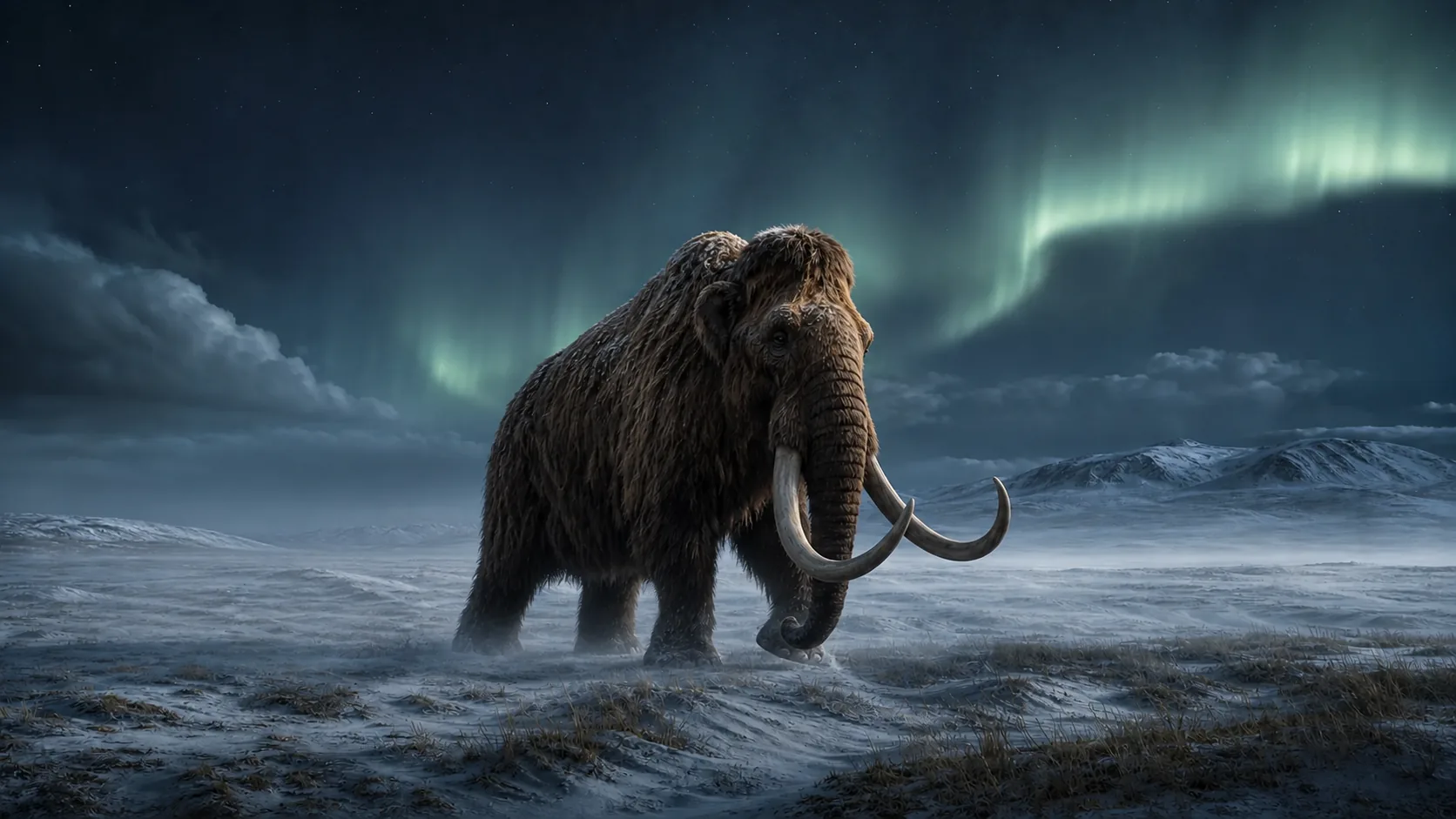 View full-resolution reconstruction ↗
This is an original generative reconstruction, not a photograph or scientific plate. Measurements and interpretations below are tied to named sources.
01 / MEASUREMENTS
How tall and heavy was a woolly mammoth?
The most defensible public-facing range comes from measured skeletons interpreted alongside living elephants. Natural History Museum palaeontologist Adrian Lister describes woolly mammoths as roughly 3–3.5 metres tall at the shoulder and about 4–6 tonnes in body mass. These are useful typical values, not fixed limits.
Shoulder height is the standard comparison because the skull, soft-tissue hump and hair can make total standing height ambiguous. Weight is even less direct: no scale survives with a fossil. Researchers estimate mass from limb-bone dimensions, skeletal volume and relationships observed in living proboscideans. Different methods can therefore produce different answers for the same individual.
| Measurement | Evidence-led range | How to read it |
|---|---|---|
| Shoulder height | About 3–3.5 m | Typical adult range combining sex and specimen variation |
| Body mass | About 4–6 tonnes | Reconstructed from skeletons and elephant scaling |
| Large tusk length | Over 3.6 m along curve | Exceptional, not an adult average |
| Male vs female | Males generally larger | Exact ranges overlap and depend on age |
02 / SEXUAL DIMORPHISM
Were male woolly mammoths larger than females?
Yes. Woolly mammoths show the same broad proboscidean pattern seen in living elephants: adult males continued growing for longer and tended to be taller and heavier than females. That is why museum summaries often present a wide 4–6-tonne range rather than one average.
Sexing an incomplete fossil is not always straightforward. Pelvic anatomy can be informative, as can associated soft tissue in frozen individuals, but tusk size by itself is unreliable because both sexes had tusks and because age strongly changes their length. A responsible size estimate should identify whether it refers to a particular skeleton, a sex-specific reconstruction or a combined species range.
03 / COMPARISON
Was a woolly mammoth bigger than an elephant?
“Elephant-sized” is the accurate answer, but the comparison depends on the elephant. Smithsonian data place living Asian elephants across a broad 1.8–3.8-metre shoulder-height range and 2.75–5.42 tonnes on average. Large African bush elephants can exceed typical woolly mammoths. The Natural History Museum therefore places woolly mammoths roughly between modern Asian and African elephants rather than above both.
The mammoth still looked different at the same shoulder height. Its back sloped down behind tall shoulders, the skull formed a dome, the ears and tail were compact, and a thick coat enlarged the visual outline. Huge spiralling tusks projected forward and inward. These proportions—not simply mass—created the iconic profile.
04 / TUSKS
How long were woolly mammoth tusks?
Large tusks could exceed 12 feet, or about 3.6 metres, measured along the outer curve. That number describes exceptional tusks rather than every adult. Tusks grew in layers throughout life, and a substantial root remained embedded in the skull. The visible length on a living animal was therefore shorter than the full fossil measurement.
Curvature matters. Woolly mammoth tusks swept outward, forward and inward in a spiral, unlike a straight ruler. Researchers measure along the curve and use growth layers and chemistry to investigate age, season, diet and movement. A Science study followed isotope changes along a 1.7-metre tusk to reconstruct the travels of one Arctic male over about 28 years.
05 / METHOD & UNCERTAINTY
How do scientists estimate mammoth size?
Mounted skeletons
Articulated or carefully associated skeletons provide shoulder height, body length and limb proportions, but missing cartilage and distorted bones must be corrected.
Limb-bone scaling
Circumference and length of weight-bearing bones are compared with living elephants. The method is reproducible but depends on the reference sample.
Volumetric models
Three-dimensional body envelopes are built around a skeleton and assigned tissue density. Small changes in body outline can meaningfully change mass.
Population context
Age, sex, geography and island isolation matter. One large male should not be presented as the dimensions of the whole species.
Editorial rule: EXTINCT ATLAS reports a range and its source, distinguishes typical from exceptional specimens, and avoids false precision when the fossil record cannot support it.
FAQ
Questions readers ask
How big was a woolly mammoth?
Typical adults stood about 3–3.5 metres (9.8–11.5 feet) at the shoulder and weighed roughly 4–6 tonnes. Males generally occupied the upper end of that range and females the lower end; individual estimates vary with specimen and method.
Was a woolly mammoth bigger than an African elephant?
Not necessarily. Typical woolly mammoths fell between modern Asian and African elephants in size. Large African bush elephants could stand taller and weigh more, while the mammoth's coat, shoulder hump and tusks made its outline appear especially massive.
How long were woolly mammoth tusks?
Large tusks could exceed 3.6 metres (12 feet) measured along the curve. Length varied with age, sex and individual growth, and part of every tusk remained anchored inside the skull.
Were male woolly mammoths larger than females?
Yes. As in living elephants, adult males were generally larger. Published popular ranges often combine both sexes, so a single 'average mammoth' number hides meaningful variation.
What was the largest mammoth species?
Woolly mammoths were not the largest. Steppe and southern mammoths could approach four metres at the shoulder and about ten tonnes, although estimates vary by specimen and method.
SOURCES & FURTHER READING
Evidence used for this guide
Measurements and causal claims are tied to museum summaries or peer-reviewed research. External sources may update as new specimens and analyses are published.
- 01Were all mammoths woolly? ↗Natural History Museum, London
Expert overview of mammoth evolution, body size, cold adaptations and the extinction debate.
- 02Woolly Mammoth ↗U.S. National Park Service
Beringian habitat, grazing ecology, anatomy and tusk evidence.
- 03Temporal dynamics of woolly mammoth genome erosion prior to extinction ↗Cell · PubMed PMID 38942016
Genome study of the last Wrangel Island population and its severe bottleneck.
- 04Lifetime mobility of an Arctic woolly mammoth ↗Science · PubMed PMID 34385399
Tusk isotope study reconstructing movement across an Arctic mammoth's lifetime.
- 05Climate Change, Humans, and the Extinction of the Woolly Mammoth ↗PLOS Biology
Range-model analysis of climate, habitat and human pressure.