
Explore this animal in Size of Extinct Animals ↗
18 / Paleozoic
Dimetrodon
Dimetrodon grandis
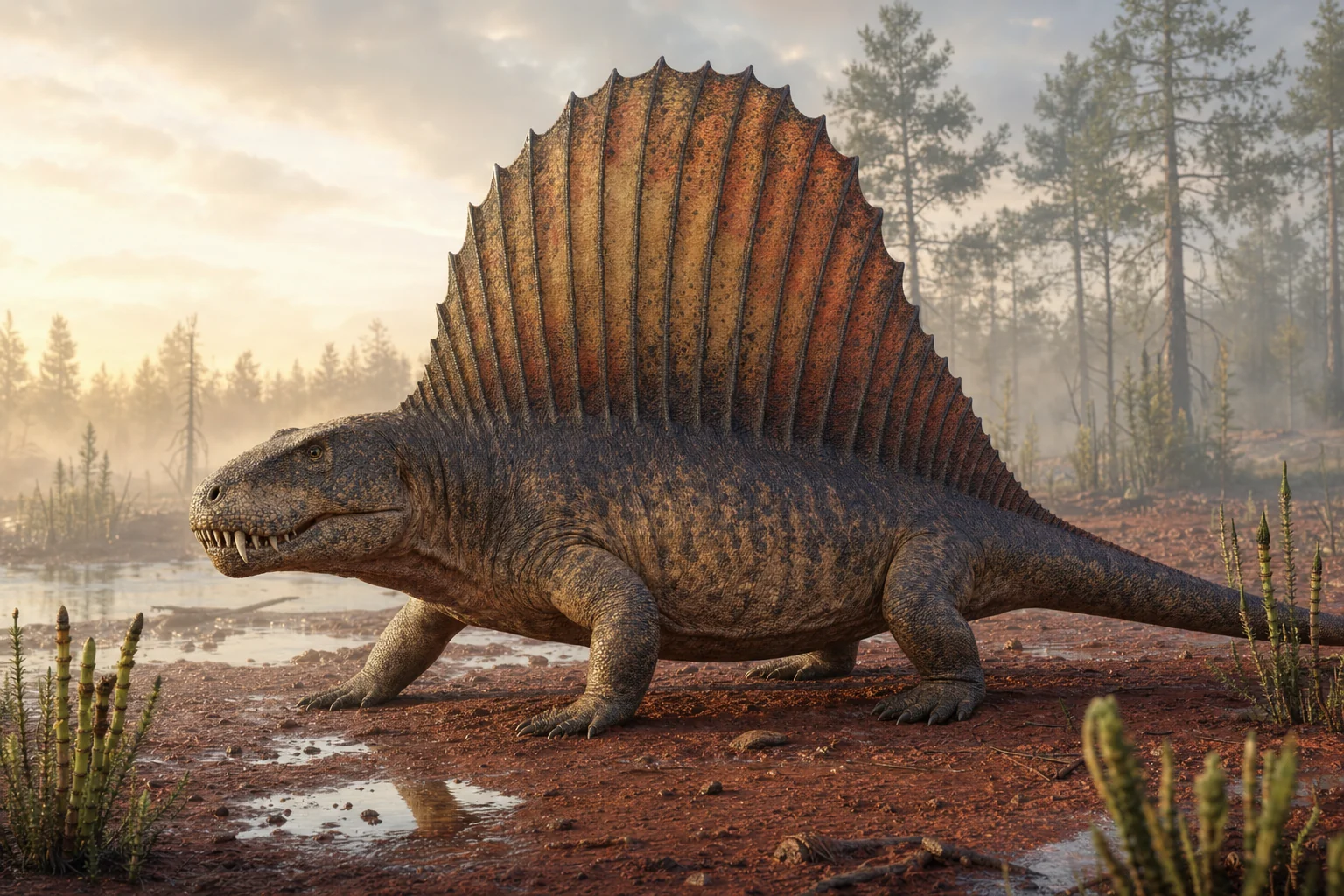
This sail-backed predator was closer to mammals than to dinosaurs.
 View original image · 1536 × 1024
- Time range
- About 295–272 million years ago
- Final stage
- Early Permian
- Geographic range
- North America
01 / ANSWER FIRST
What was Dimetrodon?
Dimetrodon was an Early Permian predatory synapsid—more closely related to mammals than to dinosaurs—recognised by tall vertebral spines supporting a skin sail.
It lived about 40 million years before the first dinosaurs. Different tooth shapes and a large temporal opening behind the eye mark feeding innovations on the mammal lineage, while the sail's living thickness, colour and primary role remain debated.
02 / QUICK FACTS
Dimetrodon at a glance
- Scientific name
- Dimetrodon grandis
- Age
- ~295–272 million years ago
- Length
- Species ranged ~1.7–4.6 m
- Identity
- Non-mammalian synapsid
- Sail
- Elongated neural spines
- Teeth
- Differentiated cutting and canine-like teeth
- Diet
- Carnivorous
- Range
- North America and Europe
03 / CORE QUESTION
What was the sail for?
Blood vessels and broad surface area inspired heat-gain and cooling models, but vascular bone does not reveal total soft tissue or prove thermoregulation as the main selected function.
Sails varied with species, size and growth and would have been conspicuous in profile. Display, recognition, apparent size and thermoregulation may all have contributed rather than one exclusive purpose.
Read the complete sail-function guideHow to read the numbers
This page separates direct evidence, comparative inference and unresolved debate.
04 / LIFE & DISCOVERY TIMELINE
A pre-dinosaur predator on the mammal side of the tree
Synapsid radiation
Dimetrodon species diversify in seasonal wetlands.
Genus named
Edward Cope recognises differentiated teeth.
Sail models tested
Thermal calculations dominate early interpretations.
Not a dinosaur
Cladistics places it on the mammal-line synapsids.
05 / ANATOMY
A low-slung predator with differentiated teeth
Neural-spine sail
Tall vertebral rods supported a continuous dorsal structure.
Temporal opening
One skull opening behind each eye anchored jaw muscle.
Different teeth
Incisiform, canine-like and cutting teeth divided feeding roles.
Sprawling limbs
Limbs projected laterally but posture was more dynamic than old dragging art.
06 / DIET & BEHAVIOUR
What did Dimetrodon eat?
Fish, amphibians and other tetrapods were potential prey, varying strongly among differently sized species.
Read the complete guide07 / DIET & BEHAVIOUR
Was it warm-blooded?
The sail debate does not establish mammal-like endothermy; physiology is inferred indirectly from bone, growth and ecology.
08 / RANGE & HABITAT
Where did Dimetrodon live?
Most famous fossils come from red-bed river and floodplain deposits of Texas and Oklahoma, with related species in New Mexico and Europe.
Texas red beds
Abundant skeletons anchor anatomy and growth.
Oklahoma
Additional species and size classes occur.
New Mexico
Western records extend the range.
Seasonal lowlands
Channels and drought-prone ponds concentrated prey.
09 / FOSSIL EVIDENCE
How do scientists know about Dimetrodon?
Skeletons
Many individuals preserve skull, spine and limbs.
Histology
Spine and limb growth record age and vascularity.
Tooth wear
Damage and replacement reveal feeding mechanics.
Phylogeny
Skull openings and anatomy place it among synapsids.
10 / DISAPPEARANCE & DEBATE
Why is Dimetrodon not a dinosaur?
It lived earlier and belongs to Synapsida, the branch that later produced mammals; dinosaurs lie on the separate archosaur side of the amniote tree.
The familiar sail is a superficial resemblance to some dinosaurs, not a taxonomic character.
12 / FREQUENTLY ASKED QUESTIONS
Dimetrodon FAQ
Was Dimetrodon a dinosaur?
No. It was a non-mammalian synapsid closer to mammals.
When did it live?
In the Early Permian, tens of millions of years before dinosaurs.
How big was it?
Species ranged from under two to about 4.6 metres.
What was the sail for?
Display and thermoregulation are both plausible contributors.
What did it eat?
Fish, amphibians and other early tetrapods.
Why is it called Dimetrodon?
The name refers to its differently shaped teeth.
04 / SOURCES & FURTHER READING
Check the source record
Use the scientific name to compare taxonomy, occurrence records and the fossil record. Database coverage and classifications may differ.
05 / REVISION HISTORY
How has this record changed?
- Rewrote an extinction cause that presented environmental or faunal turnover as established; it is now given as context the record does not prove.
- Expanded into a bilingual S-tier hub with two evidence-led guides.
- Verified authoritative entity sources and added three responsive reconstruction sizes.
- Initial bilingual species record published.
06 / CORRECTIONS & ADDITIONS