
Explore this animal in Size of Extinct Animals ↗
20 / Cenozoic
Giant Ground Sloth
Megatherium americanum
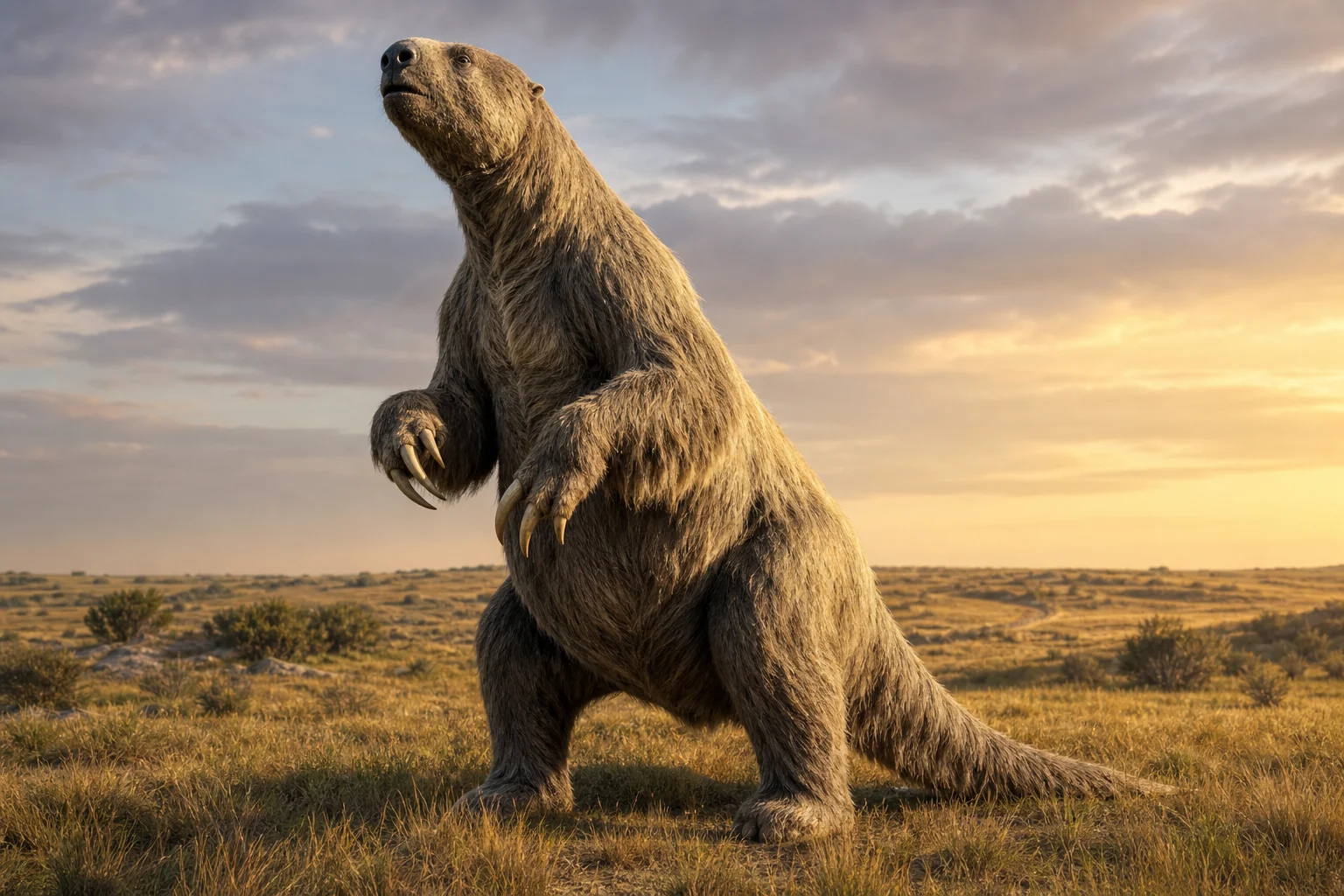
Standing on its hind legs, this elephant-sized sloth could reach high branches with huge claws.
 View original image · 1536 × 1024
- Time range
- About 400,000–10,000 years ago
- Final stage
- End of the Pleistocene
- Geographic range
- South American grasslands and woodlands
01 / ANSWER FIRST
What was Megatherium?
Megatherium americanum was one of the largest ground sloths, a South American herbivore that could weigh up to about four tonnes and stand roughly 3.5 metres tall when rearing.
It was not a permanently upright giant sloth. Massive hind limbs, a strong tail and inward-curving claws allowed stable quadrupedal walking and short bouts of rearing to browse or defend, while exact locomotor posture remains debated.
02 / QUICK FACTS
Megatherium at a glance
- Scientific name
- Megatherium americanum
- Age
- Middle Pleistocene to ~12,600 years ago
- Mass
- About 2–4 tonnes
- Rearing height
- Around 3.5 m
- Diet
- Herbivorous browser
- Movement
- Primarily quadrupedal; capable of rearing
- Range
- Southern and central South America
- Last secure evidence
- ~12,600 calibrated years BP
03 / CORE QUESTION
What did Megatherium eat, and why did it go extinct?
Teeth, jaw mechanics and carbon isotopes support a predominantly herbivorous browser that selected leaves, shoots and other vegetation. Giant claws could pull branches and defend the body; occasional omnivory has been proposed but lacks equally direct support.
Megatherium survived climatic cycles but disappeared soon after humans spread through southern South America. Campo Laborde preserves secure butchery around 12,600 calibrated years ago. The best current explanation weighs human hunting together with rapid environmental and food-web change.
Read the complete diet and extinction guideHow to read the numbers
This page separates direct evidence, comparative inference and unresolved debate.
04 / LIFE & DISCOVERY TIMELINE
From Darwin's fossil giant to a dated human encounter
Giant browser established
Megatherium americanum spread across temperate and subtropical South America.
First famous skeleton
A Luján specimen reached Madrid and Cuvier recognised an extinct giant sloth.
Darwin collects relatives
South American ground-sloth fossils helped connect living faunas with extinct regional giants.
Campo Laborde butchery
Cut marks and human activity provide a secure terminal-Pleistocene interaction.
05 / ANATOMY
A heavy browser with powerful support
Massive hind limbs
Broad pelvis and strong femora carried tonnes of body mass and supported rearing.
Weight-bearing tail
A muscular tail could complete a tripod with the hind limbs during feeding or defence.
Large curved claws
Foreclaws were powerful but turned inward, requiring the animal to walk on the sides of its hands.
Ever-growing teeth
Simple high-crowned teeth lacked enamel and wore continuously against fibrous vegetation.
06 / DIET & BEHAVIOUR
Was Megatherium a meat-eater?
Herbivory is best supported by teeth, jaws and isotopes. Scavenging or opportunistic animal food cannot be absolutely excluded, but predatory reconstructions exceed current evidence.
Read the complete guide07 / DIET & BEHAVIOUR
Did it walk on two legs?
It could rear, and some biomechanics permit bipedal bouts, but trackways and weight-bearing anatomy favour habitual quadrupedal progression. Permanent human-like walking is unsupported.
08 / RANGE & HABITAT
Where did Megatherium live?
Fossils trace Megatherium americanum across the southern half of South America in grassland, woodland and open dry mosaics.
Argentine Pampas
Abundant skeletons and archaeological sites anchor anatomy and terminal dates.
Uruguay
Open habitats preserve additional large-bodied records.
Bolivia and inland valleys
Fossils extend the species through varied elevations and vegetation.
Flexible habitat use
Tooth and isotope evidence indicate regional dietary variation rather than one uniform mammoth-steppe niche.
09 / FOSSIL EVIDENCE
How do scientists know about Megatherium?
Near-complete skeletons
Museum mounts preserve skull, limbs, pelvis and tail together for biomechanical reconstruction.
Tooth isotopes
Carbon signatures test browsing habitat and support a herbivorous diet.
Trackways
Footprints constrain hand posture, gait and whether apparent bipedal tracks may be overprinted quadrupedal steps.
Campo Laborde
Cut marks, spatial context and radiocarbon dates document human butchery near the species' last secure appearance.
10 / DISAPPEARANCE & DEBATE
Why did Megatherium go extinct?
Megatherium disappeared near the end of the Pleistocene amid rapid ecological change and human expansion; direct butchery proves interaction, while regional extinction was probably multi-factor.
Campo Laborde rules out claims of survival many millennia later, but one kill site does not quantify continent-wide hunting. Climate altered vegetation and water while low reproductive rates could make added mortality difficult to absorb.
12 / FREQUENTLY ASKED QUESTIONS
Megatherium FAQ
How large was Megatherium?
Large adults are estimated at roughly 2–4 tonnes and around 3.5 metres high when rearing.
Was Megatherium a giant sloth?
It was a giant ground sloth related to living sloths, but it lived mainly on land.
Did Megatherium walk upright?
It could rear and perhaps take short bipedal steps, but habitual movement was primarily quadrupedal.
What did Megatherium eat?
Teeth, jaws and isotopes best support leaves, shoots and other plant foods.
Did humans hunt Megatherium?
Yes. Campo Laborde preserves secure evidence of butchery around 12,600 calibrated years ago.
When did Megatherium go extinct?
The youngest secure evidence is near 12,600 calibrated years before present.
04 / SOURCES & FURTHER READING
Check the source record
Use the scientific name to compare taxonomy, occurrence records and the fossil record. Database coverage and classifications may differ.
05 / REVISION HISTORY
How has this record changed?
- Expanded into a bilingual S-tier hub with anatomy, diet and extinction evidence guides.
- Verified authoritative entity sources and added three responsive reconstruction sizes.
- Initial bilingual species record published.
06 / CORRECTIONS & ADDITIONS