
Explore this animal in Size of Extinct Animals ↗
40 / Mesozoic
Allosaurus
Allosaurus fragilis
A lightweight skull and serrated teeth equipped this large predator for repeated slashing bites.
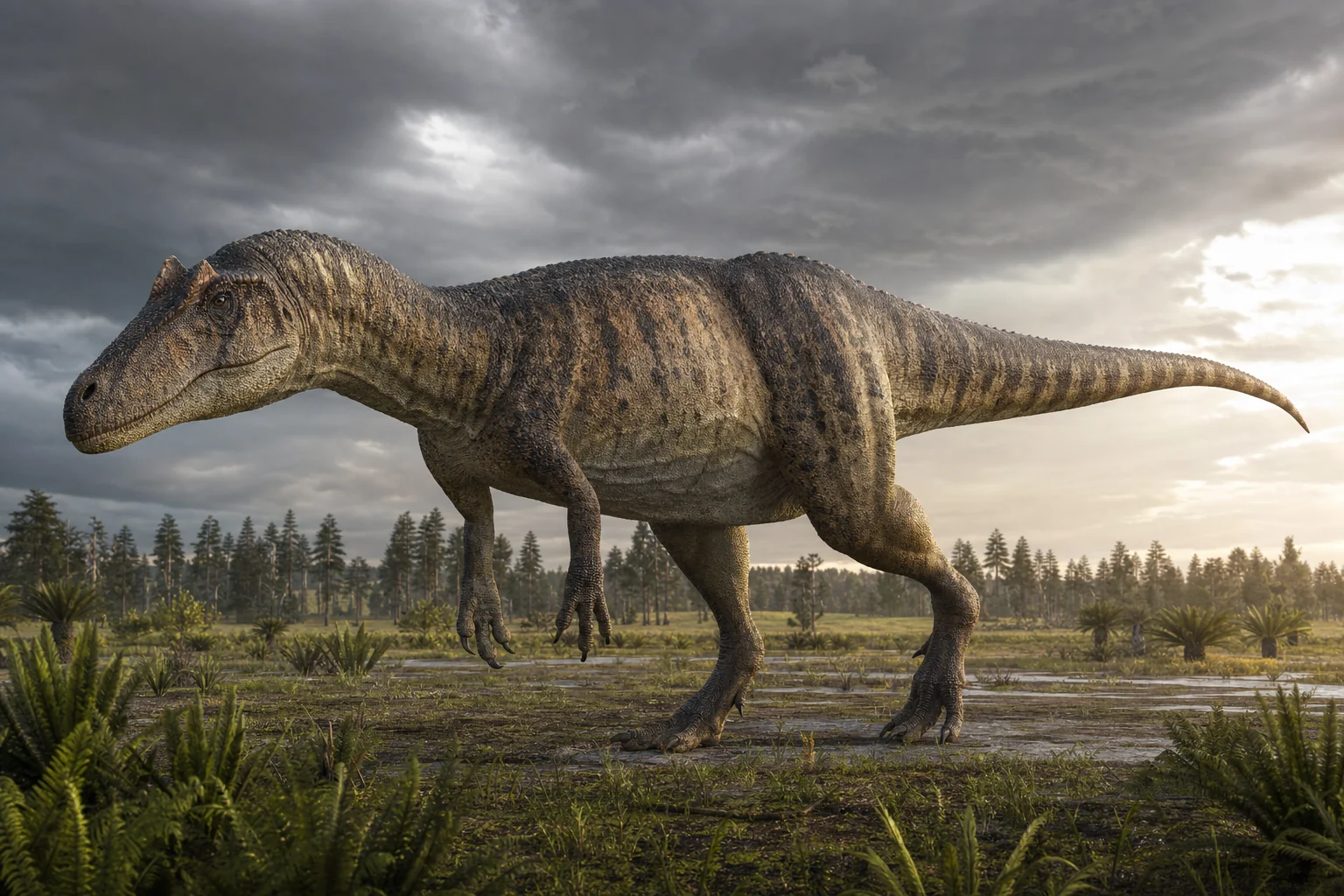 View original image · 1536 × 1024
- Time range
- About 155–145 million years ago
- Final stage
- Late Jurassic
- Geographic range
- Western North America
01 / ANSWER FIRST
What was Allosaurus?
Allosaurus fragilis was a large theropod and common top predator of western North America's Late Jurassic Morrison ecosystem.
Many skeletons reveal growth, injuries and variation better than in most giant theropods. Typical adults were about 8–10 metres long; unusually large Allosaurus material requires taxonomic and scaling caution.
02 / QUICK FACTS
Allosaurus at a glance
- Scientific name
- Allosaurus fragilis
- Age
- ~152–145 million years ago
- Length
- Typical adults ~8–10 m
- Mass
- Often ~1.5–3 tonnes
- Hands
- Three clawed fingers
- Skull
- Light, wide-gaping, brow crests
- Diet
- Large herbivores and carrion
- Range
- Western North America
03 / CORE QUESTION
How did Allosaurus kill and feed?
Its skull tolerated feeding stress despite a lower estimated bite force than Tyrannosaurus. Wide gape, serrated teeth and powerful neck muscles support repeated bites and head retraction that sliced flesh.
The popular hatchet-strike model is only one biomechanical interpretation and has been revised. Bite-marked Stegosaurus and sauropod bones prove carcass contact, but each trace alone cannot distinguish hunting from scavenging.
Read the complete feeding-evidence guideHow to read the numbers
This page separates direct evidence, comparative inference and unresolved debate.
04 / LIFE & DISCOVERY TIMELINE
From Bone Wars name to one of the best-sampled theropods
Morrison predator
Allosaurus shares floodplains with Stegosaurus and sauropods.
Marsh names Allosaurus
Fragmentary bones receive the 'different lizard' name.
Cleveland-Lloyd sample
A dense quarry yields many juvenile and adult bones.
Species and Saurophaganax revised
New skull work and reanalysis refine Allosaurus diversity.
05 / ANATOMY
A mobile-necked theropod with grasping hands
Brow crests
Paired lacrimal horns framed the eyes; display and protection remain hypotheses.
Wide-gaping skull
Jaw joints and muscles permitted a broad gape with cutting teeth.
Three-fingered arms
Long clawed hands could grasp at close range.
Flexible neck
Ball-and-socket vertebral joints enabled strong head movement during feeding.
06 / DIET & BEHAVIOUR
What did Allosaurus eat?
Bite traces and ecosystem context include Stegosaurus and sauropods, whether hunted, scavenged or both.
Read the complete guide07 / DIET & BEHAVIOUR
Did Allosaurus hunt in packs?
Bonebed aggregation may result from drought, traps or carcasses. Coordinated pack hunting is possible but not demonstrated.
08 / RANGE & HABITAT
Where did Allosaurus live?
A. fragilis is best documented across the Morrison Formation of the western United States in seasonal river and floodplain settings.
Utah
Cleveland-Lloyd and Dinosaur National Monument preserve large samples.
Colorado
Quarries produced key skulls and skeletons.
Wyoming
Big Al records growth and extensive healed injury.
Morrison floodplains
Seasonal rivers supported diverse giant herbivores.
09 / FOSSIL EVIDENCE
How do scientists know about Allosaurus?
Many skeletons
Growth series separate typical adults from exceptional claims.
Pathologies
Healed fractures reveal survival and physical risk.
Bite traces
Tooth spacing links feeding to herbivore carcasses.
Digital skull models
FEA and dynamics test bite, gape and neck motion.
10 / DISAPPEARANCE & DEBATE
What makes Allosaurus scientifically important?
Its unusually large sample lets researchers test growth, variation, injury and feeding rather than relying on one giant specimen.
That abundance also creates taxonomic complexity: specimens once pooled together may represent A. fragilis, A. jimmadseni or other material. Strong claims must name the specimen and species.
12 / FREQUENTLY ASKED QUESTIONS
Allosaurus FAQ
How large was Allosaurus?
Typical adults were roughly 8–10 metres and 1.5–3 tonnes.
Was it bigger than T. rex?
No. Typical Allosaurus was substantially smaller and lighter.
How many fingers did it have?
Three clawed fingers on each hand.
Did it hunt Stegosaurus?
Bite traces show interaction and feeding, but do not identify every encounter as a live hunt.
Did it hunt in packs?
Coordinated pack hunting remains unproven.
What was Big Al?
A subadult Allosaurus skeleton with numerous healed and active injuries.
04 / SOURCES & FURTHER READING
Check the source record
Use the scientific name to compare taxonomy, occurrence records and the fossil record. Database coverage and classifications may differ.
05 / REVISION HISTORY
How has this record changed?
- Expanded into a bilingual S-tier hub with two evidence-led guides.
- Verified authoritative entity sources and added three responsive reconstruction sizes.
- Initial bilingual species record published.
06 / CORRECTIONS & ADDITIONS