
Explore this animal in Size of Extinct Animals ↗
41 / Mesozoic
Brachiosaurus
Brachiosaurus altithorax
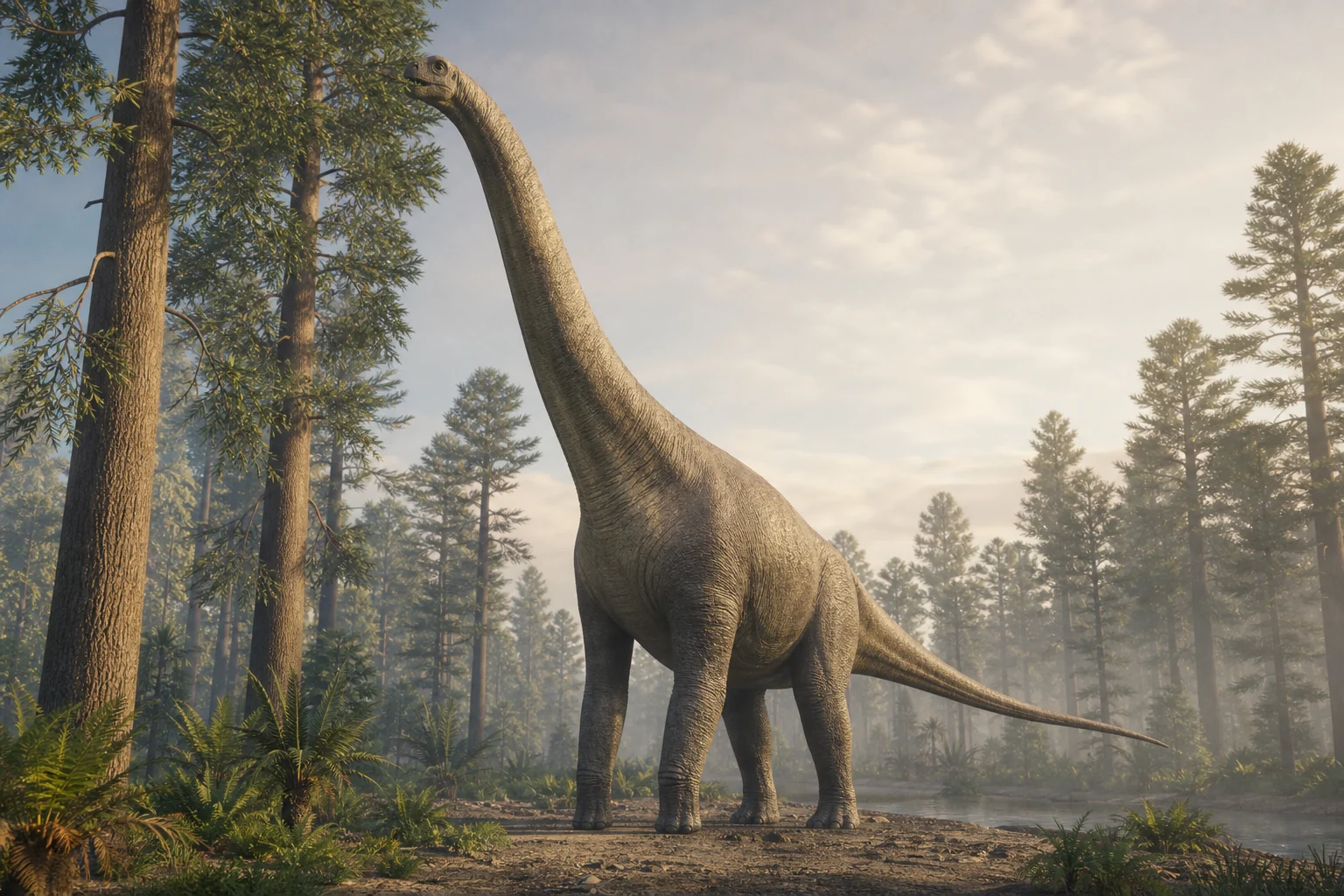
Long forelimbs lifted its shoulders and neck toward the Jurassic canopy.
 View original image · 1536 × 1024
- Time range
- About 154–150 million years ago
- Final stage
- Late Jurassic
- Geographic range
- Western North America
01 / ANSWER FIRST
What was Brachiosaurus?
Brachiosaurus was a giant Late Jurassic sauropod whose longer forelimbs, deep chest and high shoulders created one of the tallest feeding profiles in the Morrison ecosystem.
The North American species Brachiosaurus altithorax is known from an incomplete type skeleton and tentatively referred skull and bones. Much familiar imagery came from the more complete African animal once called Brachiosaurus brancai, now usually Giraffatitan, so responsible reconstructions separate direct anatomy from close-relative inference.
02 / QUICK FACTS
Brachiosaurus at a glance
- Scientific name
- Brachiosaurus altithorax
- Age
- About 154–150 million years ago
- Length
- Roughly 18–22 m in common reconstructions
- Mass
- Several tens of tonnes; uncertain
- Shoulder height
- About 6 m in large reconstructions
- Diet
- Tree foliage and other vegetation
- Range
- Western North America
- Key specimen
- FMNH PR 25107, incomplete holotype
03 / CORE QUESTION
How tall and heavy was Brachiosaurus?
The holotype preserves much of the trunk and limbs but lacks the complete neck, skull and tail. Common reconstructions around 18–22 metres long and several tens of tonnes combine its own proportions with cautious information from close brachiosaurids.
Long forelimbs raised the shoulders and the base of the neck, making vertical reach more important than total length. Exact head height changed with neck pose, soft tissues and specimen maturity; one fixed height should not be treated as a measured fact.
Read the complete size, height and Giraffatitan guideHow to read the numbers
This page separates direct evidence, comparative inference and unresolved debate.
04 / LIFE & DISCOVERY TIMELINE
How the arm lizard changed identity
Holotype excavated
Field Museum crews found a partial giant skeleton in western Colorado.
Brachiosaurus named
Elmer Riggs highlighted the long forelimbs and unusually deep chest.
Giraffatitan separated
The better-known African species was increasingly recognised as a distinct genus.
CT and pneumatic anatomy
Skull, teeth and rib air spaces refined feeding and respiratory reconstruction.
05 / ANATOMY
Built high, lightened from within
Long forelimbs
Forelimbs longer than hindlimbs elevated the shoulders and produced an upward-sloping trunk.
Deep chest
Very long ribs created the high thorax referenced by the species name altithorax.
Pneumatic bones
Air-sac diverticula invaded vertebrae and even ribs, reducing skeletal mass without making the animal hollow.
Small skull
A compact head with spoon-like teeth cropped plants without heavy oral chewing.
06 / DIET & BEHAVIOUR
What did Brachiosaurus eat?
Its high shoulders and long neck opened access to conifer, cycad and other foliage above many contemporary herbivores. CT evidence suggests slower tooth replacement than some Morrison sauropods, implying a different feeding strategy.
Read the complete guide07 / DIET & BEHAVIOUR
Did it rear on two legs?
Its front-heavy high-shouldered build made habitual rearing less likely than in some other sauropods. Occasional posture changes are difficult to exclude, but high browsing did not require permanent bipedal feeding.
08 / RANGE & HABITAT
Where did Brachiosaurus live?
Secure Brachiosaurus altithorax material comes from the Morrison Formation of western North America, a seasonal landscape of rivers, floodplains and woodlands.
Colorado
The holotype and referred skull history anchor the genus in the state.
Morrison floodplains
Seasonal channels and wooded patches supported diverse sauropod communities.
High browse
Conifers and taller vegetation created a feeding zone above lower browsers.
Not African Brachiosaurus
Tanzanian Giraffatitan is a close relative, not evidence that B. altithorax ranged across Africa.
09 / FOSSIL EVIDENCE
What evidence reconstructs Brachiosaurus?
Holotype skeleton
Trunk and limb bones directly establish the deep chest, high shoulders and giant scale.
Tentative skull referral
CT data support a brachiosaurid skull, but lack of overlap with the holotype keeps the referral cautious.
Pneumatic ribs
Openings in holotype ribs record air-sac invasion and internal lightening.
Giraffatitan comparison
More complete African skeletons fill broad gaps while taxonomic differences define where inference must stop.
10 / DISAPPEARANCE & DEBATE
Why did Brachiosaurus disappear?
Brachiosaurus disappears from the record during Late Jurassic ecosystem turnover; no single extinction event is demonstrated for the genus.
Changes in climate, vegetation, geography and dinosaur communities accompanied the end of classic Morrison ecosystems. Brachiosaurid relatives survived into the Cretaceous elsewhere, so the loss of Brachiosaurus was a lineage and regional turnover, not the end of the entire body plan.
12 / FREQUENTLY ASKED QUESTIONS
Brachiosaurus FAQ
How big was Brachiosaurus?
Common reconstructions are roughly 18–22 metres long and several tens of tonnes, but the holotype is incomplete.
How tall was it?
Large reconstructions place the shoulder near 6 metres; head height varied with neck posture.
Is the Berlin skeleton Brachiosaurus?
It is generally classified as Giraffatitan brancai, a related African genus once placed in Brachiosaurus.
Did Brachiosaurus live in water?
No. Columnar limbs, tracks and sauropod anatomy support a fully terrestrial animal; high nostrils do not make a snorkel.
Did it hold its neck straight up?
Probably not in one fixed pose. Neutral posture, feeding and movement could use different neck angles.
What did it eat?
Likely tall conifer and cycad foliage plus other available plants, cropped with spoon-like teeth.
04 / SOURCES & FURTHER READING
Check the source record
Use the scientific name to compare taxonomy, occurrence records and the fossil record. Database coverage and classifications may differ.
05 / REVISION HISTORY
How has this record changed?
- Rewrote an extinction cause that presented environmental or faunal turnover as established; it is now given as context the record does not prove.
- Upgraded to a bilingual S-tier topic hub with two independent evidence guides.
- Verified authoritative entity sources and added three responsive reconstruction sizes.
- Initial bilingual species record published.
06 / CORRECTIONS & ADDITIONS