
STEGOSAURUS TOPIC HUB · DEFENCE EVIDENCE
How Did Stegosaurus Defend Itself Against Allosaurus?
Evidence that Stegosaurus used its tail spikes as weapons: flexible vertebrae, healed injuries, a punctured Allosaurus bone and biomechanical limits.
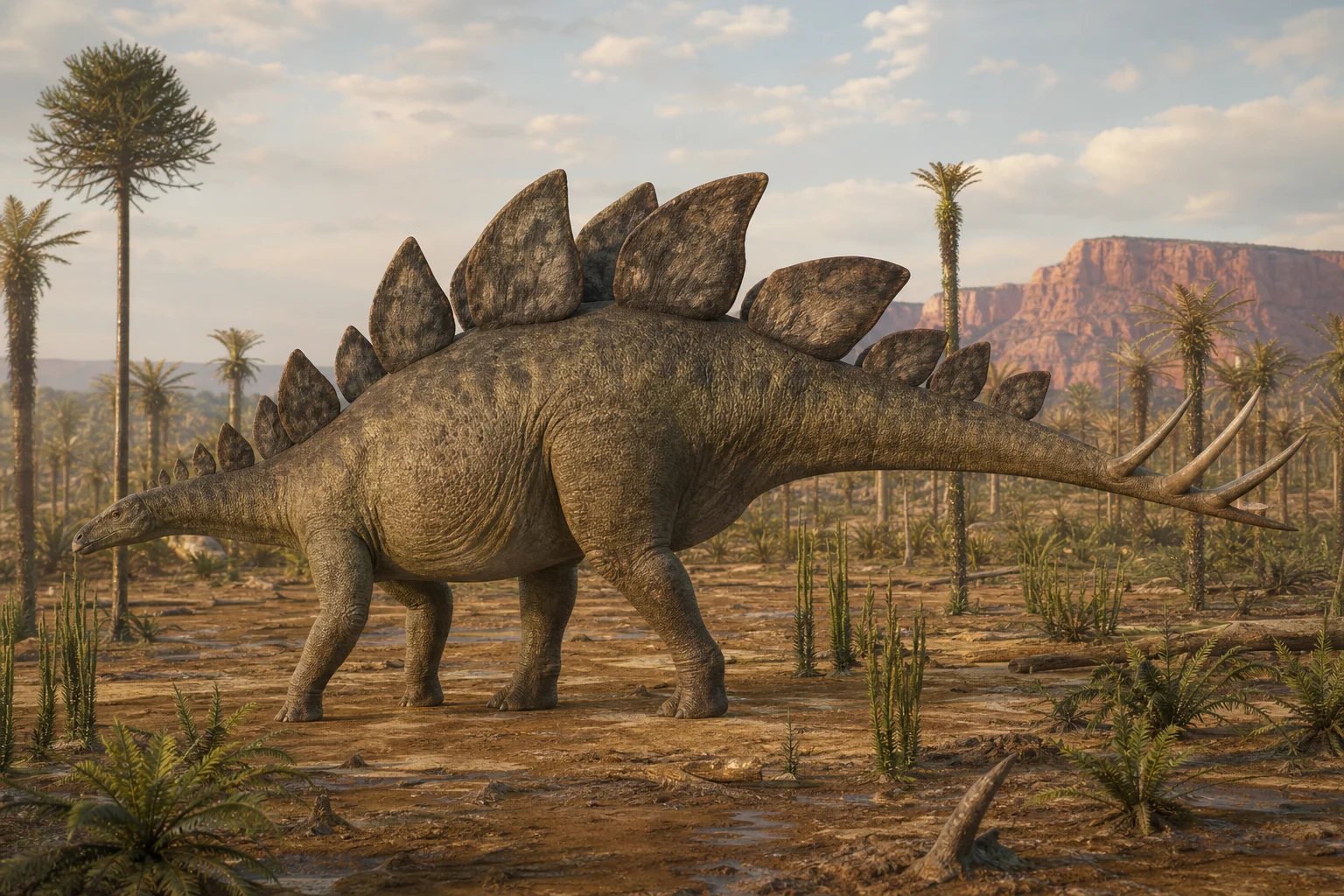 View full-resolution reconstruction ↗
This is an original generative reconstruction, not a photograph or scientific plate. Measurements and interpretations below are tied to named sources.
01 / PHYSICAL EVIDENCE
What proves the tail spikes were weapons?
Some Stegosaurus spikes preserve broken, remodelled tips, showing impacts survived in life. An Allosaurus tail vertebra bears a partly healed puncture whose size and shape match a stegosaur spike.
02 / TAIL MECHANICS
Could the tail swing sideways?
Tail vertebrae and reduced ossified tendons allowed more lateral movement than in many dinosaurs. Large muscle attachments supplied force, while the high hips positioned the spikes near a theropod's legs and body.
03 / THE THAGOMIZER
What was the thagomizer?
The informal name describes two pairs of long spikes at the tail tip. It is useful shorthand, but individual species differed in spike number, angle and proportions.
04 / ALLOSAURUS
Did Allosaurus attack Stegosaurus?
The two animals shared Morrison ecosystems, and the punctured vertebra demonstrates at least one close encounter. It does not establish how often attacks happened, whether the predator initiated them or the outcome of most encounters.
05 / DEFENCE STRATEGY
How might Stegosaurus have positioned itself?
A threatened animal may have turned its hindquarters toward danger and kept the head away, using tail sweeps to control distance. This is a biomechanical scenario, not directly preserved behaviour.
06 / EVIDENCE VERDICT
How certain is the combat reconstruction?
Weapon use is unusually well supported for a dinosaur because both the weapon and compatible injuries exist. Strike speed, targeting, social defence and routine predator tactics remain uncertain.
FREQUENTLY ASKED QUESTIONS
Questions readers ask
How big was Stegosaurus?
Large individuals reached about 9 metres; mass varies with specimen and maturity.
Were the plates flat?
No. Articulated evidence supports two staggered rows standing upright in the skin.
Did it have two brains?
No. The enlarged sacral space was not a second brain; comparable structures store glycogen in living birds.
Could the tail spikes injure Allosaurus?
Yes. A healed Allosaurus puncture and damaged Stegosaurus spikes support real weapon use.
What were the plates for?
Display and recognition are plausible; heat exchange may have contributed, but no single function is proven.
Did it meet T. rex?
No. Stegosaurus lived roughly 80 million years earlier; Allosaurus was a contemporary predator.
SOURCES & FURTHER READING
Evidence used in this guide
Measurements and interpretations are tied to museum resources or peer-reviewed studies; disputed conclusions include evidence on both sides.
- 01Stegosaurus ↗Natural History Museum, London
Museum overview of size, plates, diet, range and tail defence.
- 02Secrets of the Stegosaurus ↗Natural History Museum, London
Sophie’s skeleton, 3D mass methods, maturity and preserved armour.
- 03New insights into the lifestyle of Allosaurus ↗PeerJ
Peer-reviewed pathology review including the tail-spike interpretation of an Allosaurus wound.