
STEGOSAURUS TOPIC HUB · SIZE & ANATOMY
Stegosaurus Size, Plates and the Two-Brain Myth
How large was Stegosaurus, how were its plates arranged, what did they do, and why the dinosaur did not have a second brain?
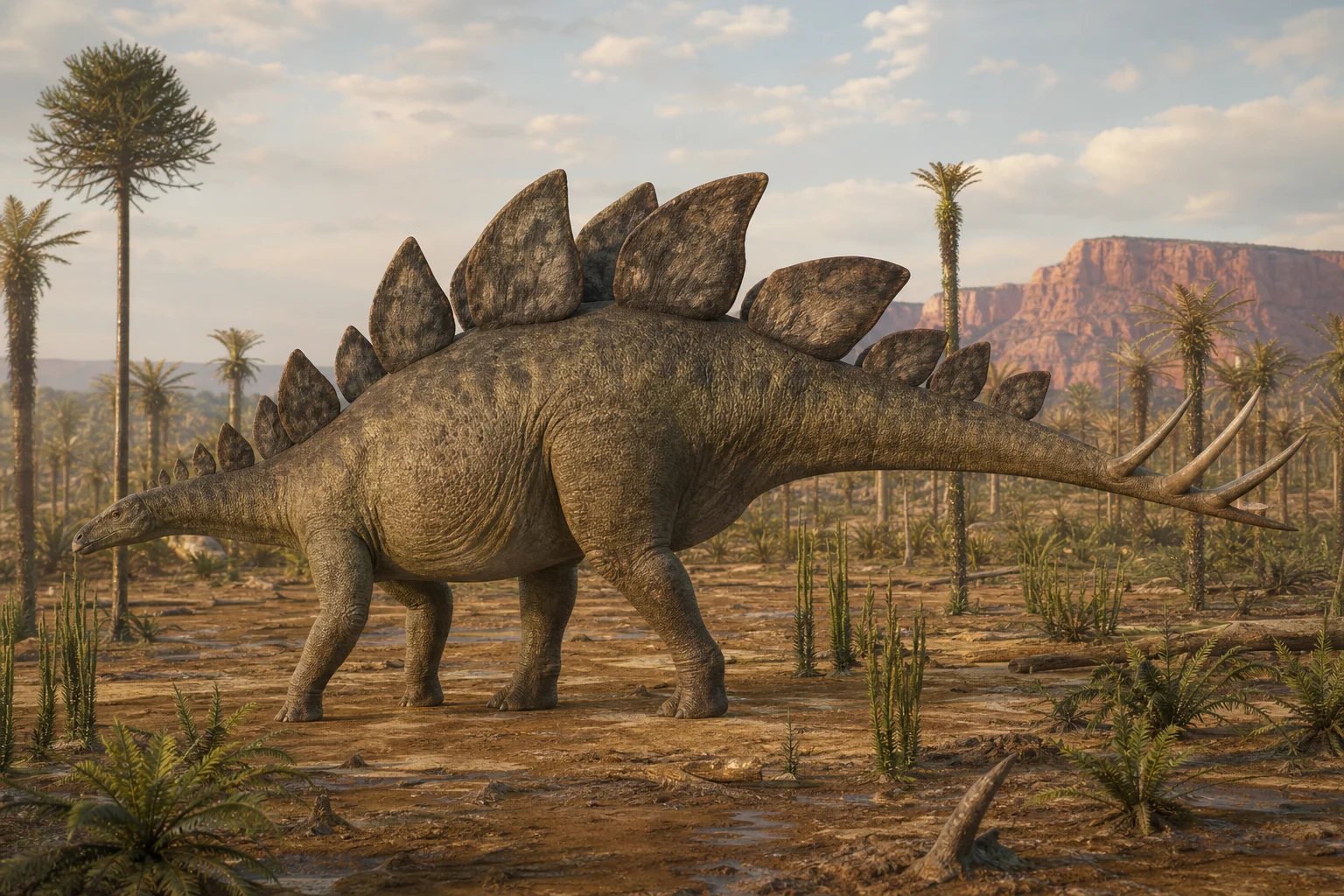 View full-resolution reconstruction ↗
This is an original generative reconstruction, not a photograph or scientific plate. Measurements and interpretations below are tied to named sources.
01 / SIZE
How big was Stegosaurus?
The largest Stegosaurus specimens approach 9 metres, but most complete skeletons are smaller. Mass depends strongly on specimen maturity and how the deep torso is reconstructed.
02 / SOPHIE
Why is the Sophie skeleton important?
More than 80 percent complete, Sophie preserves much of one animal in reliable association. Three-dimensional scans improve posture and mass estimates while growth evidence shows it was a young adult.
03 / PLATE ARRANGEMENT
How were the plates arranged?
Articulated finds support two alternating rows standing upright in skin rather than one paired row or a flat roof. Exact symmetry and spacing varied along the neck, back and tail.
04 / PLATE FUNCTION
What were the plates for?
Display and recognition fit their visibility and growth changes; blood-vessel grooves make heat exchange possible. Fossils do not demonstrate one exclusive function, and the thin plates offered limited armour.
05 / BRAIN MYTH
Did Stegosaurus have two brains?
No. A widened sacral canal was once imagined as a second brain, but comparable spaces in living birds contain a glycogen-rich organ. Movement was controlled by the brain in the skull and spinal nervous system.
06 / EVIDENCE VERDICT
Which features are certain and uncertain?
Upright plates, high hips, short forelimbs and four tail spikes are well supported. Plate colour, soft-tissue edges, adult mass and the balance among display and thermal roles remain uncertain.
FREQUENTLY ASKED QUESTIONS
Questions readers ask
How big was Stegosaurus?
Large individuals reached about 9 metres; mass varies with specimen and maturity.
Were the plates flat?
No. Articulated evidence supports two staggered rows standing upright in the skin.
Did it have two brains?
No. The enlarged sacral space was not a second brain; comparable structures store glycogen in living birds.
Could the tail spikes injure Allosaurus?
Yes. A healed Allosaurus puncture and damaged Stegosaurus spikes support real weapon use.
What were the plates for?
Display and recognition are plausible; heat exchange may have contributed, but no single function is proven.
Did it meet T. rex?
No. Stegosaurus lived roughly 80 million years earlier; Allosaurus was a contemporary predator.
SOURCES & FURTHER READING
Evidence used in this guide
Measurements and interpretations are tied to museum resources or peer-reviewed studies; disputed conclusions include evidence on both sides.
- 01Stegosaurus ↗Natural History Museum, London
Museum overview of size, plates, diet, range and tail defence.
- 02Secrets of the Stegosaurus ↗Natural History Museum, London
Sophie’s skeleton, 3D mass methods, maturity and preserved armour.
- 03New insights into the lifestyle of Allosaurus ↗PeerJ
Peer-reviewed pathology review including the tail-spike interpretation of an Allosaurus wound.