
SPINOSAURUS TOPIC HUB · SIZE & ANATOMY
Spinosaurus Size, Sail and Body Shape: A Changing Reconstruction
How large was Spinosaurus? Examine incomplete skeletons, body mass, the sail, shortened legs, deep tail and why reconstructions keep changing.
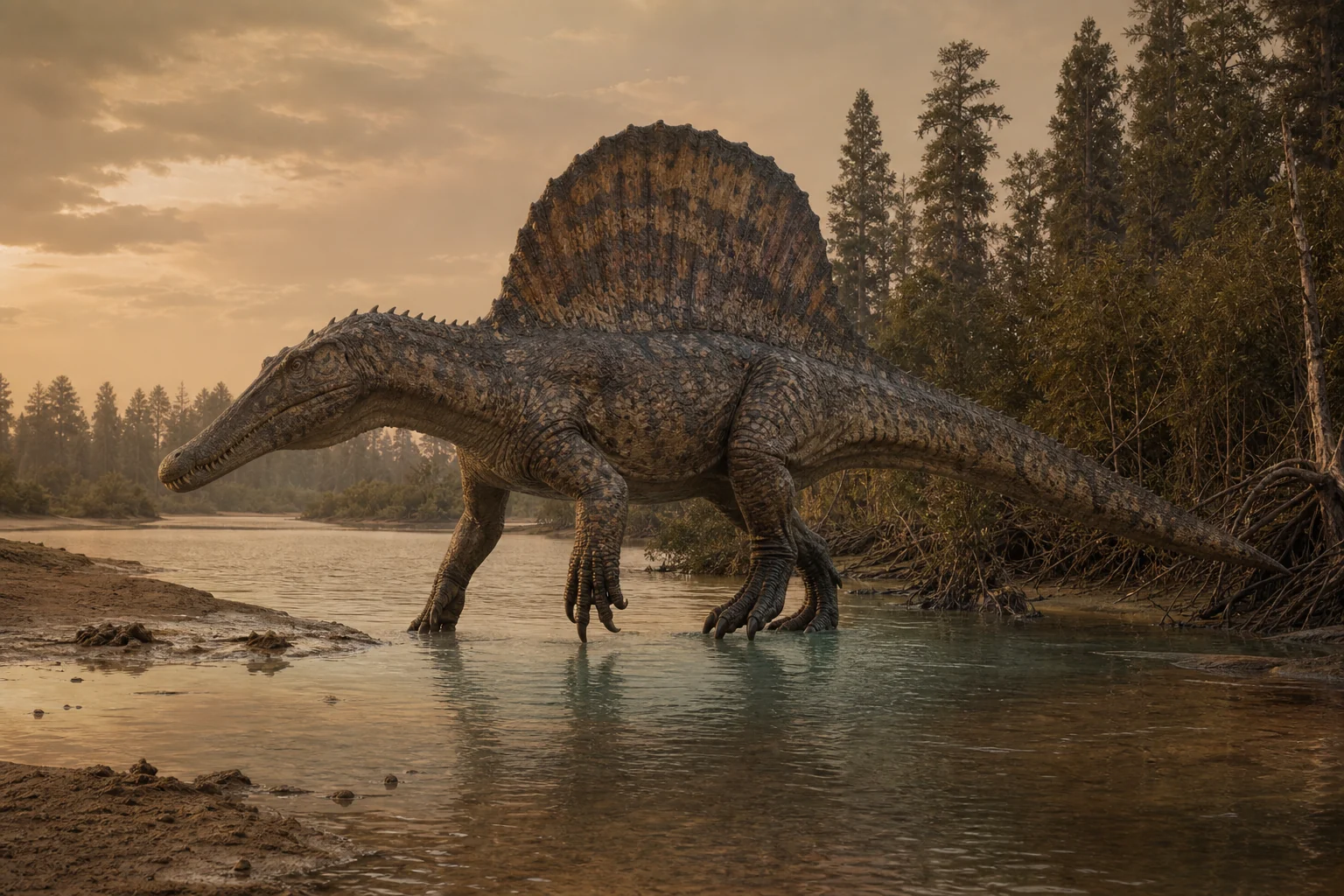 View full-resolution reconstruction ↗
This is an original generative reconstruction, not a photograph or scientific plate. Measurements and interpretations below are tied to named sources.
01 / FOSSIL RECORD
Why is there no definitive Spinosaurus skeleton?
The first partial Egyptian skeleton was destroyed in 1944. Modern Moroccan material adds skull, trunk, limbs and tail, but researchers debate whether all pieces belong to one individual and how mature that individual was.
A composite can reveal anatomy but cannot be measured as if it were one complete body. Scaling each region from differently sized individuals compounds uncertainty.
02 / LENGTH & MASS
Was Spinosaurus the largest carnivorous dinosaur?
It was probably among the longest, with popular museum estimates near 14 metres. Length is not mass: its long snout, extended vertebral spines and long tail add linear dimensions without creating the deep muscular torso of the heaviest tyrannosaurs.
Mass estimates of several tonnes depend on ribcage depth, soft-tissue sail and density. Claims of a precise record-holder should identify the specimen and metric—length, mass or height.
03 / THE SAIL
What did the tall back spines support?
Some neural spines rose about 1.5 metres above the vertebral bodies. Bone texture and spacing are compatible with a tall soft-tissue display, but fossils do not preserve its complete edge, thickness or colour.
Display and recognition are widely plausible because the structure dominated the silhouette. Thermoregulation, fat storage and hydrodynamic roles have been proposed, yet none excludes multiple functions.
04 / LEGS & POSTURE
Could Spinosaurus walk normally on land?
Its hindlimbs were proportionally shorter than in many giant theropods. That lowered the hips and shifted the centre of mass, but it does not prove a permanently quadrupedal or helpless terrestrial animal.
Trackways are unknown and the hands lack ordinary weight-bearing adaptations. Digital models disagree over stance because pelvic position, soft-tissue mass and specimen association remain uncertain.
05 / THE DEEP TAIL
How did the tail change the reconstruction?
Associated tail vertebrae published in 2020 have very tall spines and elongated chevrons, producing a broad vertical profile. Physical models generated more aquatic thrust than ordinary theropod tails.
Greater thrust shows capability, not an entire lifestyle. The tail also affected display, balance and terrestrial mass distribution, and whole-body drag remains contested.
06 / RECONSTRUCTION RULES
How should Spinosaurus be illustrated today?
Show the long narrow snout, tall sail, shortened hindlimbs and deep tail, while leaving room for uncertainty in torso depth, stance, sail thickness and colour. Label exact length and mass values as estimates rather than observations.
FREQUENTLY ASKED QUESTIONS
Questions readers ask
Was Spinosaurus bigger than T. rex?
It was probably longer, often reconstructed near 14 metres, but likely lighter than the heaviest T. rex. Both estimates depend on incomplete fossils and different body plans.
Could Spinosaurus swim?
Almost certainly at some level. The unresolved question is whether it was an efficient underwater pursuit predator or mainly a wader and surface swimmer.
What was the sail for?
Display and recognition are plausible; thermoregulation, fat storage and aquatic roles have also been proposed. Fossils do not preserve colour or the complete soft-tissue outline.
What did Spinosaurus eat?
Its snout and teeth are specialised for seizing fish, but it was probably an opportunistic carnivore capable of eating other animals and carrion.
Why was the first skeleton lost?
The Munich museum collection holding it was destroyed in a 1944 Allied bombing raid. Stromer's descriptions and photographs remain important evidence.
Did Spinosaurus walk on four legs?
A permanently quadrupedal gait is not established. Forelimbs were robust, but the hands and shoulder anatomy were not built like normal weight-bearing feet.
SOURCES & FURTHER READING
Evidence used in this guide
Measurements and interpretations are tied to museum resources or peer-reviewed studies; disputed conclusions include evidence on both sides.
- 01Spinosaurus ↗Natural History Museum, London
Museum overview of size, anatomy, diet, sail and semi-aquatic interpretation.
- 02Tail-propelled aquatic locomotion in a theropod dinosaur ↗Nature
Physical tail-model tests supporting greater aquatic thrust.
- 03Subaqueous foraging among carnivorous dinosaurs ↗Nature
Comparative bone-density evidence for subaqueous foraging in Spinosaurus.
- 04Spinosaurus is not an aquatic dinosaur ↗eLife
Hydrodynamic and skeletal critique of specialised pursuit-diving interpretations.
- 05New sabre-crested Spinosaurus species ↗Natural History Museum, London
Current evidence favouring wading in another Spinosaurus species and documenting display anatomy.