
SPINOSAURUS TOPIC HUB · AQUATIC ECOLOGY
Could Spinosaurus Swim and What Did It Eat? The Evidence Debate
Fish-eating anatomy, tail propulsion, dense bones, hydrodynamic criticism and the evidence for Spinosaurus as a wader, surface swimmer or underwater hunter.
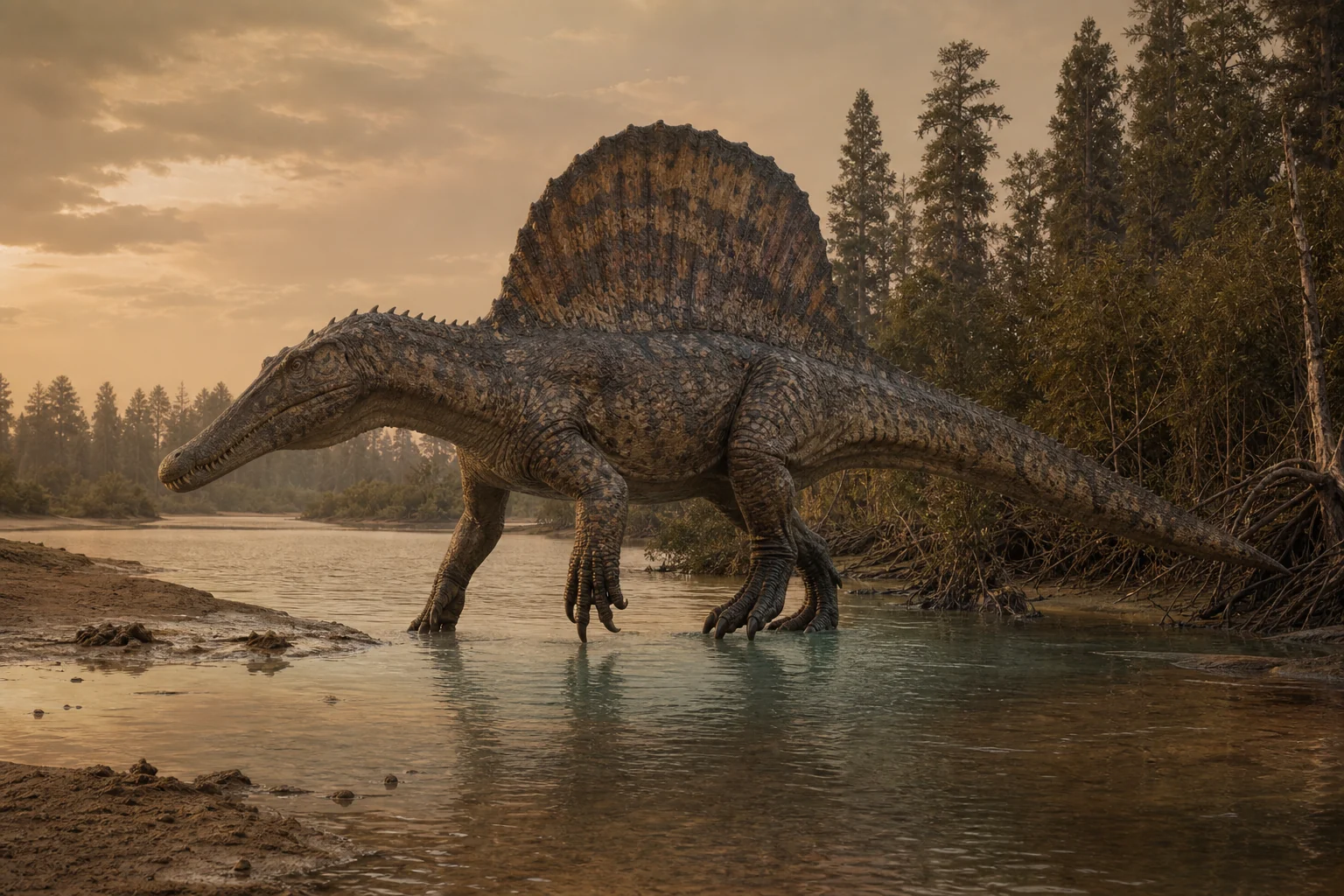 View full-resolution reconstruction ↗
This is an original generative reconstruction, not a photograph or scientific plate. Measurements and interpretations below are tied to named sources.
01 / FISH-EATING ANATOMY
What proves Spinosaurus ate fish?
Its long narrow jaws, terminal expansion and interlocking smooth conical teeth resemble prey-gripping systems in fish-eating crocodilians. Related Baryonyx preserves fish scales in its body cavity, strengthening the family-level interpretation.
Fish-specialised does not mean fish-only. Spinosaurids could seize terrestrial animals, scavenge and exploit stranded prey, especially in seasonal rivers.
02 / TAIL PROPULSION
Could the tail propel Spinosaurus?
Robotic flapping tests found the deep tail produced greater thrust and efficiency than tails of terrestrial theropods. The profile was closer to aquatic vertebrate propulsors, supporting meaningful swimming performance.
The experiment compared isolated tail shapes. It did not demonstrate speed, manoeuvrability or energetic efficiency of the complete sail-backed animal.
03 / BONE DENSITY
What do dense bones indicate?
Spinosaurus ribs and femora have reduced internal spaces. Across many living and extinct animals, dense bones often act as ballast in species that forage underwater.
Body size and load-bearing can also increase density, and not every diver follows the same pattern. Bone density is strong comparative evidence, not a direct film of behaviour.
04 / HYDRODYNAMIC CRITIQUE
Why do some researchers reject pursuit diving?
Whole-body models find substantial drag from the sail and trunk, difficulty maintaining stable roll and pitch, and limited tail muscle volume relative to specialised aquatic reptiles.
These results support a shoreline or shallow-water hunter that could swim but was not built for fast underwater chases. Critics of that critique note uncertainty in soft tissue and specimen reconstruction.
05 / COMPETING MODELS
Wader, surface swimmer or diver?
All three models agree that water and fish were central. A wader stalks from shallows; a surface swimmer crosses and forages at the air-water boundary; a pursuit diver submerges and actively chases prey.
Current fossils establish capacity better than frequency. Spinosaurus may have used different modes by depth, prey and season instead of fitting one label permanently.
06 / EVIDENCE VERDICT
What can we safely say?
Spinosaurus was a fish-adapted, water-associated theropod with a tail capable of useful aquatic thrust and dense bones compatible with subaqueous foraging. Efficient deep pursuit diving remains a testable but disputed interpretation.
FREQUENTLY ASKED QUESTIONS
Questions readers ask
Was Spinosaurus bigger than T. rex?
It was probably longer, often reconstructed near 14 metres, but likely lighter than the heaviest T. rex. Both estimates depend on incomplete fossils and different body plans.
Could Spinosaurus swim?
Almost certainly at some level. The unresolved question is whether it was an efficient underwater pursuit predator or mainly a wader and surface swimmer.
What was the sail for?
Display and recognition are plausible; thermoregulation, fat storage and aquatic roles have also been proposed. Fossils do not preserve colour or the complete soft-tissue outline.
What did Spinosaurus eat?
Its snout and teeth are specialised for seizing fish, but it was probably an opportunistic carnivore capable of eating other animals and carrion.
Why was the first skeleton lost?
The Munich museum collection holding it was destroyed in a 1944 Allied bombing raid. Stromer's descriptions and photographs remain important evidence.
Did Spinosaurus walk on four legs?
A permanently quadrupedal gait is not established. Forelimbs were robust, but the hands and shoulder anatomy were not built like normal weight-bearing feet.
SOURCES & FURTHER READING
Evidence used in this guide
Measurements and interpretations are tied to museum resources or peer-reviewed studies; disputed conclusions include evidence on both sides.
- 01Spinosaurus ↗Natural History Museum, London
Museum overview of size, anatomy, diet, sail and semi-aquatic interpretation.
- 02Tail-propelled aquatic locomotion in a theropod dinosaur ↗Nature
Physical tail-model tests supporting greater aquatic thrust.
- 03Subaqueous foraging among carnivorous dinosaurs ↗Nature
Comparative bone-density evidence for subaqueous foraging in Spinosaurus.
- 04Spinosaurus is not an aquatic dinosaur ↗eLife
Hydrodynamic and skeletal critique of specialised pursuit-diving interpretations.
- 05New sabre-crested Spinosaurus species ↗Natural History Museum, London
Current evidence favouring wading in another Spinosaurus species and documenting display anatomy.