
Explore this animal in Size of Extinct Animals ↗
44 / Mesozoic
Giganotosaurus
Giganotosaurus carolinii
A giant narrow-skulled theropod shared its world with immense sauropods.
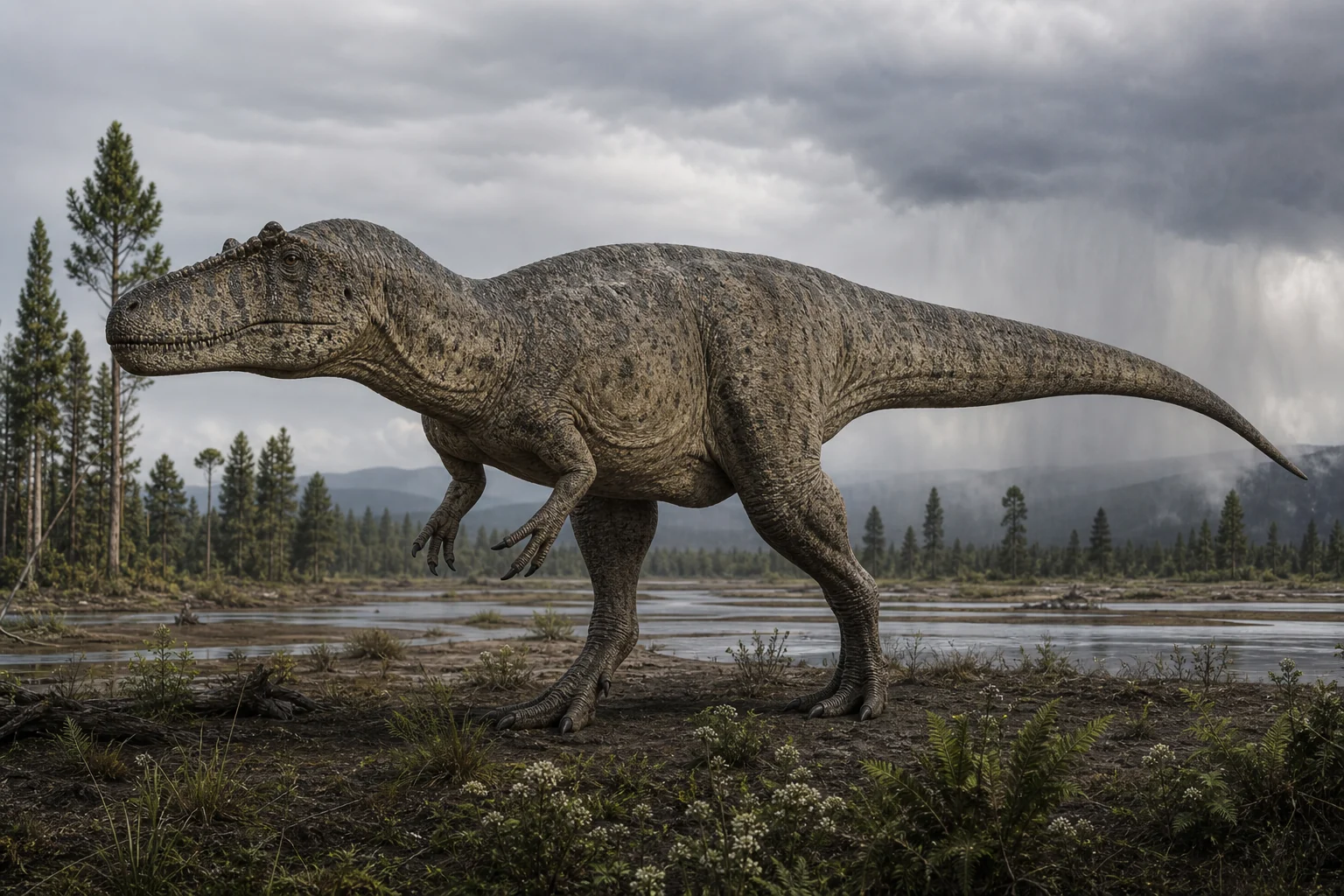 View original image · 1536 × 1024
- Time range
- About 99.6–97 million years ago
- Final stage
- Early Late Cretaceous
- Geographic range
- South America · Present-day Argentina
01 / ANSWER FIRST
What was Giganotosaurus?
Giganotosaurus carolinii was a giant carcharodontosaurid theropod that lived in Patagonia about 98 million years ago.
The holotype preserves much of the skeleton but its skull is incomplete. A minimum length near 12 metres is well supported; higher 13–14-metre claims depend on fragmentary material and older long-skull reconstructions.
02 / QUICK FACTS
Giganotosaurus at a glance
- Scientific name
- Giganotosaurus carolinii
- Age
- ~99–97 million years ago
- Length
- At least ~12 m; upper estimates debated
- Mass
- Often estimated ~6–8 tonnes
- Skull
- Incomplete; reconstructed ~1.5–1.6 m
- Teeth
- Laterally compressed and serrated
- Family
- Carcharodontosauridae
- Range
- Neuquén, Argentina
03 / CORE QUESTION
Was Giganotosaurus bigger than Tyrannosaurus rex?
Giganotosaurus may have been slightly longer than many T. rex specimens, but length estimates overlap and its tail and body proportions differ. The heaviest well-measured T. rex individuals probably exceeded the Giganotosaurus holotype in mass.
Their heads and teeth indicate different feeding systems: Giganotosaurus had a long light skull with slicing teeth, while T. rex had a deeper skull and robust bone-crushing dentition. They lived about 30 million years apart and never met.
Read the complete comparison guideHow to read the numbers
This page separates direct evidence, comparative inference and unresolved debate.
04 / LIFE & DISCOVERY TIMELINE
A Patagonian skeleton changes the giant-theropod record
Huincul apex predator
Large carcharodontosaurids hunt amid giant sauropods.
Rubén Carolini discovers bones
A field discovery begins excavation near Villa El Chocón.
Species described
Coria and Salgado name Giganotosaurus carolinii.
Skull length revised
Braincase and relatives shorten exaggerated early reconstructions.
05 / ANATOMY
A long-skulled slicing predator
Long skull
A narrow elongated cranium increased reach but is incompletely preserved.
Blade-like teeth
Compressed serrated crowns cut flesh rather than resist repeated bone crushing.
Powerful hind limbs
A 1.43-metre femur and robust pelvis supported a multi-tonne body.
Reduced arms
Carcharodontosaurid forelimbs were smaller than Allosaurus arms but not tyrannosaurid two-fingered limbs.
06 / DIET & BEHAVIOUR
What did Giganotosaurus eat?
It likely hunted large herbivores and scavenged, but no direct gut content or kill site ties it specifically to adult Argentinosaurus.
Read the complete guide07 / DIET & BEHAVIOUR
Did it hunt in packs?
A related Mapusaurus bonebed shows aggregation, not coordinated Giganotosaurus hunting. Pack claims remain unproven.
08 / RANGE & HABITAT
Where did Giganotosaurus live?
Secure remains come from the Candeleros Formation in Neuquén Province, within the broader early Late-Cretaceous Patagonian ecosystem.
Villa El Chocón
The holotype locality and museum preserve the defining skeleton.
Candeleros floodplains
Braided rivers crossed semi-arid landscapes.
Neuquén Basin
Sediments preserve diverse dinosaurs and reptiles.
South American isolation
Distinct predator lineages evolved apart from northern tyrannosaurids.
09 / FOSSIL EVIDENCE
How do scientists know about Giganotosaurus?
Holotype skeleton
Skull, vertebrae, pelvis and limbs establish anatomy and minimum size.
Second dentary
A larger jaw fragment tests individual variation but not a whole body.
Braincase
Anatomy constrains skull length, senses and carcharodontosaurid relationships.
Huincul fauna
Associated herbivores define available prey without proving attacks.
10 / DISAPPEARANCE & DEBATE
What remains uncertain about Giganotosaurus?
Its minimum giant size and carcharodontosaurid identity are secure, while maximum length, skull outline, social behaviour and exact prey remain uncertain.
Only two important individuals are known. New relatives help fill anatomy but should not silently replace missing Giganotosaurus bones.
12 / FREQUENTLY ASKED QUESTIONS
Giganotosaurus FAQ
How long was Giganotosaurus?
At least about 12 metres; higher estimates are debated.
Was it bigger than T. rex?
It may have been longer, while the largest T. rex was likely heavier.
Did they fight?
No. They lived on different continents about 30 million years apart.
What did it eat?
Large Patagonian herbivores were likely prey or carrion.
Did it hunt Argentinosaurus?
Possible ecological overlap exists, but no direct attack fossil is known.
Did it hunt in packs?
There is no direct Giganotosaurus evidence for coordinated packs.
04 / SOURCES & FURTHER READING
Check the source record
Use the scientific name to compare taxonomy, occurrence records and the fossil record. Database coverage and classifications may differ.
05 / REVISION HISTORY
How has this record changed?
- Expanded into a bilingual S-tier hub with two evidence-led guides.
- Verified authoritative entity sources and added three responsive reconstruction sizes.
- Initial bilingual species record published.
06 / CORRECTIONS & ADDITIONS