
Explore this animal in Size of Extinct Animals ↗
106 / Mesozoic
Argentinosaurus
Argentinosaurus huinculensis
A handful of colossal vertebrae and limb bones indicate one of the largest land animals known.
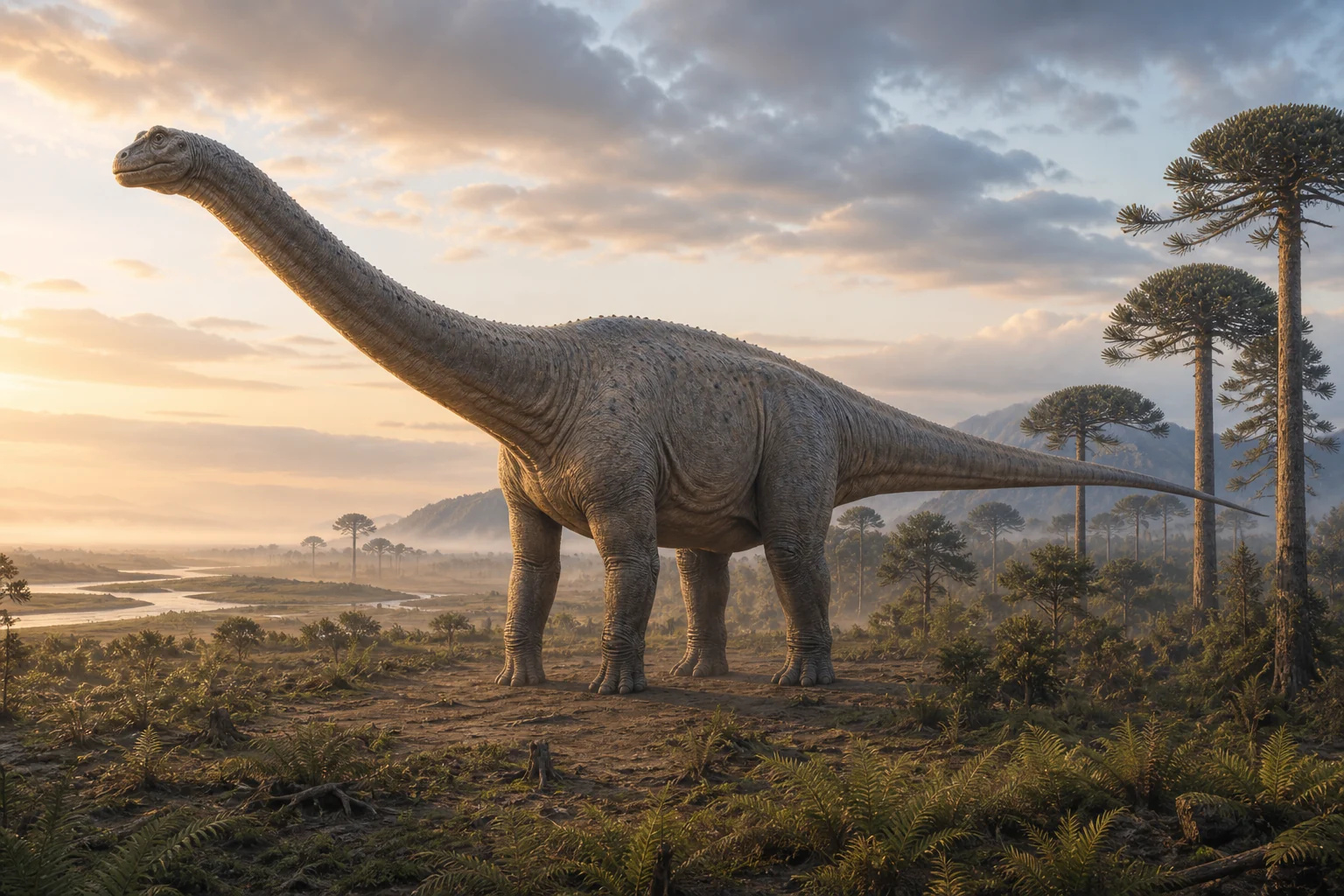 View original image · 1536 × 1024
- Time range
- About 96–92 million years ago
- Final stage
- Early Late Cretaceous
- Geographic range
- South America · Present-day Argentina
01 / ANSWER FIRST
What was Argentinosaurus?
Argentinosaurus huinculensis was a colossal titanosaur sauropod from mid-Cretaceous Patagonia and one of the largest dinosaurs supported by diagnostic fossils.
Only several vertebrae, ribs, a sacrum fragment, tibia and fibula are securely known. Complete skeletons are scaled composites, so length near 30–35 metres and mass around 60–80 tonnes are ranges rather than direct measurements.
02 / QUICK FACTS
Argentinosaurus at a glance
- Scientific name
- Argentinosaurus huinculensis
- Age
- ~96–92 million years ago
- Length
- Often estimated ~30–35 m
- Mass
- Often estimated ~60–80 tonnes
- Identity
- Giant titanosaur sauropod
- Diet
- High-volume herbivore
- Evidence
- Fragmentary vertebrae and limb bones
- Range
- Neuquén, Argentina
03 / CORE QUESTION
How big was Argentinosaurus really?
Giant vertebrae and limb bones directly establish exceptional scale, but body length depends on comparison with more complete titanosaurs. Reconstructions near 30–35 metres are widely defensible; the 39.7-metre museum model is one explicit composite.
Mass estimates vary with the skeleton, soft-tissue outline and density. A 2013 convex-hull model produced 83.2 tonnes for the museum reconstruction, while other methods often return lower values. No single number applies to every adult.
Read the complete size-estimation guideHow to read the numbers
This page separates direct evidence, comparative inference and unresolved debate.
04 / LIFE & DISCOVERY TIMELINE
A few enormous bones become a biomechanical giant
Patagonian giant
Titanosaurs browse floodplain vegetation in the Huincul ecosystem.
First fossil found
A rancher reports a giant bone in Neuquén Province.
Species named
Vertebrae and limbs establish Argentinosaurus huinculensis.
Digital walking model
A scanned museum reconstruction tests mass and locomotion.
05 / ANATOMY
A giant body known from its load-bearing core
Huge vertebrae
Dorsal centra and arches reveal a broad air-filled axial skeleton.
Robust hind limb
Tibia and fibula constrain columnar support and scaling.
Air-sac system
Vertebral cavities lightened the skeleton without making the body hollow.
Long neck and tail
Their proportions are inferred mainly from related titanosaurs.
06 / DIET & BEHAVIOUR
What did Argentinosaurus eat?
Teeth are not securely associated, so diet is inferred as bulk plant feeding from titanosaur relatives and available flora.
Read the complete guide07 / DIET & BEHAVIOUR
Could it run?
Digital models support steady walking; high-speed running would impose extreme forces and is not demonstrated.
08 / RANGE & HABITAT
Where did Argentinosaurus live?
All diagnostic fossils come from the Huincul Formation of Neuquén Province, a warm seasonal floodplain system.
Plaza Huincul
The type locality and museum anchor the species.
River floodplains
Sediments record channels, soils and seasonal disturbance.
Patagonian woodland
Conifers and flowering plants supplied forage.
Huincul fauna
Large theropods and other sauropods shared the region.
09 / FOSSIL EVIDENCE
How do scientists know about Argentinosaurus?
Type vertebrae
Diagnostic shapes establish identity and extraordinary scale.
Limb bones
Weight-bearing dimensions constrain mass and stance.
Comparative skeletons
More complete titanosaurs fill missing proportions with uncertainty.
Digital dynamics
Musculoskeletal simulation tests feasible walking patterns.
10 / DISAPPEARANCE & DEBATE
Was Argentinosaurus the largest dinosaur?
It is one of the strongest candidates, but fragmentary fossils prevent a definitive single-species ranking.
Patagotitan and other giant titanosaurs preserve different portions and produce overlapping estimates. Ranking should compare methods and uncertainty, not just the largest published number.
12 / FREQUENTLY ASKED QUESTIONS
Argentinosaurus FAQ
How long was Argentinosaurus?
Most defensible reconstructions are roughly 30–35 metres.
How much did it weigh?
Common estimates span roughly 60–80 tonnes, with model dependence.
Is there a complete skeleton?
No. Only several vertebrae and limb elements are securely known.
Was it larger than a blue whale?
No. The largest blue whales are substantially heavier.
Could it run?
Steady walking is supported; running is not demonstrated.
Did Giganotosaurus hunt it?
They shared a formation broadly, but no direct fossil records an attack on Argentinosaurus.
04 / SOURCES & FURTHER READING
Check the source record
Use the scientific name to compare taxonomy, occurrence records and the fossil record. Database coverage and classifications may differ.
05 / REVISION HISTORY
How has this record changed?
- Expanded into a bilingual S-tier hub with two evidence-led guides.
- Verified authoritative entity sources and added three responsive reconstruction sizes.
- Initial bilingual species record published.
06 / CORRECTIONS & ADDITIONS