
Explore this animal in Size of Extinct Animals ↗
42 / Mesozoic
Diplodocus
Diplodocus carnegii
A whip-like tail balanced an extremely long neck on this lightly built giant.
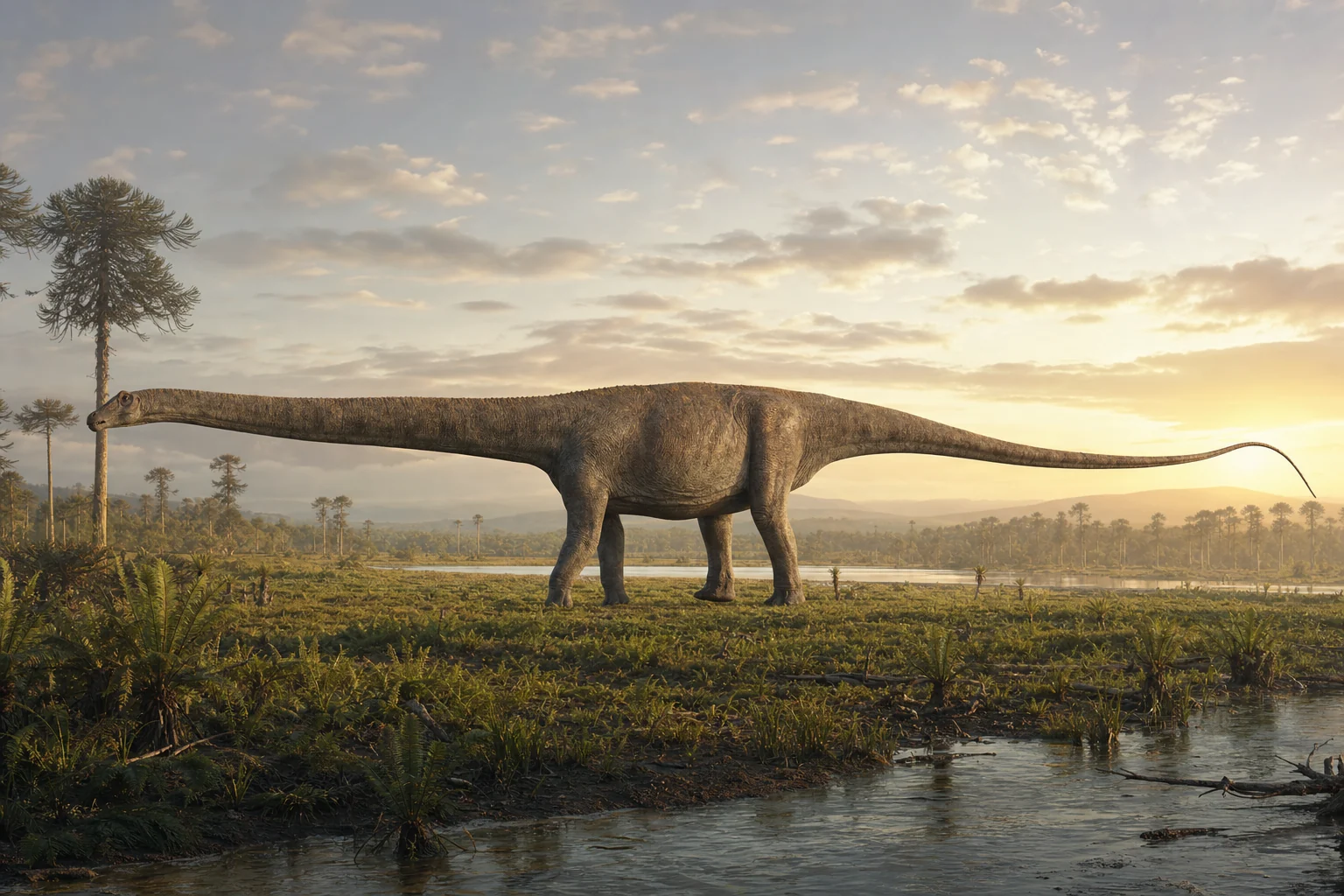 View original image · 1536 × 1024
- Time range
- About 154–152 million years ago
- Final stage
- Late Jurassic
- Geographic range
- Western North America
01 / ANSWER FIRST
What was Diplodocus?
Diplodocus was a long, lightly built sauropod that lived on Late Jurassic floodplains of western North America about 154–152 million years ago.
Its body was balanced between an elongated neck and an even longer tapering tail. Several substantial skeletons make its proportions better known than those of many giant sauropods, but mass, habitual neck angle and tail function still depend on models rather than direct observation.
02 / QUICK FACTS
Diplodocus at a glance
- Scientific name
- Diplodocus carnegii
- Age
- About 154–152 million years ago
- Length
- About 24–26 m for D. carnegii
- Mass
- Around 12–15 tonnes; model-dependent
- Diet
- Herbivore; stripped soft vegetation
- Posture
- Quadrupedal with tail held clear of ground
- Tail
- More than 70 vertebrae; no proven sonic boom
- Range
- Morrison Formation, western USA
03 / CORE QUESTION
Could Diplodocus crack its tail like a supersonic whip?
The tail narrowed from a muscular base to very slender terminal vertebrae, so the whip analogy is anatomically understandable. Earlier computer models proposed a hypothetical soft-tissue tip that might exceed the speed of sound.
A newer multibody model that included air resistance and soft-tissue strength found much lower speeds and predicted that a supersonic tip would fail. Forceful sweeping, defence, display or contact remain possible, but a sonic boom is not supported by current biomechanical evidence.
Read the complete tail-biomechanics guideHow to read the numbers
This page separates direct evidence, comparative inference and unresolved debate.
04 / LIFE & DISCOVERY TIMELINE
From a Wyoming skeleton to a global dinosaur icon
Diplodocus named
Othniel Charles Marsh named the genus from Morrison Formation remains.
D. carnegii discovered
A substantial Wyoming skeleton became the basis of Carnegie Museum's famous mount.
Dippy casts travel
Plaster casts sent abroad made Diplodocus one of the world's best-known dinosaurs.
Supersonic tail retested
A soft-tissue-aware model rejected the sonic-boom scenario while leaving slower tail uses open.
05 / ANATOMY
A long body built light
Small skull
A low skull carried peg-like teeth concentrated at the front of the jaws.
Pneumatic neck
Air-filled spaces reduced vertebral mass while complex joints and ligaments supported the neck.
Columnar limbs
Straight, weight-bearing limbs supported a broad torso; the hind limbs were slightly longer.
Whiplash tail
A deep muscular base transitioned into dozens of increasingly slender caudal vertebrae.
06 / DIET & BEHAVIOUR
What did Diplodocus eat?
Forward comb-like teeth suited stripping leaves and shoots rather than chewing. Wear patterns support multiple feeding angles, while a large fermenting gut processed swallowed plant matter.
Read the complete guide07 / DIET & BEHAVIOUR
How high could it browse?
Neck flexibility allowed a broad feeding envelope, but habitual vertical giraffe-like browsing is debated. Much feeding probably occurred from ground level to moderate height.
08 / RANGE & HABITAT
Where did Diplodocus live?
Diplodocus is known from the Morrison Formation, a vast Late Jurassic landscape of rivers, seasonal floodplains and open woodland in western North America.
Wyoming
Major D. carnegii skeletons established the classic body plan.
Colorado
The genus was first named from Morrison deposits in the region.
Montana and Utah
Additional remains broaden the geographic and ecological record.
Morrison community
Diplodocus shared landscapes with Stegosaurus, Allosaurus and other sauropods.
09 / FOSSIL EVIDENCE
What evidence anchors the reconstruction?
Substantial skeletons
Multiple overlapping individuals constrain the skull, vertebral column, limbs and overall proportions.
Trackway context
Sauropod trackways independently support upright limbs and tails held off the ground.
Tooth microwear
Microscopic wear tests feeding direction and helps separate plausible diets from visual speculation.
Digital mechanics
Neck and tail simulations test motion, but their answers depend on muscles, ligaments and boundary conditions.
10 / DISAPPEARANCE & DEBATE
Why did Diplodocus disappear?
Diplodocus vanished during Late Jurassic ecosystem turnover; no single species-level extinction event is known.
Changing climates, vegetation and dinosaur communities reshaped western North America. Diplodocid relatives persisted elsewhere and later, so the end of Diplodocus was a lineage turnover rather than the end of sauropods.
12 / FREQUENTLY ASKED QUESTIONS
Diplodocus FAQ
How long was Diplodocus?
Well-known D. carnegii reconstructions are about 24–26 metres long.
Was Diplodocus the heaviest dinosaur?
No. Its long body was relatively slender; many titanosaurs and brachiosaurids were much heavier.
Did its tail make a sonic boom?
Current soft-tissue-aware modelling does not support supersonic speed.
Did Diplodocus drag its tail?
Skeletons and sauropod trackways support a tail held clear of the ground during normal walking.
Could it raise its neck vertically?
Some elevation was possible, but habitual near-vertical posture remains debated.
Did Diplodocus chew plants?
Its teeth mainly cropped or stripped vegetation; most processing likely occurred in the gut.
04 / SOURCES & FURTHER READING
Check the source record
Use the scientific name to compare taxonomy, occurrence records and the fossil record. Database coverage and classifications may differ.
05 / REVISION HISTORY
How has this record changed?
- Upgraded to a bilingual S-tier topic hub with size-posture and tail-biomechanics guides.
- Verified authoritative entity sources and added three responsive reconstruction sizes.
- Initial bilingual species record published.
06 / CORRECTIONS & ADDITIONS