
ARGENTINOSAURUS TOPIC HUB · SIZE EVIDENCE
Argentinosaurus Size, Length and Weight: What the Fossils Show
Separate measured vertebrae and limb bones from modelled length and mass estimates for one of the largest dinosaurs.
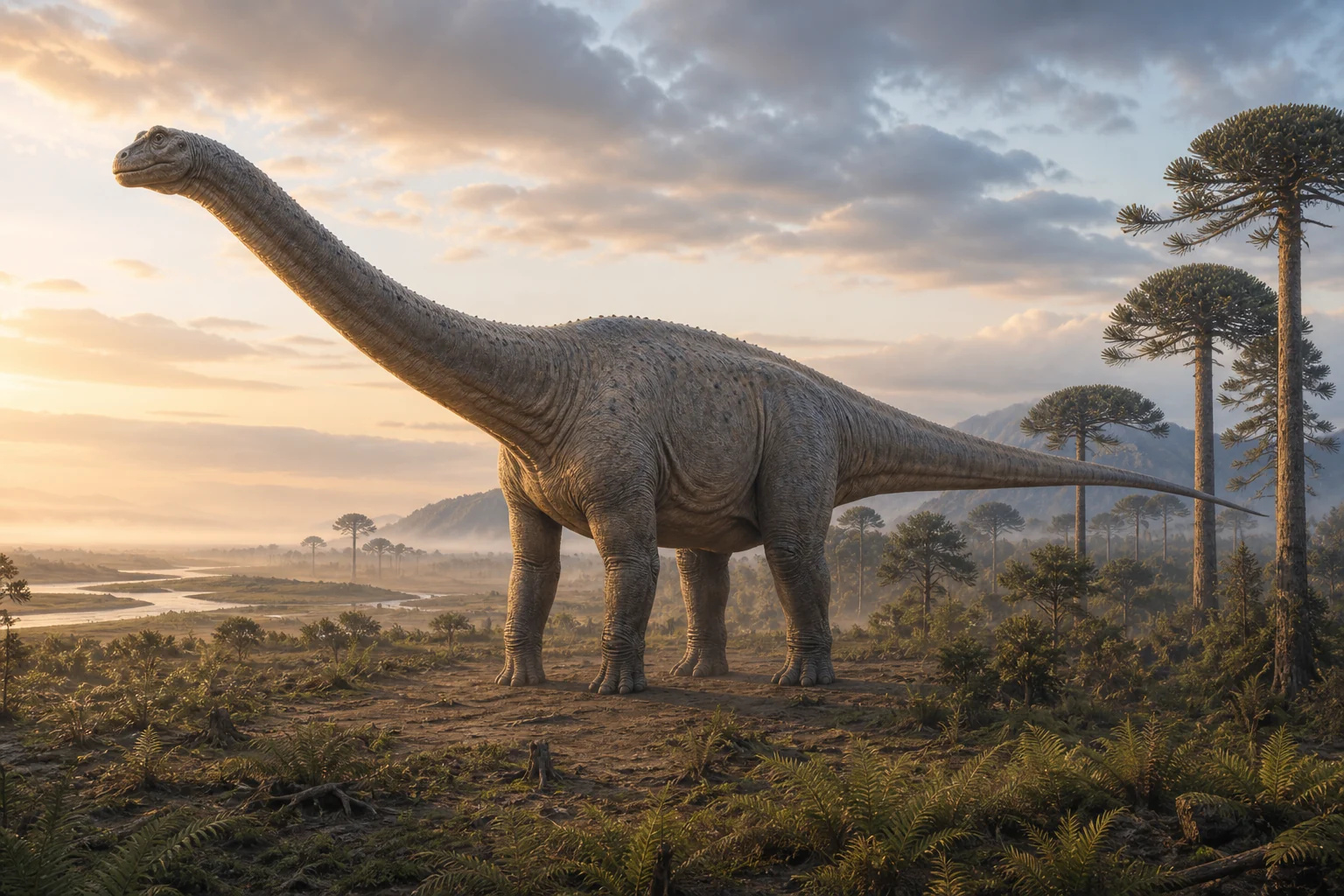 View full-resolution reconstruction ↗
This is an original generative reconstruction, not a photograph or scientific plate. Measurements and interpretations below are tied to named sources.
01 / KNOWN BONES
What was actually found?
The type material includes enormous back vertebrae, sacral elements, ribs and limb bones rather than a complete skeleton. Those measurements are real; neck, skull and most tail proportions come from relatives.
02 / LENGTH
How is 30–35 metres estimated?
Researchers scale preserved elements against more complete titanosaurs and assemble a plausible vertebral series. Different reference taxa and posture produce different total lengths.
03 / MASS
Where do 60–90 tonnes come from?
Limb circumference equations and three-dimensional volumetric models estimate mass. Missing girths, air spaces and body outline require assumptions, so a range is more honest than a decimal figure.
04 / LARGEST DINOSAUR
Was it definitely the largest dinosaur?
It ranks among the largest well-known titanosaurs, but Patagotitan, Dreadnoughtus and fragmentary taxa overlap after uncertainty. Rankings change with specimen and model.
05 / COMPARISON
How does it compare with a human?
A person would reach only partway up the lower leg, while the torso alone was several metres deep. Such diagrams should use the same ground plane and state the chosen estimate.
06 / UNCERTAINTY
Which facts are most secure?
The extraordinary size of individual vertebrae and limb bones is secure. Exact body length, neck posture, tail length and mass are progressively more model-dependent.
FREQUENTLY ASKED QUESTIONS
Questions readers ask
How long was Argentinosaurus?
Most defensible reconstructions are roughly 30–35 metres.
How much did it weigh?
Common estimates span roughly 60–80 tonnes, with model dependence.
Is there a complete skeleton?
No. Only several vertebrae and limb elements are securely known.
Was it larger than a blue whale?
No. The largest blue whales are substantially heavier.
Could it run?
Steady walking is supported; running is not demonstrated.
Did Giganotosaurus hunt it?
They shared a formation broadly, but no direct fossil records an attack on Argentinosaurus.
SOURCES & FURTHER READING
Evidence used in this guide
Measurements and interpretations are tied to museum resources or peer-reviewed studies; disputed conclusions include evidence on both sides.
- 01March of the Titans ↗PLOS ONE · DOI 10.1371/journal.pone.0078733
Digital skeleton, 83.2-tonne model and locomotion simulation.
- 02Why were dinosaurs so big? ↗Natural History Museum, London
Museum context for titanosaur scale and mammal comparison.
- 03A new giant sauropod from Patagonia ↗Ameghiniana
Original diagnostic description of Argentinosaurus.