
ARGENTINOSAURUS TOPIC HUB · BIOLOGY
How Did Argentinosaurus Walk, Grow and Eat?
Use musculoskeletal simulation, titanosaur eggs and sauropod anatomy to reconstruct a giant from fragmentary remains.
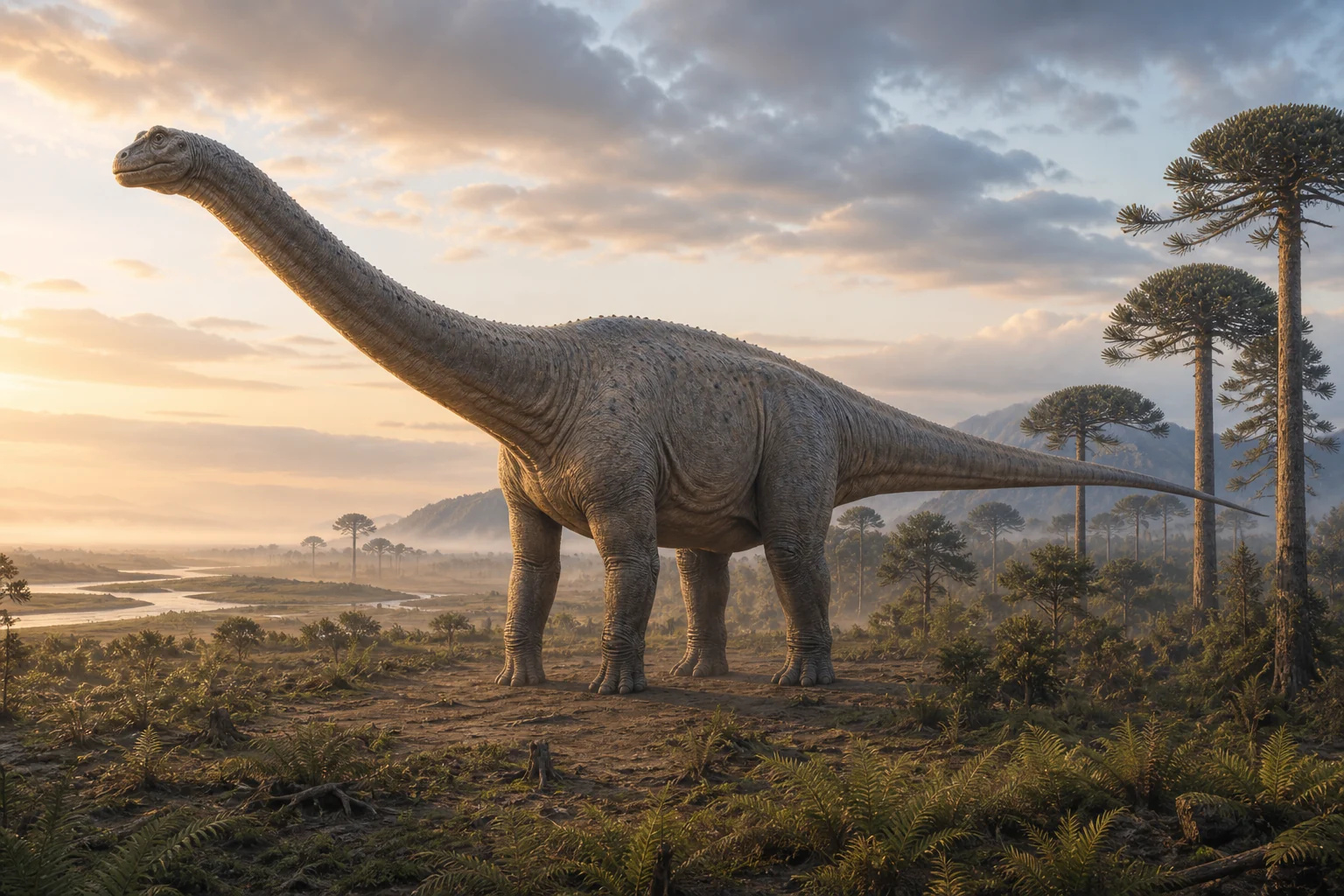 View full-resolution reconstruction ↗
This is an original generative reconstruction, not a photograph or scientific plate. Measurements and interpretations below are tied to named sources.
01 / GAIT
How did such a heavy animal walk?
Columnar limbs kept joints aligned under the body, while a broad stance stabilised the trunk. Musculoskeletal simulation produces a plausible slow walk, not a filmed measurement of one species.
02 / SPEED
Could Argentinosaurus run?
High mass raises bone and muscle stress, making an aerial running phase unlikely in adult giants. Modelled walking speeds depend on muscle assumptions and should not be treated as exact maxima.
03 / FEEDING
How did it eat enough?
A long neck swept through a large feeding envelope while teeth stripped vegetation and the gut performed most processing. Not chewing increased intake rate but required a large fermenting digestive system.
04 / GROWTH
How did a hatchling become a giant?
Titanosaurs hatched from eggs far smaller than adults. Bone histology in related sauropods shows rapid sustained growth interrupted by seasonal lines, followed by slower adult deposition.
05 / AIR SACS
Did air sacs help?
Hollowed vertebrae record an avian-style air-sac system that lightened the axial skeleton and ventilated lungs efficiently. It reduced structural mass but did not make the animal buoyant or weightless.
06 / BEHAVIOUR
Did Argentinosaurus live in herds?
Titanosaur nesting grounds and sauropod trackways show social aggregation in related animals, but no Argentinosaurus herd is preserved. Group life is plausible and should remain labelled inference.
FREQUENTLY ASKED QUESTIONS
Questions readers ask
How long was Argentinosaurus?
Most defensible reconstructions are roughly 30–35 metres.
How much did it weigh?
Common estimates span roughly 60–80 tonnes, with model dependence.
Is there a complete skeleton?
No. Only several vertebrae and limb elements are securely known.
Was it larger than a blue whale?
No. The largest blue whales are substantially heavier.
Could it run?
Steady walking is supported; running is not demonstrated.
Did Giganotosaurus hunt it?
They shared a formation broadly, but no direct fossil records an attack on Argentinosaurus.
SOURCES & FURTHER READING
Evidence used in this guide
Measurements and interpretations are tied to museum resources or peer-reviewed studies; disputed conclusions include evidence on both sides.
- 01March of the Titans ↗PLOS ONE · DOI 10.1371/journal.pone.0078733
Digital skeleton, 83.2-tonne model and locomotion simulation.
- 02Why were dinosaurs so big? ↗Natural History Museum, London
Museum context for titanosaur scale and mammal comparison.
- 03A new giant sauropod from Patagonia ↗Ameghiniana
Original diagnostic description of Argentinosaurus.