
Explore this animal in Size of Extinct Animals ↗
454 / Mesozoic
Dreadnoughtus
Dreadnoughtus schrani
A relatively complete skeleton makes this giant titanosaur unusually measurable.
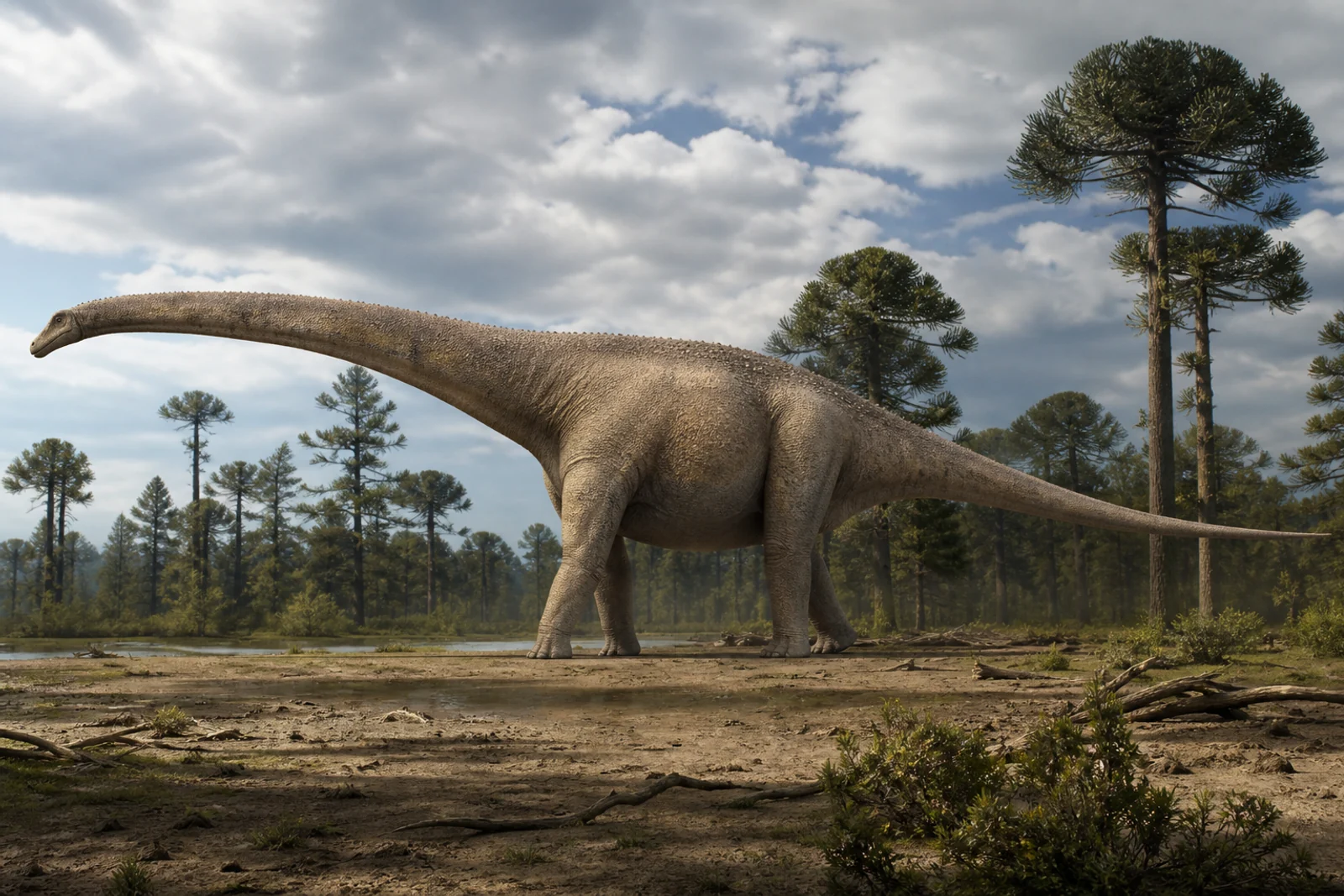 View original image · 1600 × 1067
- Time range
- About 77 million years ago
- Final stage
- Late Cretaceous
- Geographic range
- Floodplain woodland · Patagonia, Argentina
01 / ANSWER FIRST
What was Dreadnoughtus?
Dreadnoughtus schrani was a giant plant-eating titanosaur from Late Cretaceous Patagonia. An unusually informative partial skeleton makes it important for studying how very large dinosaurs were built.
Its fame comes from both size and evidence. A preserved femur, humerus, vertebrae and other bones let researchers test different ways of reconstructing the same animal, rather than extrapolating only from a single fragment.
02 / QUICK FACTS
Dreadnoughtus at a glance
- Scientific name
- Dreadnoughtus schrani
- Length
- About 26 m in the original reconstruction
- Mass
- Model-dependent; see the estimates below
- Diet
- Herbivorous
- Location
- Santa Cruz, Patagonia, Argentina
- Formation
- Cerro Fortaleza Formation, Late Cretaceous
Dreadnoughtus size and weight: why do estimates differ?
The original reconstruction was about 26 metres long. That is total body length, not a standing height or a direct measurement of a complete articulated skeleton.
Lacovara and colleagues estimated about 59.3 metric tonnes in 2014 using limb-bone scaling. Bates and colleagues tested three-dimensional body volumes in 2015 and obtained approximately 22.1–38.2 tonnes under their model assumptions.
These are different estimates of a fossil individual, not a measured weight or a growth range. Limb scaling and volume models rely on different assumptions about body proportions, soft tissue and density. Quoting the largest number alone hides that uncertainty.
Life and discovery timeline
Life in Patagonia
Dreadnoughtus lived in the environment preserved by the Cerro Fortaleza Formation.
Original description
Lacovara and colleagues published the skeleton, diagnosis and limb-based mass estimate.
A volumetric reassessment
Bates and colleagues used digital reconstruction to test lower mass estimates.
03 / ANATOMY
A titanosaur built to support a huge body
Weight-bearing limbs
The preserved upper limb bones are central to the original mass calculation. Bone circumference is measurable; converting it into body mass requires a relationship calibrated from other animals.
Long neck and tail
A long neck enlarged the feeding reach, while the tail extended behind the body. Missing parts mean overall proportions must still be reconstructed.
Incomplete head
Limited craniodental material does not provide a complete skull. The detailed face in a reconstruction includes interpretation from related sauropods.
04 / DIET & BEHAVIOUR
What did Dreadnoughtus eat?
It was a herbivore. Its sauropod body plan supports gathering large quantities of vegetation, but an exact daily food intake, favoured plant species or maximum feeding height cannot be read directly from these bones.
05 / DIET & BEHAVIOUR
Was it still growing?
The original study interpreted skeletal and bone-histological features as evidence that the large individual had not finished growing. This does not reveal its eventual adult mass or the maximum size of the species.
06 / RANGE & HABITAT
Where was Dreadnoughtus found?
The known specimens come from southern Patagonia in Argentina, in Upper Cretaceous continental deposits.
River landscapes
The discovery site preserves evidence of rapid burial in a river-associated setting. Burial circumstances help explain preservation but do not establish the cause of the species' extinction.
Two individuals
The original description included a large holotype and a smaller individual. Their association does not by itself establish family relationships or social organisation.
07 / FOSSIL EVIDENCE
Why is the Dreadnoughtus skeleton important?
Completeness needs a definition
The often-quoted roughly 70% figure concerns representation of postcranial skeletal elements in the original study. It does not mean a complete skull or 70% of every bone's original volume survives.
Models can be tested
Digital bones allow researchers to change soft-tissue envelopes and compare volume estimates. Transparent assumptions make competing reconstructions scientifically useful.
08 / DISAPPEARANCE & DEBATE
Was Dreadnoughtus the biggest dinosaur?
It was enormous, but no secure single ranking follows from the available fossils and conflicting mass models.
Other giant titanosaurs are often known from less complete material. Comparing them requires the same metric and compatible methods. The particular cause of Dreadnoughtus' disappearance is unknown.
09 / FREQUENTLY ASKED QUESTIONS
Dreadnoughtus FAQ
How much did Dreadnoughtus weigh?
Published methods differ: about 59.3 tonnes from the 2014 limb-scaling calculation, versus about 22.1–38.2 tonnes from the 2015 volumetric models. None is a measured weight.
Was Dreadnoughtus longer than T. rex?
Yes. The approximately 26-metre reconstruction is substantially longer than a large T. rex, though these are very different body plans.
Was its skeleton complete?
No. It is unusually informative for a giant titanosaur, but important elements are missing and the skull is incomplete.
04 / SOURCES & FURTHER READING
Check the source record
Use the scientific name to compare taxonomy, occurrence records and the fossil record. Database coverage and classifications may differ.
05 / REVISION HISTORY
How has this record changed?
- Rewrote an extinction cause that presented environmental or faunal turnover as established; it is now given as context the record does not prove.
- Added a sourced bilingual topic hub covering size, discovery history, anatomy, diet, habitat, uncertainty and FAQs; updated search metadata.
- Verified authoritative entity sources and added three responsive reconstruction sizes.
- Initial bilingual species record published.
06 / CORRECTIONS & ADDITIONS