
Explore this animal in Size of Extinct Animals ↗
04 / Paleozoic
Trilobites
Trilobita
They occupied seafloors for nearly 300 million years, and their compound eyes preserve secrets of early vision.
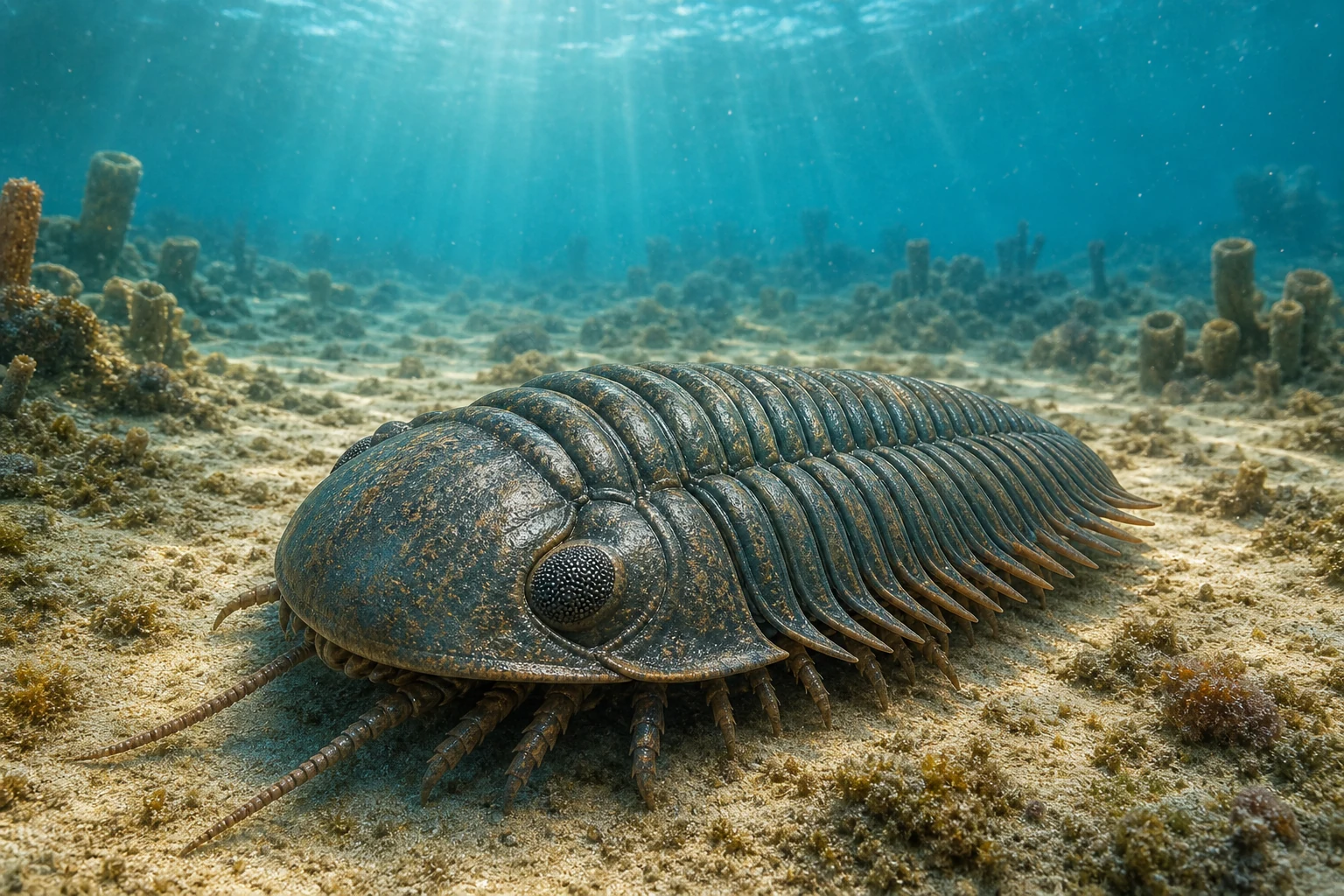 View original image · 1536 × 1024
- Time range
- About 521–252 million years ago
- Final stage
- End of the Permian
- Geographic range
- Paleozoic oceans worldwide
01 / ANSWER FIRST
What was a trilobite?
Trilobites were a class of marine arthropods containing more than 20,000 described species, not a single animal species.
They occupied Palaeozoic oceans for more than 250 million years. Their mineralised dorsal exoskeleton fossilised readily, while rare exceptional deposits reveal antennae, jointed legs, gills, guts and eggs hidden below.
02 / QUICK FACTS
Trilobites at a glance
- Scientific group
- Class Trilobita
- Time range
- About 521–252 million years ago
- Diversity
- More than 20,000 described species
- Habitat
- Marine, from shores to deeper water
- Body regions
- Cephalon, thorax and pygidium
- Eyes
- Mostly compound eyes with calcite lenses
- Growth
- Molted repeatedly through life
- Final extinction
- End-Permian, 252 million years ago
03 / CORE QUESTION
Why are there so many trilobite fossils?
A calcite-rich dorsal exoskeleton resisted decay and each animal shed multiple shells as it grew. One trilobite could therefore contribute many fossilisable pieces, and transported molts can be mistaken for carcasses.
Abundance does not make every reconstruction complete. Antennae, limbs, gills and internal organs usually vanished, so exceptional preservation and comparisons among species are essential.
Read the complete anatomy and molting guideHow to read the numbers
This page separates direct evidence, comparative inference and unresolved debate.
04 / LIFE & DISCOVERY TIMELINE
A 270-million-year evolutionary archive
First clear trilobites
Mineralised trilobites appear abruptly in Early Cambrian marine rocks.
Major diversification
Orders and ecologies expanded across continental shelves and open water.
Repeated crises
Several groups declined through extinction pulses while survivors persisted.
Final extinction
The end-Permian crisis eliminated the last surviving trilobite lineages.
05 / ANATOMY
One name, thousands of body variations
Three longitudinal lobes
A raised axial lobe ran between two pleural lobes, giving the class its name.
Three tagmata
The shield-like cephalon, articulated thorax and fused pygidium varied greatly among species.
Calcite compound eyes
Most species used mineral lenses; some developed giant eyes, stalks or complete blindness.
Biramous limbs
Rare fossils show a walking branch and a gill-bearing branch beneath each segment.
06 / DIET & BEHAVIOUR
What did trilobites eat?
The class included deposit feeders, scavengers, predators and probable suspension feeders; one diet cannot represent every species.
Read the complete guide07 / DIET & BEHAVIOUR
Why did some enroll?
Interlocking segments let many species shield the soft underside, but enrollment styles and ability differed among lineages.
08 / RANGE & HABITAT
Where did trilobites live?
Trilobites inhabited marine environments worldwide; their rapid evolution and wide distribution make many species valuable index fossils.
Tropical shelves
Warm shallow seas hosted diverse crawling and swimming forms.
Reefs and slopes
Spiny, streamlined and broad-bodied designs occupied different substrates.
Open water
Some large-eyed forms probably swam above the bottom and tracked light or prey.
Deep or dark habitats
Reduced or absent eyes evolved repeatedly where vision offered little advantage.
09 / FOSSIL EVIDENCE
What does the trilobite record preserve?
Exoskeletons and molts
Complete shields and separated parts document anatomy, growth and burial history.
Soft-part fossils
Exceptional sites preserve antennae, limbs, gills, guts and reproductive structures.
Trace fossils
Crawling, resting and feeding traces connect bodies to behaviour and sediment.
Biostratigraphy
Short-lived widespread species correlate rock layers and reconstruct ancient geography.
10 / DISAPPEARANCE & DEBATE
Why did trilobites go extinct?
Trilobites survived several mass extinctions but their reduced final diversity was eliminated during the end-Permian marine crisis about 252 million years ago.
Rapid warming, ocean deoxygenation, acidification and food-web disruption transformed marine habitats. These global pressures ended the remaining lineages; no single predator replaced an entire class.
12 / FREQUENTLY ASKED QUESTIONS
Trilobites FAQ
Is a trilobite one species?
No. Trilobita is a class containing more than 20,000 described species.
Are trilobites insects?
No. Both are arthropods, but trilobites form a wholly extinct separate branch.
Could trilobites see?
Many had calcite-lensed compound eyes; others had reduced eyes or none.
Why did they molt?
A rigid exoskeleton could not expand continuously, so growth required shedding it.
What did trilobites eat?
Diet varied across species and included sediment, carrion, small animals and suspended particles.
When did trilobites go extinct?
The last lineages disappeared in the end-Permian mass extinction about 252 million years ago.
04 / SOURCES & FURTHER READING
Check the source record
Use the scientific name to compare taxonomy, occurrence records and the fossil record. Database coverage and classifications may differ.
05 / REVISION HISTORY
How has this record changed?
- Upgraded to a bilingual S-tier topic hub with new anatomy, ecology and extinction evidence guides.
- Verified authoritative entity sources and added three responsive reconstruction sizes.
- Initial bilingual species record published.
06 / CORRECTIONS & ADDITIONS