
TRILOBITE TOPIC HUB · ECOLOGY & EXTINCTION
How Did Trilobites Live and Why Did They Go Extinct?
Explore 250 million years of trilobite habitats, diets, traces, mass extinctions and the final end-Permian marine crisis.
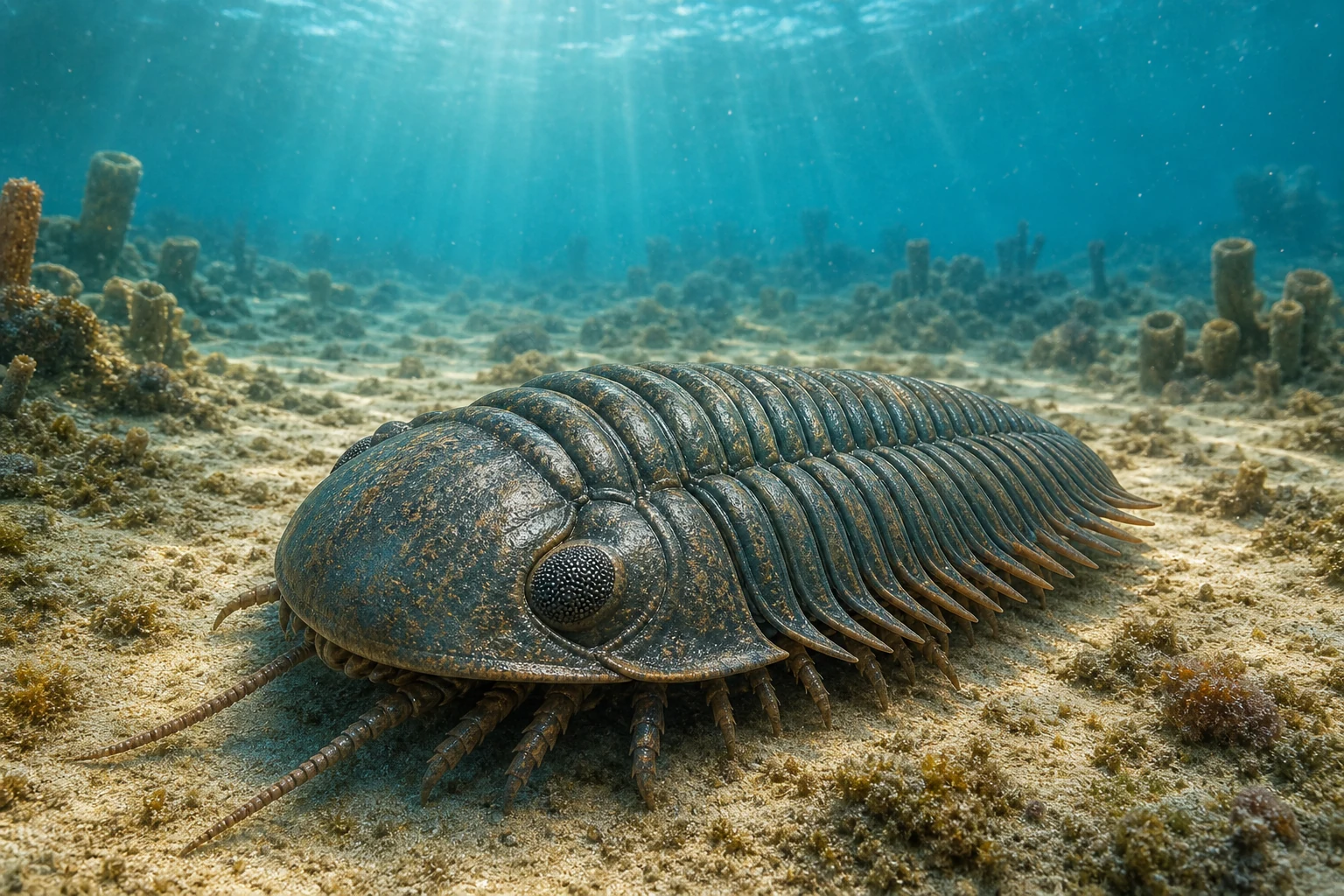 View full-resolution reconstruction ↗
This is an original generative reconstruction, not a photograph or scientific plate. Measurements and interpretations below are tied to named sources.
01 / HABITATS
Where in the ocean did trilobites live?
Fossils occur in tidal flats, shelves, reefs, slopes and deep basins. Eye form, shell profile, sediment and associated organisms distinguish bottom crawlers, burrowers and swimmers, while each species occupied a narrower range than the class.
02 / DIETS
What did trilobites eat?
Limb form, mouthparts, traces and rare guts reveal sediment feeders, scavengers, predators and suspension feeders. Bohemolichas preserved ostracods, bivalves and echinoderm fragments in its gut; there is no class-wide menu.
03 / BEHAVIOUR
How do trace fossils reveal activity?
Resting impressions and crawling or feeding trails record contact with sediment. Matching trace width and age to body fossils links motion to plausible makers, although several arthropods can create similar marks.
04 / EARLIER CRISES
How did the class survive so long?
The class was repeatedly pruned in Cambrian, end-Ordovician and Devonian crises. Geographic and ecological spread left some lineages outside the worst conditions, but each recovery replaced communities with fewer branches.
05 / FINAL CRISIS
What happened at the end of the Permian?
Massive volcanism drove greenhouse warming, ocean stratification, oxygen loss and acidification while disrupting primary production. Only a limited set of proetid lineages remained, and the crisis removed them about 252 million years ago.
06 / VERDICT
Did one predator wipe them out?
No. Predation influenced armour and ecology, but the final loss coincides with global environmental catastrophe after long diversity decline. Explaining a 270-million-year class requires lineage histories and ocean change, not one replacement story.
FREQUENTLY ASKED QUESTIONS
Questions readers ask
Is a trilobite one species?
No. Trilobita is a class containing more than 20,000 described species.
Are trilobites insects?
No. Both are arthropods, but trilobites form a wholly extinct separate branch.
Could trilobites see?
Many had calcite-lensed compound eyes; others had reduced eyes or none.
Why did they molt?
A rigid exoskeleton could not expand continuously, so growth required shedding it.
What did trilobites eat?
Diet varied across species and included sediment, carrion, small animals and suspended particles.
When did trilobites go extinct?
The last lineages disappeared in the end-Permian mass extinction about 252 million years ago.
SOURCES & FURTHER READING
Evidence used in this guide
Measurements and interpretations are tied to museum resources or peer-reviewed studies; disputed conclusions include evidence on both sides.
- 01How trilobites conquered prehistoric oceans ↗Natural History Museum, London
Museum synthesis of diversity, eyes, ecology and long evolutionary history.
- 02Trilobite research ↗Natural History Museum, London
Research overview noting more than 20,000 species and major scientific uses.
- 03What are trilobites? ↗Australian Museum
Museum guide to calcite exoskeletons, eyes, appendages and molting.
- 04The palaeoecology of the Trilobita ↗Journal of Zoology · DOI 10.1111/jzo.12108
Peer-reviewed synthesis of vision, trace fossils, molting and palaeoecology.