
Explore this animal in Size of Extinct Animals ↗
30 / Paleozoic
Anomalocaris
Anomalocaris canadensis
A meter-long swimmer with grasping frontal appendages was a giant of Cambrian seas.
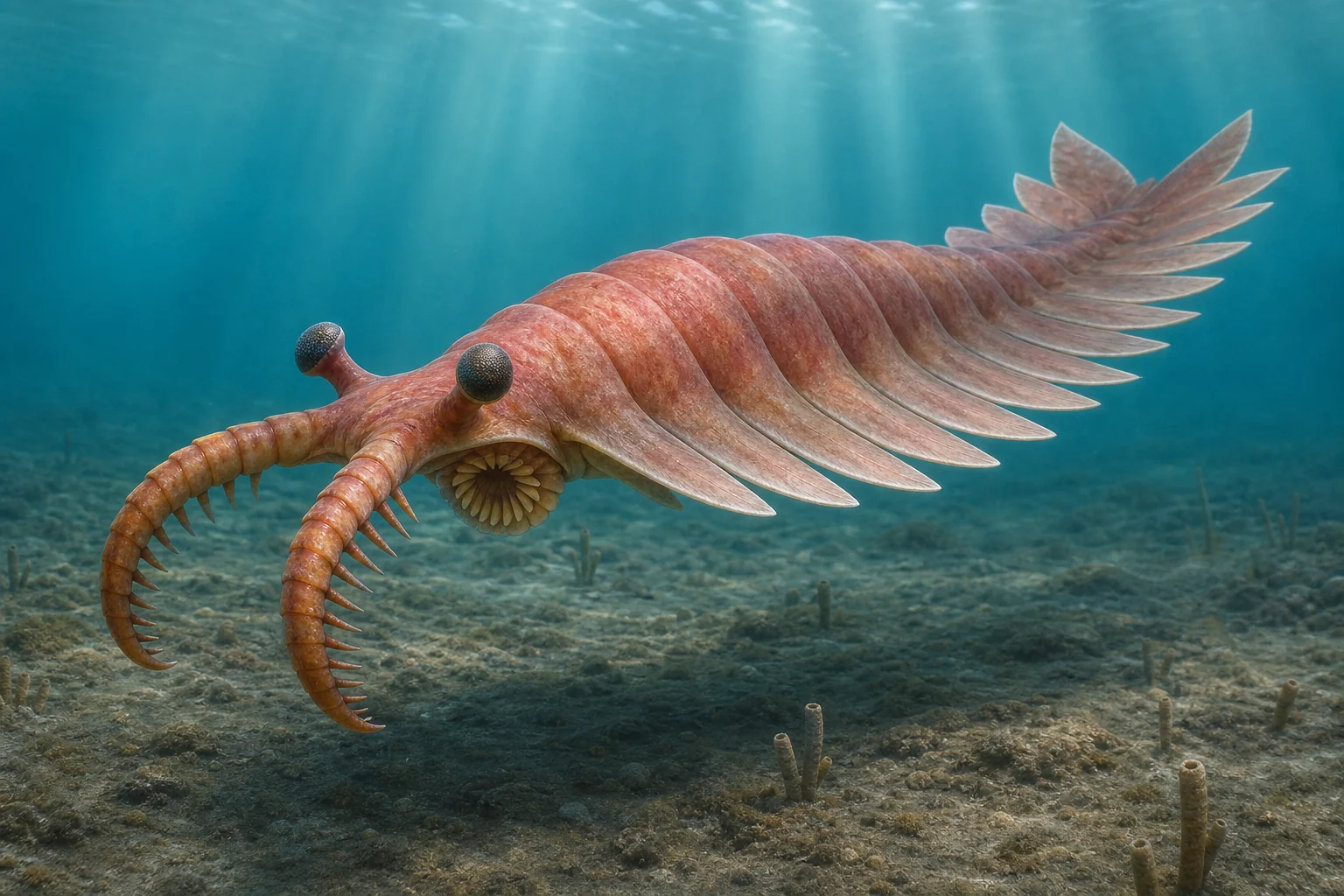 View original image · 1536 × 1024
- Time range
- About 521–508 million years ago
- Final stage
- Middle Cambrian
- Geographic range
- Laurentian shallows · Present-day Canada
01 / ANSWER FIRST
What was Anomalocaris?
Anomalocaris canadensis was a large radiodont, an early stem-group arthropod relative that swam in Cambrian seas about 508 million years ago.
Its frontal appendages, mouth and body were first named as separate organisms. Reassembly revealed a streamlined swimmer with paired grasping limbs and large compound eyes—not a shrimp and not a dinosaur-age monster.
02 / QUICK FACTS
Anomalocaris at a glance
- Scientific name
- Anomalocaris canadensis
- Age
- About 508 million years ago
- Length
- Commonly reconstructed around 50–60 cm
- Identity
- Radiodont; stem-group arthropod relative
- Vision
- Large stalked compound eyes
- Locomotion
- Undulating lateral swimming flaps
- Diet
- Likely soft, mobile prey
- Range
- Burgess Shale, British Columbia
03 / CORE QUESTION
Could Anomalocaris crush trilobites?
The circular mouth and frontal limbs once inspired a specialised shell-crusher image. Yet mouth plates show limited closure and some damaged trilobites cannot be securely tied to Anomalocaris.
A 2023 biomechanical study found the slender appendages better suited to rapidly capturing soft prey in the water column than handling hard benthic shells. This changes its likely menu without making it harmless.
Read the complete feeding biomechanics guideHow to read the numbers
This page separates direct evidence, comparative inference and unresolved debate.
04 / LIFE & DISCOVERY TIMELINE
How separate fossils became one animal
The 'odd shrimp' named
An isolated frontal appendage was interpreted as a crustacean abdomen.
Mouth and body separated
Circular mouths and headless bodies received different identities in Burgess Shale studies.
Whole animal reconstructed
Whittington and Briggs united appendages, mouth and body as radiodont anatomy.
Prey mechanics retested
Digital models supported rapid capture of soft mobile prey rather than shell crushing.
05 / ANATOMY
A swimming body built before modern arthropod heads
Frontal appendages
Paired segmented limbs bore ventral spines that formed a flexible prey basket.
Oral cone
Overlapping plates ringed the mouth, but they did not meet like crushing vertebrate jaws.
Compound eyes
Large stalked eyes with many lenses imply strong motion detection and visual hunting.
Swimming flaps
Overlapping lateral flaps propagated waves along the body while the tail steered.
06 / DIET & BEHAVIOUR
What did Anomalocaris eat?
Appendage mechanics favour soft-bodied, agile animals captured above the bottom; exact prey species are not preserved in a confirmed gut.
Read the complete guide07 / DIET & BEHAVIOUR
Was it the first apex predator?
It was among the largest visual predators in its community, but Cambrian food webs included multiple radiodont niches rather than one universal ruler.
08 / RANGE & HABITAT
Where is Anomalocaris known from?
The best A. canadensis material comes from the Burgess Shale of Canada; similar radiodonts elsewhere should not automatically be assigned to the same species.
Walcott Quarry
Exceptional soft-tissue fossils established the classic anatomy.
Greater Phyllopod Bed
Fine mud burial preserved eyes, flaps and limbs as carbonaceous films.
Laurentian shelf
The community occupied a tropical marine basin near a carbonate escarpment.
Global radiodont context
Chinese and Australian fossils reveal related body plans and different feeding specialisations.
09 / FOSSIL EVIDENCE
How was Anomalocaris reconstructed?
Articulated bodies
Rare whole specimens prove which mouth, limbs, eyes and flaps belonged together.
Isolated appendages
Numerous limbs reveal segmentation, spines, growth and deformation.
Eye fossils
Preserved lens arrays test visual capability and arthropod eye evolution.
Digital mechanics
Finite-element and kinematic models compare prey handling hypotheses.
10 / DISAPPEARANCE & DEBATE
Why did Anomalocaris disappear?
A. canadensis leaves the record after its Middle Cambrian interval; no single extinction cause can be isolated from the fossil sample.
Radiodont relatives survived much longer, so the disappearance of this species reflects lineage and ecosystem turnover rather than the immediate failure of the entire body plan.
12 / FREQUENTLY ASKED QUESTIONS
Anomalocaris FAQ
How big was Anomalocaris?
A. canadensis is commonly reconstructed around 50–60 centimetres; larger radiodont estimates may belong to other taxa.
Was Anomalocaris a shrimp?
No. It was a radiodont on the arthropod stem lineage.
Did it eat trilobites?
Possible encounters cannot be excluded, but current biomechanics favours softer mobile prey over specialised shell crushing.
How did it swim?
Successive waves along overlapping lateral flaps generated thrust and the tail helped steer.
Why was it reconstructed incorrectly?
Soft bodies often disarticulated, so mouth, limbs and torso were originally named separately.
Was it an apex predator?
It was a major predator, but exact food-web rank varies with community and prey assumptions.
04 / SOURCES & FURTHER READING
Check the source record
Use the scientific name to compare taxonomy, occurrence records and the fossil record. Database coverage and classifications may differ.
05 / REVISION HISTORY
How has this record changed?
- Upgraded to a bilingual S-tier topic hub with new body-reconstruction and feeding-biomechanics guides.
- Verified authoritative entity sources and added three responsive reconstruction sizes.
- Initial bilingual species record published.
06 / CORRECTIONS & ADDITIONS