
TRILOBITE TOPIC HUB · ANATOMY & GROWTH
Trilobite Anatomy, Eyes, Molting and Enrollment
How did thousands of trilobite species build, see through, shed and protect a mineralised arthropod body?
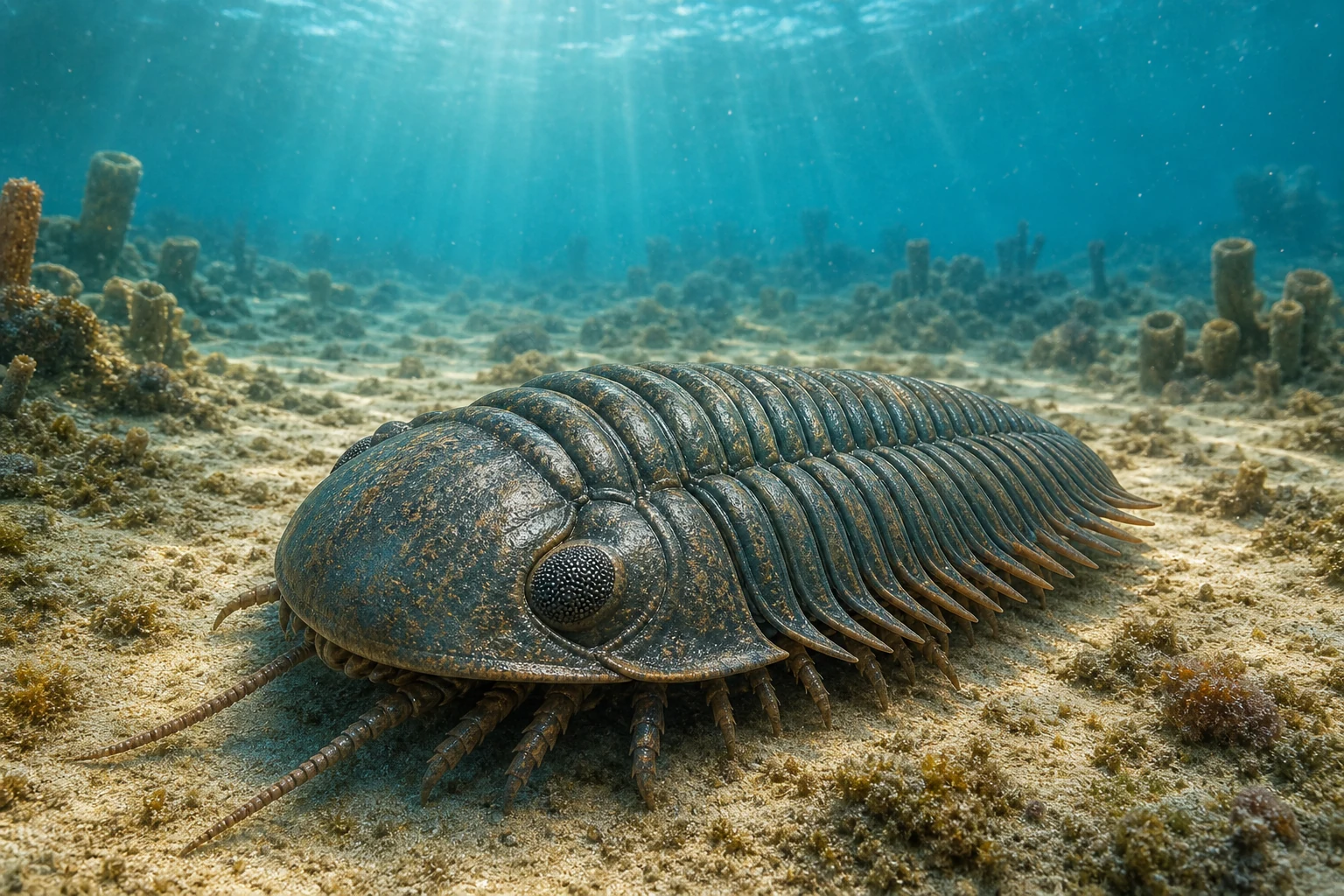 View full-resolution reconstruction ↗
This is an original generative reconstruction, not a photograph or scientific plate. Measurements and interpretations below are tied to named sources.
01 / THREE LOBES
Where does the name come from?
Viewed from above, a central axial lobe runs between left and right pleural lobes. This longitudinal division differs from the head-thorax-tail division. Species altered width, spines and segment number without losing the recognisable plan.
02 / UNDERSIDE
What was hidden below the shell?
Rare soft-part fossils show antennae and repeated biramous limbs: one branch walked while another carried gill filaments. Mouth, gut and reproductive structures reveal an active animal rather than an empty mineral shield.
03 / CRYSTAL EYES
How did calcite lenses work?
Transparent calcite lenses were crystallographically oriented to control light. Holochroal, schizochroal and abathochroal arrangements differed in size and packing. Eye direction suggests habitat, but lens count alone cannot give exact acuity.
04 / MOLTING
How did a rigid shell grow?
A trilobite split the old exoskeleton along sutures or body boundaries, emerged soft and enlarged, then mineralised the new covering. Empty molts can accumulate, so open cheeks or displaced shields often record growth rather than predation.
05 / ENROLLMENT
Did every trilobite roll into a ball?
Many flexed the thorax until head and tail shields enclosed the soft underside, aided by locking grooves. Others curled only partly or relied on spines, burial or escape, so one defensive image cannot represent the whole class.
06 / DIVERSITY
Why is there no single trilobite body?
More than 20,000 described species ranged from tiny blind burrowers to large spiny swimmers. Any claim about size, colour, eye form or behaviour should name a genus or species; a class-level picture is an educational composite.
FREQUENTLY ASKED QUESTIONS
Questions readers ask
Is a trilobite one species?
No. Trilobita is a class containing more than 20,000 described species.
Are trilobites insects?
No. Both are arthropods, but trilobites form a wholly extinct separate branch.
Could trilobites see?
Many had calcite-lensed compound eyes; others had reduced eyes or none.
Why did they molt?
A rigid exoskeleton could not expand continuously, so growth required shedding it.
What did trilobites eat?
Diet varied across species and included sediment, carrion, small animals and suspended particles.
When did trilobites go extinct?
The last lineages disappeared in the end-Permian mass extinction about 252 million years ago.
SOURCES & FURTHER READING
Evidence used in this guide
Measurements and interpretations are tied to museum resources or peer-reviewed studies; disputed conclusions include evidence on both sides.
- 01How trilobites conquered prehistoric oceans ↗Natural History Museum, London
Museum synthesis of diversity, eyes, ecology and long evolutionary history.
- 02Trilobite research ↗Natural History Museum, London
Research overview noting more than 20,000 species and major scientific uses.
- 03What are trilobites? ↗Australian Museum
Museum guide to calcite exoskeletons, eyes, appendages and molting.
- 04The palaeoecology of the Trilobita ↗Journal of Zoology · DOI 10.1111/jzo.12108
Peer-reviewed synthesis of vision, trace fossils, molting and palaeoecology.