
Explore this animal in Size of Extinct Animals ↗
17 / Paleozoic
Arthropleura
Arthropleura armata
This many-segmented arthropod grew longer than a person in coal-swamp forests.
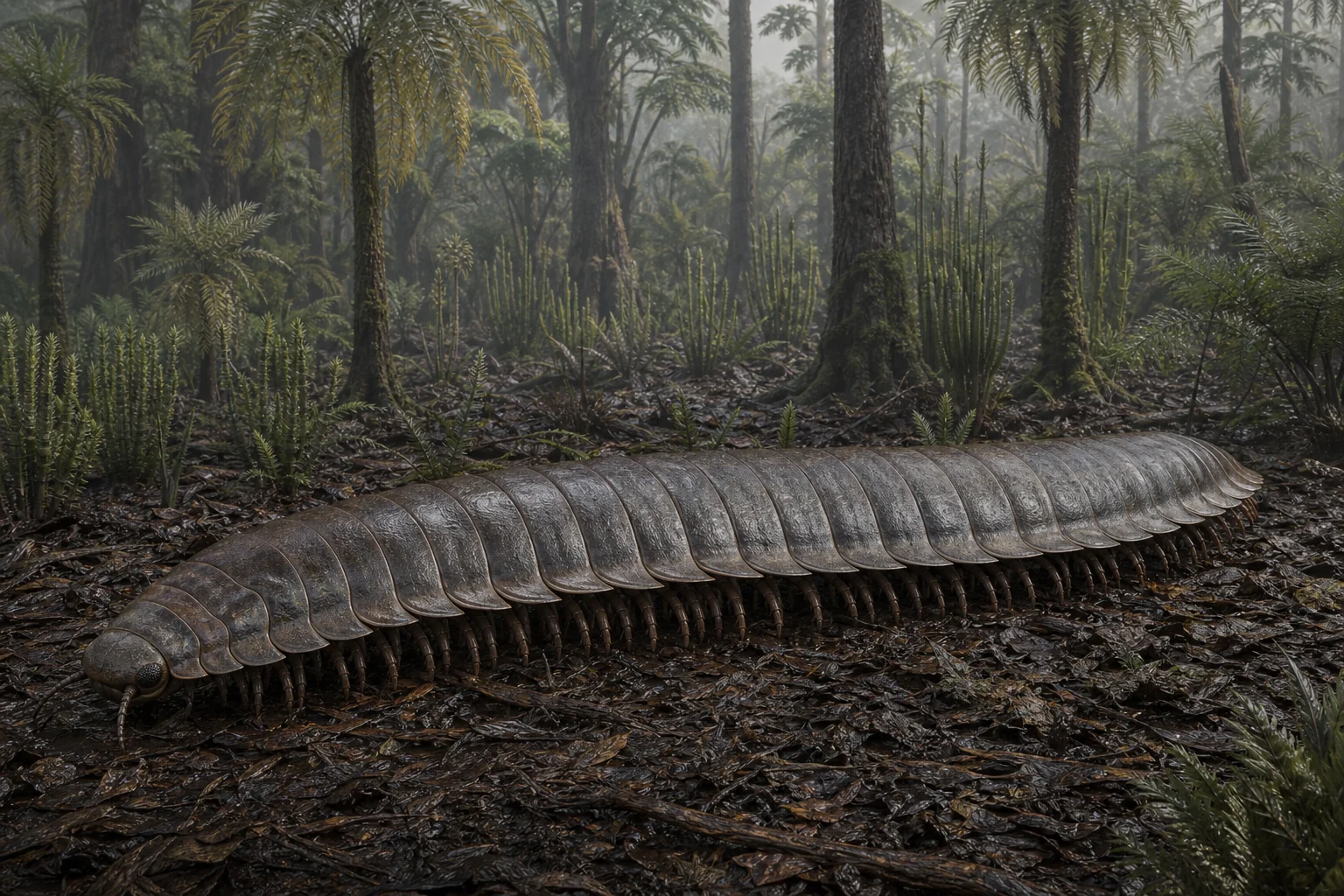 View original image · 1536 × 1024
- Time range
- About 345–290 million years ago
- Final stage
- Late Carboniferous–Early Permian
- Geographic range
- Tropical forests of Europe · North America
01 / ANSWER FIRST
What was Arthropleura?
Arthropleura was a giant many-legged arthropod of Carboniferous and early Permian forests, with the largest individuals estimated at about 2.6 metres long and around 50 kilograms.
Despite its Chinese and popular centipede-like names, it was not a true centipede. New head fossils reveal a mosaic myriapod close to the millipede side of the family tree, while its exact diet remains unknown.
02 / QUICK FACTS
Arthropleura at a glance
- Scientific name
- Arthropleura armata
- Age
- About 345–290 million years ago
- Maximum length
- Estimated up to about 2.6 m
- Maximum mass
- Estimated around 50 kg
- Identity
- Giant myriapod, not a true centipede
- Body
- Broad overlapping tergites
- Diet
- Unresolved
- Range
- Europe and North America
03 / CORE QUESTION
What did Arthropleura eat, and why was it so large?
Plant material, spores and detritus are plausible foods, but the feeding apparatus of giant adults is not preserved well enough to prove herbivory. Juvenile heads add antennae, mandible evidence and a millipede-like body plan without settling the menu.
High atmospheric oxygen may have eased respiration, but size cannot be reduced to oxygen alone: giant Arthropleura appeared before the oxygen maximum. Moist habitats, abundant resources, lineage history and low terrestrial vertebrate competition may all have contributed.
Read the diet and gigantism evidence guideHow to read the numbers
This page separates direct evidence, comparative inference and unresolved debate.
04 / LIFE & DISCOVERY TIMELINE
A giant known from armour, tracks and rare heads
Large forms already present
The Howick fossil shows giant size before peak late-Carboniferous oxygen.
Broad Euramerican range
Body plates and trackways occur in forests and river-margin deposits.
Last records
The lineage persisted as climates and vegetation mosaics changed.
Head anatomy published
Juvenile French fossils clarified eyes, antennae and myriapod relationships.
05 / ANATOMY
Armoured rings on many short legs
Broad tergites
Overlapping dorsal plates widened the body and protected flexible segment joints.
Many short legs
Trackways and juvenile bodies show repeated limbs suited to steady terrestrial walking rather than rapid centipede-like sprinting.
Myriapod mosaic head
Antennae, stalked eyes and mouthparts combine traits not matched exactly by living millipedes or centipedes.
Molted armour
Many isolated plates are interpreted as shed exoskeleton rather than carcasses, complicating body counts and growth estimates.
06 / DIET & BEHAVIOUR
Was Arthropleura herbivorous?
Possibly, but not proven. Plant fragments associated with fossils and millipede comparisons support herbivory or detritivory, while diagnostic adult guts and complete mouthparts are absent.
Read the complete guide07 / DIET & BEHAVIOUR
How fast could it move?
Trackways record coordinated walking, and short legs imply moderate rather than centipede-like speed. No footprint sequence supplies a secure maximum velocity.
08 / RANGE & HABITAT
Where did Arthropleura live?
Body fossils and trackways occur across the tropical Euramerican belt, in environments more varied than the familiar coal-swamp stereotype.
Northern England
The Howick specimen came from an open woodland river-channel setting.
Continental Europe
France, Germany and the Czech region preserve plates, juveniles and tracks.
North America
Trackways and body remains extend the lineage across the connected equatorial landmass.
Moist terrestrial mosaics
River margins, woodland and vegetated lowlands supplied humidity and cover without requiring permanent swamp water.
09 / FOSSIL EVIDENCE
How do scientists know about Arthropleura?
Body armour
Articulated and isolated tergites constrain width, segmentation and external ornament.
Trackways
Parallel rows of footprints record terrestrial movement and estimate body width.
Howick exuvium
A large partial specimen supports the 2.6-metre, roughly 50-kilogram upper reconstruction.
Juvenile heads
Three-dimensional French fossils reveal eyes, antennae and mouthpart relationships missing from giants.
10 / DISAPPEARANCE & DEBATE
Why did Arthropleura disappear?
Arthropleura vanished by the early Permian as equatorial habitats, climates and terrestrial communities changed; no single fossil-tested cause is established.
Declining humidity, vegetation turnover, changing oxygen and expanding vertebrate communities are hypotheses with different evidence. Its last occurrence should not be written as a sudden oxygen-triggered collapse.
12 / FREQUENTLY ASKED QUESTIONS
Arthropleura FAQ
How large was Arthropleura?
The largest partial fossil supports an estimate near 2.6 metres long and roughly 50 kilograms.
Was Arthropleura a centipede?
No. It was an extinct myriapod with stronger links to the millipede side, although its head was a mosaic.
What did Arthropleura eat?
The exact diet is unknown; plants and detritus are plausible but unconfirmed.
Did high oxygen make Arthropleura giant?
It may have helped, but giant specimens predate peak oxygen and other ecological factors mattered.
Could Arthropleura move quickly?
Trackways show coordinated walking, but short legs do not support a fast centipede-like sprint.
When did Arthropleura go extinct?
The youngest secure records are early Permian, roughly 290 million years old.
04 / SOURCES & FURTHER READING
Check the source record
Use the scientific name to compare taxonomy, occurrence records and the fossil record. Database coverage and classifications may differ.
05 / REVISION HISTORY
How has this record changed?
- Rewrote an extinction cause that presented environmental or faunal turnover as established; it is now given as context the record does not prove.
- Expanded into a bilingual S-tier hub with anatomy, diet and gigantism evidence guides.
- Verified authoritative entity sources and added three responsive reconstruction sizes.
- Initial bilingual species record published.
06 / CORRECTIONS & ADDITIONS