
Explore this animal in Size of Extinct Animals ↗
16 / Cenozoic
Megalodon
Otodus megalodon
Its hand-sized teeth belonged to a giant shark specialized in hunting marine mammals.
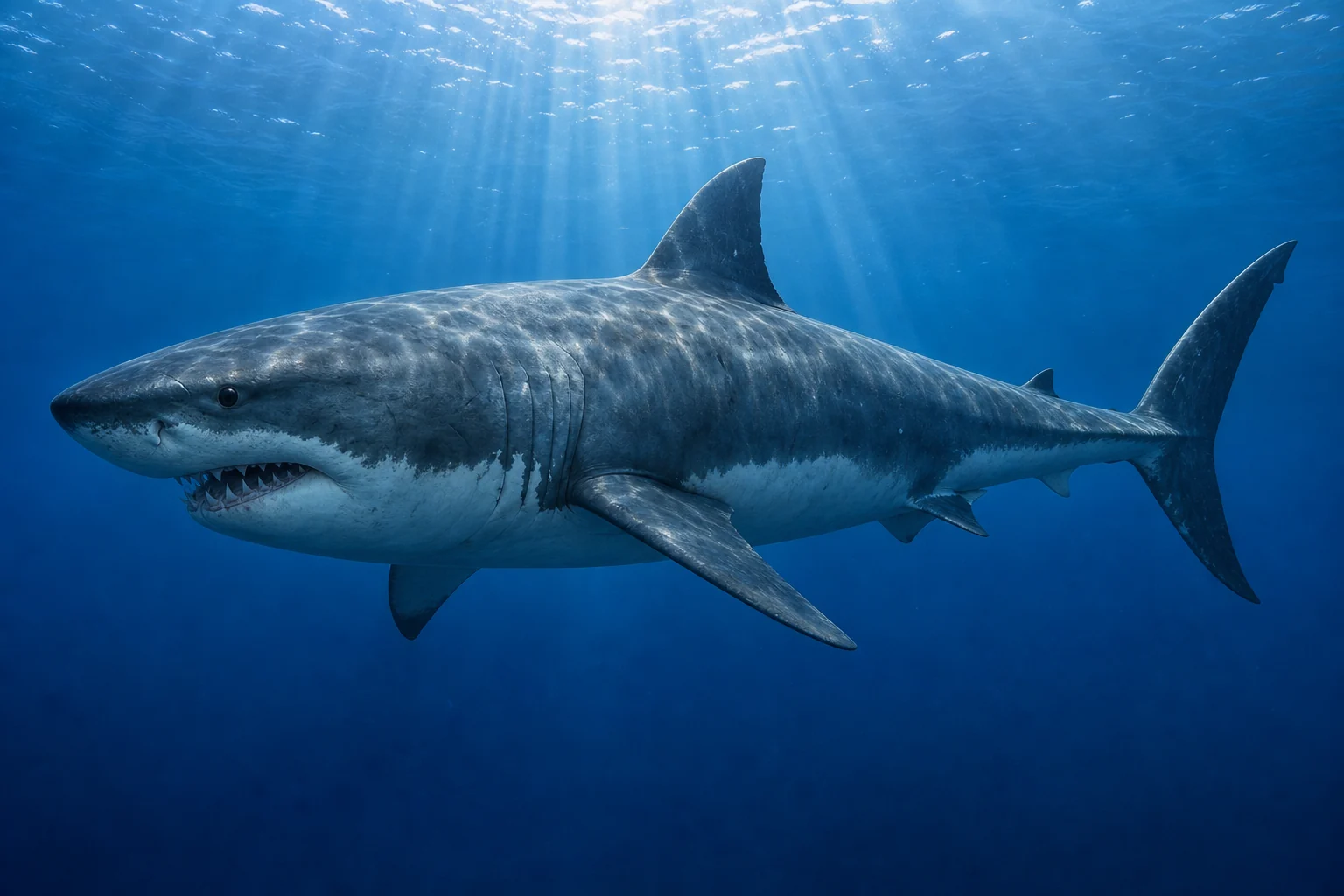 View original image · 1536 × 1024
- Time range
- About 23–3.6 million years ago
- Final stage
- Pliocene
- Geographic range
- Warm oceans worldwide
01 / ANSWER FIRST
What was Megalodon?
Megalodon was a gigantic megatooth shark that hunted marine mammals, large fishes and other sharks across warm oceans from about 23 to 3.6 million years ago.
It was not simply an enlarged great white shark. Teeth dominate its fossil record because cartilage rarely survives, so body length, mass and outline remain model-dependent. Recent work allows a maximum near 24 metres, but that is an exceptional upper estimate rather than the size of every adult.
02 / QUICK FACTS
Megalodon at a glance
- Scientific name
- Otodus megalodon
- Age
- About 23–3.6 million years ago
- Length
- Highly uncertain; exceptional maximum up to 24.3 m
- Largest teeth
- Almost 18 cm
- Diet
- Marine mammals, large fish and sharks
- Range
- Warm and temperate seas worldwide
- Skeleton
- Cartilage; teeth and vertebrae dominate
- Extinction
- About 3.6 million years ago
03 / CORE QUESTION
How big was Megalodon?
There is no complete skeleton. Traditional estimates scale tooth dimensions against living lamniform sharks and often place large adults around 15–18 metres, while a 2025 vertebral reconstruction proposed a scientifically defensible maximum of 24.3 metres and about 94 tonnes.
A maximum is not an average. Tooth position, age, sex, local temperature and the chosen living analogue all change the result. The emerging picture is longer and more slender than the familiar oversized-great-white reconstruction.
Read the complete size, teeth and body-shape guideHow to read the numbers
This page separates direct evidence, comparative inference and unresolved debate.
04 / LIFE & DISCOVERY TIMELINE
A giant lineage reconstructed from scattered hard parts
First Megalodon record
Large serrated teeth appear within an older megatooth-shark lineage.
Global warm-sea predator
Teeth occur on multiple continents and bite traces record attacks or feeding on whales.
Changing food webs
Ocean cooling, prey turnover and dietary overlap with great whites altered its ecological setting.
Last reliable fossils
Younger teeth are absent despite a rich, globally sampled shark fossil record.
05 / ANATOMY
What can the fossil body actually support?
Serrated cutting teeth
Broad triangular crowns up to nearly 18 centimetres sliced flesh and bone and were replaced continuously.
Cartilaginous skeleton
Most of the skeleton decayed. Rare calcified vertebral centra constrain growth and body length better than isolated teeth.
Uncertain body outline
No fossil preserves the complete head, fins and trunk together. Reconstructions must bracket proportions across living and extinct lamniforms.
Huge but not invulnerable
Gigantism expanded prey options but also raised energy demand and made food-web disruption more costly.
06 / DIET & BEHAVIOUR
What did Megalodon eat?
Bite-marked whale bones, tooth form and zinc isotopes place it high in marine food webs. Prey included cetaceans, seals, large fishes and sharks, with diet varying by age and region.
Read the complete guide07 / DIET & BEHAVIOUR
Did juveniles use nurseries?
Some shallow-water sites contain many smaller teeth and have been interpreted as nurseries. Tooth-position and size-estimation uncertainty mean not every proposed site is equally secure.
08 / RANGE & HABITAT
Where did Megalodon live?
Fossil teeth occur worldwide, but distribution shifted with coastlines, currents, prey and temperature.
Coastal shelves
Whale-rich productive shelves supplied prey and abundant tooth deposits.
Open-ocean corridors
A global record implies broad dispersal between feeding and breeding areas.
Warm-water concentration
Many fossils come from warm settings, while cooler-water individuals may have grown larger.
Changing Pliocene seas
Cooling and sea-level change reduced and rearranged suitable coastal habitat.
09 / FOSSIL EVIDENCE
How do scientists know about Megalodon?
Thousands of teeth
Shape, wear, chemistry and stratigraphic age record taxonomy, feeding and time range.
Rare vertebrae
Growth bands and column length constrain age, growth and maximum body reconstructions.
Bitten whale bones
Cuts, punctures and embedded tooth fragments tie the shark directly to marine-mammal carcasses.
Tooth isotopes
Zinc and oxygen isotopes test trophic position and water-temperature preferences.
10 / DISAPPEARANCE & DEBATE
Why did Megalodon go extinct?
Megalodon disappeared about 3.6 million years ago during a reorganisation of climate, coastlines, prey and marine competitors; no single cause is proven.
Cooling reduced warm shallow habitat, marine-mammal communities changed, and early great whites overlapped at similar trophic levels in some regions. A giant predator with high energy needs may have been especially exposed to several pressures acting together.
12 / FREQUENTLY ASKED QUESTIONS
Megalodon FAQ
How big was Megalodon?
Large individuals are often reconstructed around 15–18 metres, while a 2025 analysis permits an exceptional maximum of 24.3 metres. The fossil record cannot supply one exact adult size.
Is Megalodon still alive?
No. Its youngest reliable teeth are about 3.6 million years old, and no modern teeth, carcasses, DNA or observations exist despite intensive ocean study.
Was Megalodon a giant great white shark?
No. They belong to different lineages, and recent reconstructions do not require the deep-bodied outline of a great white.
What was its bite force?
Very high values come from biomechanical models, not direct measurement. They depend strongly on reconstructed body size and jaw musculature.
What did Megalodon eat?
Marine mammals, large fishes and sharks. Bite marks and tooth chemistry show a high trophic position, but diet changed through life and geography.
Why are its teeth so common?
Sharks continuously replace hard mineralised teeth, while their cartilaginous skeletons usually decay.
04 / SOURCES & FURTHER READING
Check the source record
Use the scientific name to compare taxonomy, occurrence records and the fossil record. Database coverage and classifications may differ.
05 / REVISION HISTORY
How has this record changed?
- Upgraded to a bilingual S-tier topic hub with two independent evidence guides.
- Verified authoritative entity sources and added three responsive reconstruction sizes.
- Initial bilingual species record published.
06 / CORRECTIONS & ADDITIONS