
Explore this animal in Size of Extinct Animals ↗
31 / Paleozoic
Opabinia
Opabinia regalis
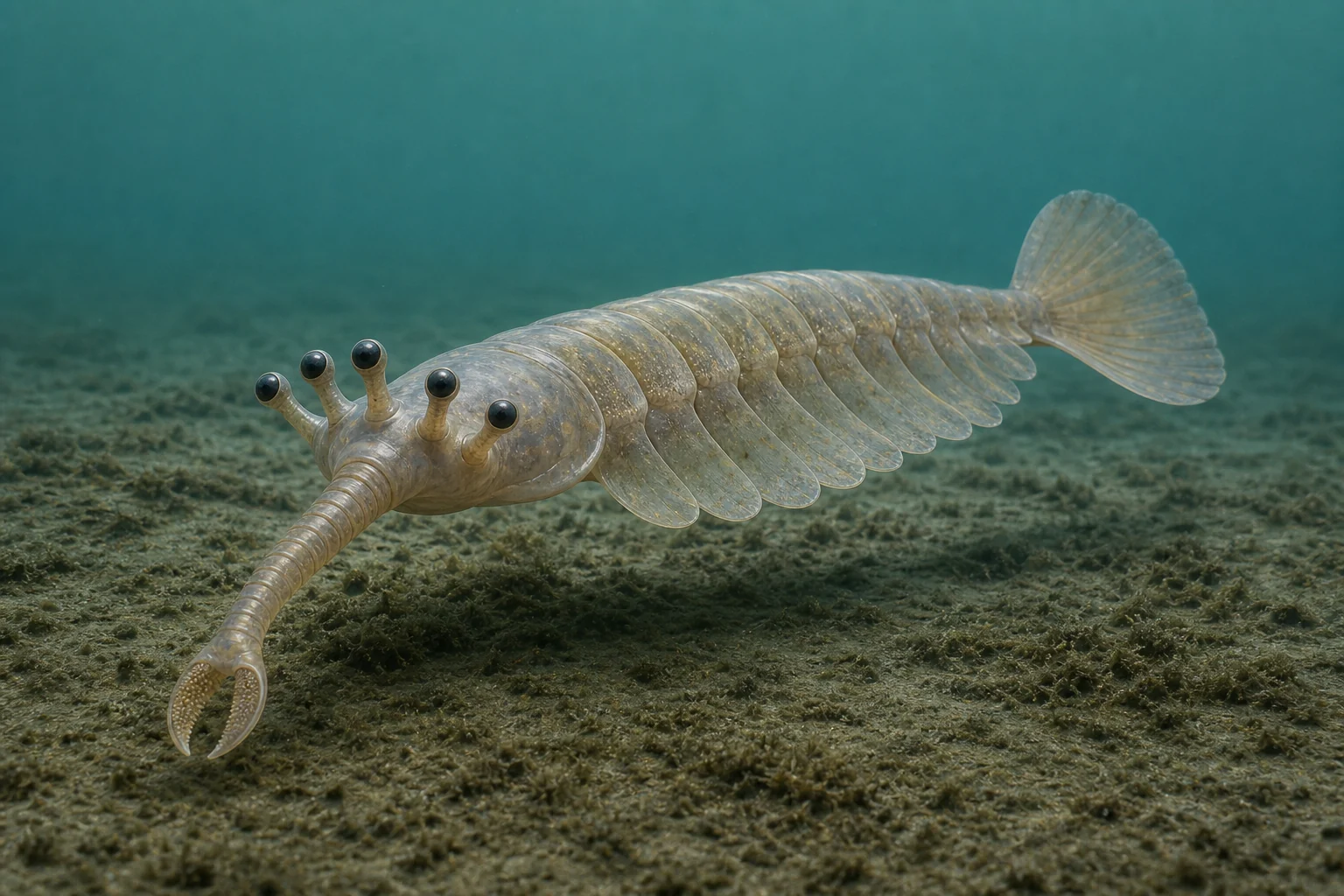
Five eyes and a grasping proboscis made this small swimmer one of the Cambrian’s strangest forms.
 View original image · 1536 × 1024
- Time range
- About 508 million years ago
- Final stage
- Middle Cambrian
- Geographic range
- Laurentian shallows · Present-day Canada
01 / ANSWER FIRST
What was Opabinia?
Opabinia regalis was a small soft-bodied Cambrian swimmer with five eyes and a flexible claw-tipped proboscis, known from the Burgess Shale.
It was not a sea scorpion, shrimp or vertebrate. Current analyses place its unusual combination near the arthropod stem, helping reconstruct how flaps, limbs and heads changed before the modern arthropod body plan.
02 / QUICK FACTS
Opabinia at a glance
- Scientific name
- Opabinia regalis
- Age
- About 508 million years ago
- Body length
- 4.3–7.0 cm (1.7–2.8 in), excluding proboscis
- Maximum specimen
- About 10.1 cm (4.0 in), including proboscis
- Eyes
- Five stalked eyes
- Feeding organ
- Flexible proboscis with opposing claws
- Locomotion
- Lateral flaps and tail fan
- Known sample
- Rare; about 42 specimens in major collections
03 / CORE QUESTION
Why did Opabinia have a proboscis?
The annulated proboscis was much longer than the head and ended in opposing, spinose claws. Because the mouth opened beneath and toward the rear of the head, the appendage could grasp small food and bend it back toward the mouth.
This feeding motion is inferred from anatomy, not preserved behaviour. The claws, large eyes and digestive glands support active predation or opportunistic feeding, while exact prey and whether it probed sediment remain uncertain.
Read the complete five-eye and proboscis guideOpabinia size: body versus whole fossil
The body range excludes the proboscis; the third value is one complete specimen including it. These are different measurements, not three growth stages.
View the ROM specimen record ↗04 / LIFE & DISCOVERY TIMELINE
From crustacean mistake to stem-arthropod icon
Walcott names Opabinia
It was initially interpreted as an unusual crustacean.
Five-eyed reconstruction shown
The unfamiliar body famously provoked laughter at a scientific meeting.
Whittington redescribes it
Detailed part-and-counterpart study established five eyes, proboscis, flaps and tail.
Stem position refined
New fossils and phylogenetic analyses place opabiniids near radiodonts on the arthropod stem.
05 / ANATOMY
How big was Opabinia?
Five eyes
Four eyes formed pairs while a larger median eye occupied the top centre of the head.
Clawed proboscis
A flexible ringed extension ended in two opposing claws with several inward spines.
Fifteen trunk segments
Each carried broad lateral flaps associated with blade-like gill structures.
Three-paired tail fan
Overlapping upward flaps probably stabilised and steered the swimming animal.
06 / DIET & BEHAVIOUR
How did Opabinia feed?
It likely seized small soft prey or organic pieces with the proboscis and transferred them to the ventral mouth.
Read the complete guide07 / DIET & BEHAVIOUR
How did it swim?
Travelling waves along the lateral flaps generated thrust; the tail fan provided stability and steering near the seafloor.
08 / RANGE & HABITAT
Where was Opabinia found?
Confirmed Opabinia regalis specimens are rare and concentrated in the Burgess Shale of British Columbia, Canada.
Walcott Quarry
Classic specimens preserve bodies in multiple orientations.
Fine mud burial
Rapid burial captured soft outlines that normal fossilisation would erase.
Nektobenthic zone
Its anatomy supports swimming close to, but not necessarily on, the seafloor.
Opabiniid relatives
Related fossils elsewhere broaden the clade without extending O. regalis itself.
09 / FOSSIL EVIDENCE
What do Opabinia fossils preserve?
Part and counterpart
Opposing slab surfaces reveal features hidden under different lighting angles.
Specimen GSC 40251
The ROM catalogue illustrates this 101 mm fossil with its proboscis bent underneath. Its total length should not be confused with body-only measurements.
Digestive glands
Paired internal structures along the gut support active processing of food.
Phylogenetic comparison
Radiodonts and other stem arthropods test which traits evolved together or separately.
10 / DISAPPEARANCE & DEBATE
Why did Opabinia disappear?
Opabinia is known from a narrow Middle Cambrian window, and no fossil evidence identifies one cause for its disappearance.
Its rarity and soft body make absence especially hard to interpret. Related stem-arthropod experiments continued, so the record shows evolutionary turnover rather than a dated catastrophe unique to Opabinia.
12 / FREQUENTLY ASKED QUESTIONS
Opabinia FAQ
Where are Opabinia fossils found?
The Royal Ontario Museum lists the Walcott and Raymond quarries of the Burgess Shale in British Columbia, Canada.
What animal had five eyes?
Opabinia regalis is a Cambrian example: four eyes formed pairs and a fifth sat centrally above them.
Was Opabinia a sea scorpion?
No. It was a soft-bodied stem-arthropod relative; true sea scorpions were later chelicerates.
How large was Opabinia?
Most bodies were 4.3–7.0 centimetres excluding the proboscis; the largest listed specimen reaches about 10.1 centimetres including it.
What was the proboscis for?
It probably grasped food with terminal claws and moved it toward the backward-facing ventral mouth.
Did Opabinia walk?
Possible small lobopod-like limbs are debated; swimming with lateral flaps is better supported.
Why is Opabinia famous?
Its unexpected anatomy transformed interpretation of Burgess Shale fossils and early arthropod evolution.
04 / SOURCES & FURTHER READING
Check the source record
Use the scientific name to compare taxonomy, occurrence records and the fossil record. Database coverage and classifications may differ.
05 / REVISION HISTORY
How has this record changed?
- Clarified body versus total length, five-eye anatomy and specimen-based fossil information.
- Upgraded to a bilingual S-tier topic hub with new five-eye anatomy and life-history guides.
- Verified authoritative entity sources and added three responsive reconstruction sizes.
- Initial bilingual species record published.
06 / CORRECTIONS & ADDITIONS