
TRICERATOPS TOPIC HUB · SIZE & ANATOMY
Triceratops Size, Horns and Frill: A Fossil Evidence Guide
How big was Triceratops? Examine body estimates, skull size, horn length, keratin sheaths, frill anatomy, growth and reconstruction uncertainty.
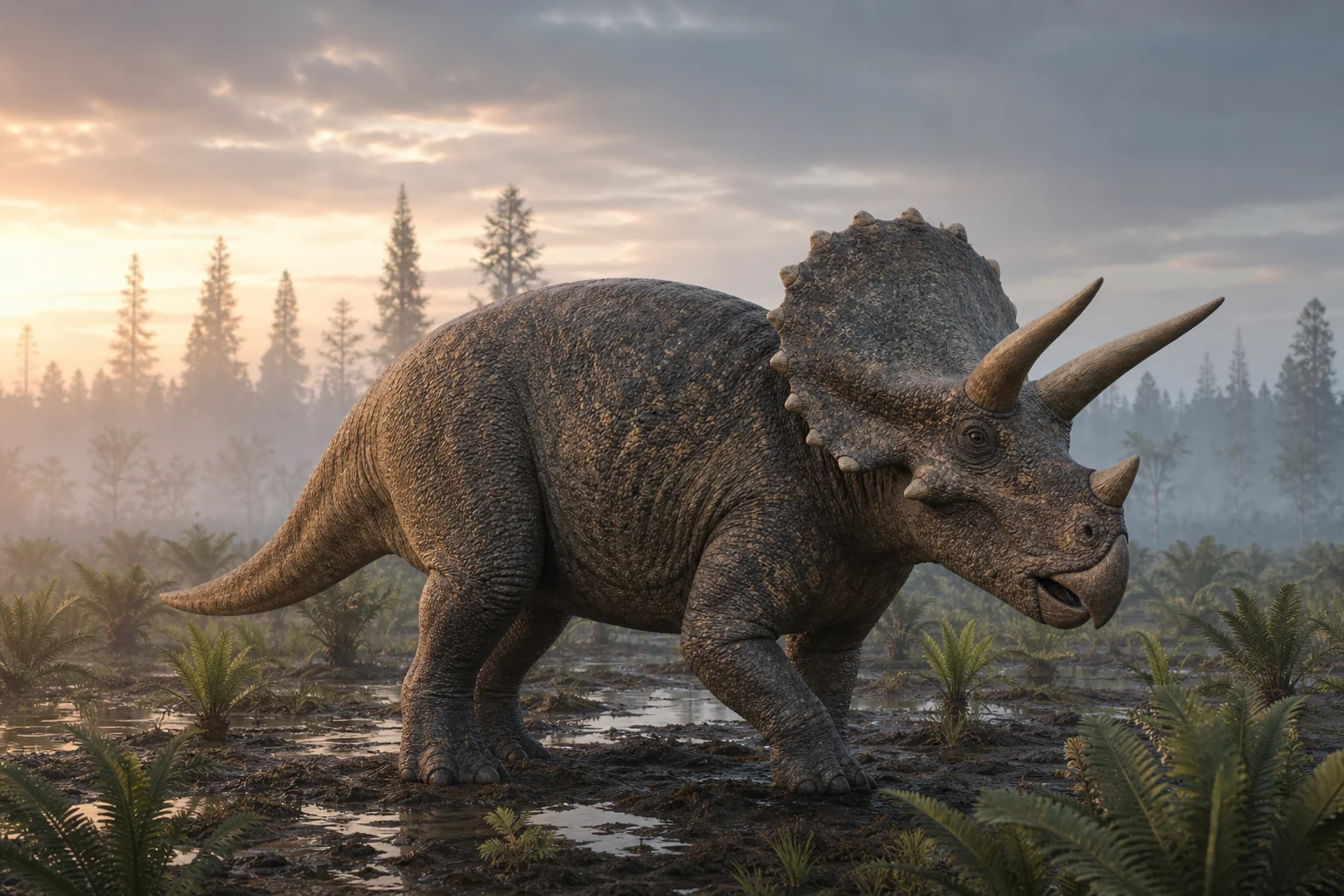 View full-resolution reconstruction ↗
This is an original generative reconstruction, not a photograph or scientific plate. Measurements and interpretations below are tied to named sources.
01 / BODY SIZE
How tall, long and heavy was Triceratops?
Well-known adult skeletons support a length near 8–9 metres. Height over the hips was roughly three metres, while the head could rise higher depending on neck posture. The Natural History Museum lists a nine-metre animal and a ten-tonne estimate, but mass values across reconstructions are broader than that single figure.
Unlike length along a skeleton, mass depends on invisible soft tissue. A narrow torso model and a deep, broad model can both fit the same ribs while producing different totals. EXTINCT ATLAS therefore treats about 6–10 tonnes as a useful orientation range rather than a settled species average.
| Measurement | Evidence-led value | Confidence |
|---|---|---|
| Adult length | About 8–9 m | Moderate; tail reconstruction varies |
| Hip height | About 2.7–3 m | Moderate; limb-based |
| Body mass | Several tonnes, often ~6–10 t | Lower; strongly model-dependent |
| Large skull | Over 2 m | High for measured specimens |
02 / GIANT SKULL
How large was the Triceratops head?
The skull combined a narrow beak, deep cheek region, long brow horns and a broad frill. In a large adult the complete unit could exceed two metres from beak to frill edge. That does not mean the whole skull was solid: air spaces, openings, thinner bone and a keratin-covered beak reduced mass.
A strong neck and shoulder complex supported the head. Posture was flexible, so drawings that lock the face permanently low or high are equally misleading. The head could crop low plants, raise for display and turn the horns toward a threat.
03 / HORNS
How long were Triceratops horns?
Large brow horn cores could approach one metre, while the nasal horn was shorter. The bone is only the internal support. As in cattle and rhinoceroses, a keratin sheath covered the core and made the living horn longer and sharper. Because keratin rarely fossilises, an exact universal extension cannot be measured.
Growth changed horn geometry. Juvenile brow horns curved backward; they rotated forward and lengthened as the skull matured. A small skull is therefore not just a scaled-down adult, and horn direction helps palaeontologists estimate growth stage.
04 / FRILL
Was the frill a solid shield?
Triceratops had a solid frill without the large paired openings of Torosaurus, but “solid” does not mean uniformly thick armour. Some regions were thin and could be punctured. The broad surface enlarged the visual profile and changed substantially during growth, evidence for display and recognition alongside any protective effect.
Small bones around the margin changed from pointed and separate in juveniles to flattened and fused in adults. That sequence is one reason skull maturity must be assessed before assigning differences to sex or species.
05 / GROWTH SERIES
How did the Triceratops skull change with age?
Backward horns
Short brow horns, pointed frill ornaments and open sutures.
Rotation and fusion
Horns lengthened and turned forward as edge bones flattened.
Robust display
Skull bones fused and the mature frill outline emerged.
Horridus to prorsus
Stratified skulls record a lineage-level shape transition in Hell Creek.
06 / METHOD & UNCERTAINTY
How do scientists estimate Triceratops size?
Associated skeletons
Limb, vertebral and girdle measurements constrain length and standing height.
3D body volume
Digital soft-tissue envelopes estimate mass; torso depth and density dominate the range.
Skull maturity
Bone texture, fusion and horn direction separate juveniles from adults.
Stratigraphic position
Exact rock level distinguishes growth variation from evolutionary change through time.
Editorial rule: body mass is reported as a range, horn-core length is separated from living horn length, and juvenile, adult and species differences are not mixed.
FAQ
Questions readers ask
How long was an adult Triceratops?
Large adults were roughly 8–9 metres long. Exact totals depend on how missing tail bones and cartilage are reconstructed.
How heavy was Triceratops?
It weighed several tonnes, with published reconstructions often spanning roughly 6–10 tonnes or more. Wide variation reflects incomplete bodies and different 3D outlines rather than an animal with one exact weight.
How large was a Triceratops skull?
A large skull could exceed two metres including the frill and beak, making it one of the largest skulls of any land animal.
Were the horns longer in life than in fossils?
Yes. Fossils preserve the bony horn core. A keratin sheath extended beyond it, but its exact thickness, curvature and tip length are unknown.
SOURCES & FURTHER READING
Evidence used for this guide
Measurements and behavioural claims are tied to museum summaries or peer-reviewed research. External sources may update as new specimens and analyses are published.
- 01Triceratops ↗Natural History Museum, London
Museum overview of size, teeth, horns, frill, skin, discovery, social evidence and encounters with Tyrannosaurus.
- 02Why did Triceratops have a frill? ↗Natural History Museum, London
Expert explanation of why display, recognition and combat are stronger interpretations than a simple neck shield.
- 03Evidence of combat in Triceratops ↗PLOS ONE · PMC2617760
Comparative lesion patterns supporting physical horn-to-horn combat as one function of Triceratops cranial ornamentation.
- 04Major cranial changes during Triceratops ontogeny ↗Proceedings of the Royal Society B · PMC1635501
A skull growth series documenting changes in horn direction, frill margins, bone texture and fusion from juveniles to adults.
- 05Evolutionary trends in Triceratops from the Hell Creek Formation ↗PNAS · PMC4104892
More than fifty stratigraphically placed skulls showing the transition from T. horridus to T. prorsus morphology through Hell Creek time.
- 06Wear biomechanics in the slicing dentition of Triceratops ↗Science Advances · PMC4640618
Three-dimensional and tissue-level analysis of the self-sharpening dental battery used to slice abrasive plants.
- 07The first Triceratops bonebed and its implications for gregarious behavior ↗Journal of Vertebrate Paleontology · DOI 10.1080/02724634.2009.10010382
A rare multi-individual assemblage that supports at least occasional aggregation without proving permanent herds.
- 08Torosaurus is not Triceratops ↗PLOS ONE · PMC3290593
A test of developmental predictions that supports retaining Torosaurus as distinct while illustrating the ongoing taxonomic debate.
- 09The Last American Dinosaurs ↗Smithsonian National Museum of Natural History
Museum context for the latest Cretaceous ecosystem and the end-Cretaceous impact extinction.